How to Get Insurance Leads Without Cold Calling
Insurance leads without cold calling come from inbound systems where the prospect raises a hand first: paid search and social ads, SEO content, referral loops, and AI search visibility. You replace dialing with a fast follow-up cadence on people who already want a quote, then track cost per issued policy.
Cold calling still works for some agents. But it scales linearly with hours on the phone, contact rates keep falling, and the compliance surface gets riskier every year. If you want to grow the book without living on the dialer, you need a system where the prospect raises a hand first.
This is the all-lines playbook for insurance leads without cold calling — final expense, Medicare, life, and beyond. It covers where inbound leads come from, what they cost, the compliance you have to respect, and the follow-up that turns a form fill into an issued policy.
What “no cold calling” actually means
It does not mean no phone. You will still call people. The difference is who you call: someone who already submitted a quote request versus a stranger on a purchased list who never asked to hear from you.
Inbound flips the economics. Instead of paying with dial hours and a 2–3% contact rate, you pay a higher price per lead for someone who is already interested. The bet you are making is that the higher lead price is more than repaid by a higher contact rate and a higher close rate, so the cost per issued policy falls even as the cost per lead rises. That bet is testable within about a month, and the rest of this page is about how to run the test honestly.
That comparison only works if you price the list honestly, so if you are still buying telemarketed lists, start by costing in the Do Not Call scrub, the consent or established-business-relationship check, and the dial hours before you set it against an inbound cost per lead. Telemarketing is not dead — it is narrower, and it is the input inbound is supposed to replace at the top of the funnel, not the dial itself.
Where insurance buyers actually buy now
The case for inbound is not a preference. It is where the transaction has moved. JD Power’s 2025 U.S. Insurance Digital Experience Study, which evaluates property and casualty insurance shoppers and customers and is based on 11,529 evaluations fielded from January through March 2025, found that more than half — 57% — of auto insurance customers had actively shopped for a new policy in the past year, which JD Power described as the highest shopping rate it had ever recorded.
The split below is where those buyers finished the transaction, not where they started researching:
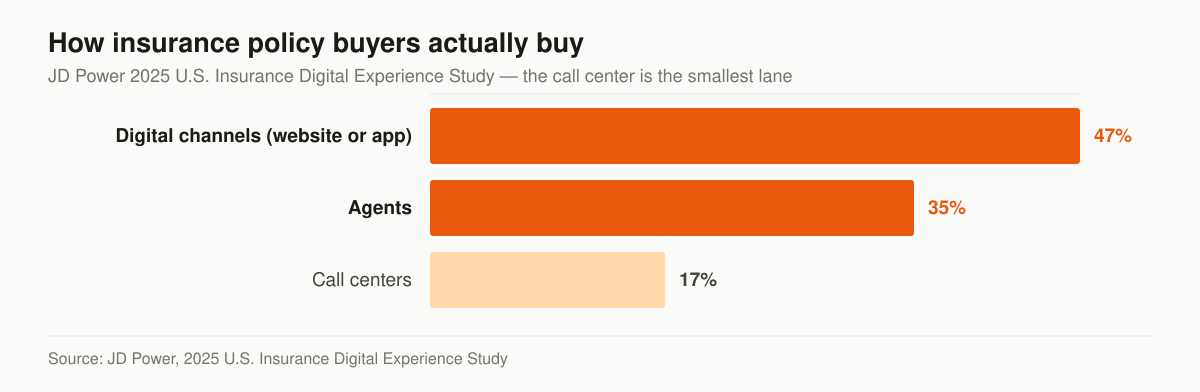
Where insurance policy buyers complete the purchase. Source: JD Power, 2025 U.S. Insurance Digital Experience Study, released 14 May 2025 and based on 11,529 evaluations fielded January through March 2025.
Read those three bars as a map of where your effort earns the most. Nearly half of policy buyers now purchase through digital channels, 35% through agents, and 17% through call centers. The agent bar has not disappeared — 35% is a large business — but it is being fed by people who did their comparison somewhere else first. The call-center bar is the one that most resembles a dialing operation, and it is the smallest of the three.
The practical reading for a solo agent or a small agency: the buyer is already online when they decide. Whether you show up there is a marketing question, not a phone question. If you are invisible in search, in the map pack, and in AI answers, you are competing for the shrinking share of buyers who will still take the call.
The five channels that replace the dialer
There is no single source. Durable books blend a few so no platform outage can zero out your pipeline.
Each row below trades speed against cost and durability — read the last two columns together before you pick one:
| Channel | Best for | Typical intent | Speed to first lead |
|---|---|---|---|
| Paid search (Google) | Medicare, term life, high-intent | Very high | Days |
| Paid social (Meta) | Final expense, life, mortgage protection | Medium | Days |
| SEO / content | All lines, compounding | High | Months |
| Referrals & reactivation | All lines, lowest cost | Very high | Immediate |
| AI search visibility | All lines, emerging | High | Weeks |
A few notes on each:
- Paid search captures people typing “Medicare plans near me” or “term life quote.” High intent, higher cost per click. See our breakdown of insurance PPC cost per click by line before you set budgets.
- Paid social works because of interruption, not search. Final expense and life perform here. Remember Meta’s Special Ad Category limits age, ZIP, and gender targeting on insurance, so creative has to do the qualifying. Our guide to Facebook ads for insurance agents covers the workarounds.
- SEO and content are slow but compounding. A page that ranks brings leads for years at near-zero marginal cost. This is the asset you build while paid channels run.
- Referrals and database reactivation are the cheapest leads you will ever get and the most ignored. If you have been writing business for a year, you already have a list of past quotes and lapsed clients sitting in a CRM or a spreadsheet.
- AI search visibility is new. People now ask ChatGPT and Google’s AI summaries for agent recommendations. If you want to be the name those engines surface, start with how to get your agency recommended by ChatGPT.
If you want one team running the whole stack instead of stitching it together, our insurance lead generation service is built exactly for this.
Which of those channels converts once the lead is in
Volume and conversion are different problems, and channels rank differently on each. Ruler Analytics published Conversion Rate Benchmarks 2026 from more than five million tracked conversions across thirteen industries. Its overall average conversion rate across all thirteen is 5.13%; the finance category averages 6.3%. The spread by source inside finance is wide.
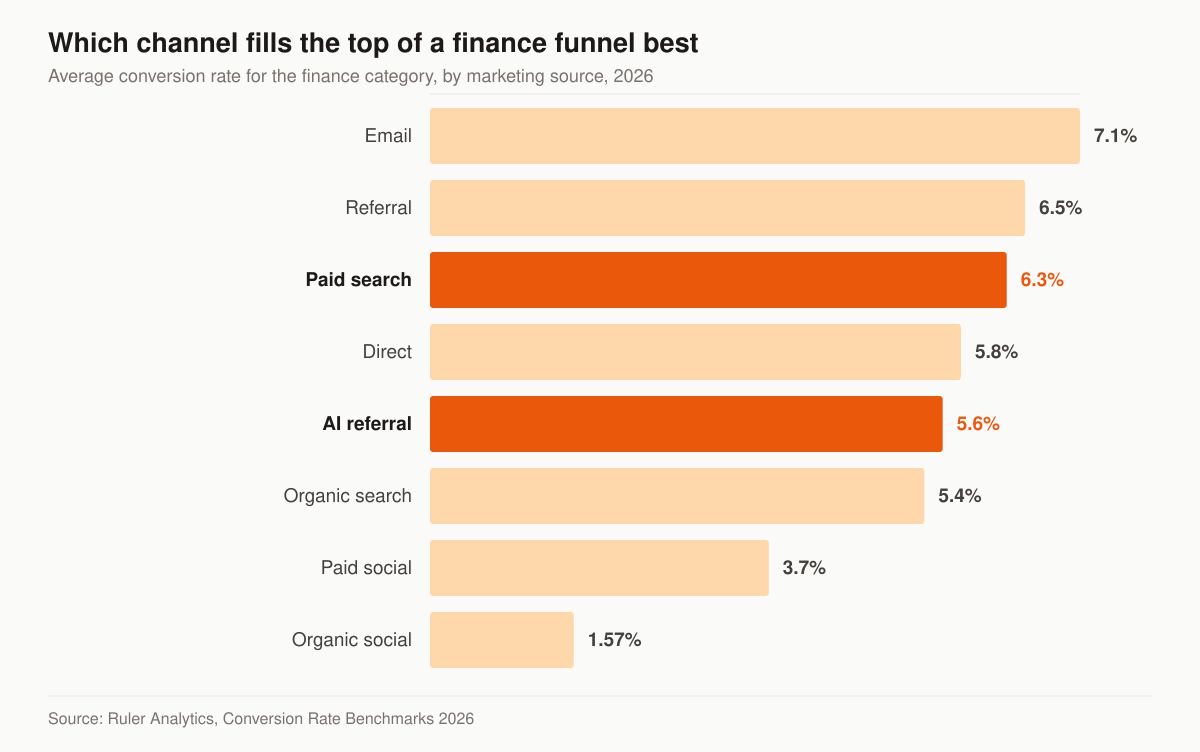
Average finance-category conversion rate by marketing source. Source: Ruler Analytics, Conversion Rate Benchmarks 2026, based on more than five million conversions tracked across thirteen industries.
Three things fall out of that chart if you are choosing where to start.
Email converts highest in the finance category at 7.1%, which is an argument for reactivation before acquisition: the cheapest conversion in the set comes from a list you already own. Referral follows at 6.5%, then paid search at 6.3% — the two sources where the prospect arrives with a reason to trust you or a reason to buy.
Paid social sits at 3.7% and organic social at 1.57%. That does not make social a bad channel for insurance; final expense and mortgage protection are bought on Meta every day. It means social buys attention rather than intent, so the same lead volume needs more touches and better qualifying before it looks like a pipeline. Budget accordingly rather than judging a Meta campaign by a search campaign’s conversion rate.
And “AI referral” — traffic arriving from an AI assistant — converts at 5.6%, above organic search’s 5.4% in the same dataset. That is a small, new bar worth watching, and it is the reason AI search visibility has stopped being an experiment.
The numbers: judge cost per sale, not cost per lead
Comparing lead prices is comparing the wrong thing. A $5 list record and a $35 inbound lead only become comparable once you carry them through to an issued policy.
Work the math like an operator:
- Lead cost — what you pay per form fill or call.
- Contact rate — what share you actually reach. Inbound runs far higher than cold lists.
- Close rate — issued policies per contacted lead.
- Cost per sale — lead cost divided by (contact rate × close rate).
The worked comparison below uses illustrative round numbers so you can see the shape of the arithmetic, then substitute your own:
| Source | Cost/lead | Close rate | Cost per issued policy |
|---|---|---|---|
| Cold-call list | $5 | 1-in-50 | $250 |
| Inbound online lead | $30 | one-in-six | $180 |
The “expensive” lead is cheaper per policy. That is the entire argument for going inbound. For a deeper version of this math, read our piece on lead cost vs. true cost per sale.
One thing the table cannot show is the hour cost. A dial list consumes the most expensive input an agency has, which is licensed selling time, and it consumes it whether or not anybody answers. An inbound lead consumes that same time only after someone has raised a hand. When you compare the two, price the hours as well as the records.
What the law asks of an outbound dial, and what it asks of an inbound one
This is the part most “stop cold calling” articles skip, and it is the part that decides whether your program survives a complaint. Two separate bodies of rules apply: the FTC’s Telemarketing Sales Rule at 16 CFR part 310, and the FCC’s TCPA rules at 47 CFR 64.1200. They overlap but are not identical, and both are worth reading before you build a call process.
Start with the definition that does the most work. Under 47 CFR 64.1200(f)(15), a telephone solicitation is “the initiation of a telephone call or message for the purpose of encouraging the purchase or rental of, or investment in, property, goods, or services, which is transmitted to any person,” and the definition then excludes a call or message “To any person with that person’s prior express invitation or permission” and “To any person with whom the caller has an established business relationship”. A genuine inbound form fill is how you get inside those exclusions. That is the legal substance behind the phrase “they raised a hand.”
The established business relationship has a clock on it. For purposes of telephone solicitations, 47 CFR 64.1200(f)(5) defines it as a relationship formed by voluntary two-way communication “on the basis of the subscriber’s purchase or transaction with the entity within the eighteen (18) months immediately preceding the date of the telephone call or on the basis of the subscriber’s inquiry or application regarding products or services offered by the entity within the three months immediately preceding the date of the call, which relationship has not been previously terminated by either party.” Read that twice if you buy aged leads: an inquiry buys three months, a transaction buys eighteen, and either party can end it.
The table below sets the two call types side by side; every requirement in the outbound column is one an inbound-first program either avoids or satisfies with a form:
| Requirement | Outbound dial to a stranger | Inbound lead who submitted a form |
|---|---|---|
| National do-not-call registry | Under 16 CFR 310.4(b)(1)(iii)(B), a call to a registered number needs express written agreement naming the seller and the number, or an established business relationship with a person who has not separately told that seller to stop calling | The form’s consent language is the written agreement, if it names you and captures the number |
| Registry scrub cadence | The TSR safe harbor at 16 CFR 310.4(b)(3)(iv) requires “a version of the ‘do-not-call’ registry obtained from the Commission no more than thirty-one (31) days prior to the date any call is made” | Still scrub; the consent is your defense, the scrub is your record |
| Calling hours | 16 CFR 310.4(c) restricts outbound calls to a person’s residence to between 8:00 a.m. and 9:00 p.m. local time at the called person’s location, absent prior consent | Same window applies; the difference is that the prospect chose the moment |
| Internal do-not-call list | 47 CFR 64.1200(d) requires anyone making calls for telemarketing purposes to a residential telephone subscriber to have instituted procedures for maintaining a list of people who ask not to be called | Same requirement, same list |
| Opt-out speed | Under 47 CFR 64.1200(d)(3), a residential subscriber’s do-not-call request must be honored within a reasonable time, and “This period may not exceed ten (10) business days from the receipt of such request” | Same ten-business-day ceiling |
| Oral disclosures on the call | 16 CFR 310.4(d) requires the telemarketer to disclose the identity of the seller, that the purpose of the call is to sell goods or services, and the nature of those goods or services | Still disclose; it is easier when the prospect asked for the quote |
Two more rules are worth knowing by number. Abandoned calls: 16 CFR 310.4(b)(1)(iv) says a call “is ‘abandoned’ under this section if a person answers it and the telemarketer does not connect the call to a sales representative within two (2) seconds of the person’s completed greeting” — which is what a predictive dialer produces at volume, and what an agent calling their own inbound leads never produces.
Revocation: 47 CFR 64.1200(a)(10) lets a called party revoke consent for calls made under paragraphs (a)(1) through (3) and (c)(2) “by using any reasonable method to clearly express a desire not to receive further calls or text messages from the caller or sender”, and treats the words stop, quit, end, revoke, opt out, cancel, and unsubscribe sent in reply to a text as a reasonable means per se. It then requires that all such requests “must be honored within a reasonable time not to exceed ten business days from receipt of such request.” If you text your inbound leads — and you should — build the stop-word handler before the first send, not after the first complaint.
Finally, the rule that did not survive. The FCC’s 2023 one-to-one consent restriction was vacated by the Eleventh Circuit in Insurance Marketing Coalition Limited v. FCC, No. 24-10277 (11th Cir., filed 24 January 2025). The stricter standard is not law. It does not follow that broad consent is safe — the older written-consent standard still governs, and a consumer who agreed to hear from a long list of partners can still dispute that they agreed to hear from you. Our full treatment is in TCPA compliance for insurance agents buying leads. We provide marketing systems, not legal advice; have your own counsel review your forms.
Speed and cadence: where the policy gets lost
Inbound leads are perishable. A web lead that sat for an hour is a different animal than one called in two minutes. We treat follow-up speed and follow-up persistence as the first two things to fix on any account, ahead of changing the lead source, because they cost nothing and they are entirely inside your control.
Minimum standard we hold campaigns to:
- Call within 5 minutes of the form fill. First-touch speed drives contact rate more than anything else.
- 6–10 touches across the first two weeks, mixing call, text, and email.
- Consent-compliant texting with documented opt-in on the form.
- A reactivation pass at 30 and 90 days for the leads that went cold.
It is easy to quit after two or three attempts and blame the lead. Build the cadence before you buy the traffic. Our insurance lead follow-up cadence lays out the exact sequence, including what to say on the voicemail and how to handle the “I never filled anything out” opener.
One clarification on what to buy. If you want inbound-style leads or live transfers delivered as a product while you build, that is a lead-purchasing transaction rather than a marketing engagement — buy leads direct from getinsureleads, our sister brand built for exactly that. We don’t sell leads on this site; we build the systems that generate them.
Compliance is a feature, not a tax
This is where inbound beats cold calling on more than economics. With inbound, the prospect comes to you, which makes consent cleaner — but it does not make TCPA disappear.
A few facts to operate by:
- TCPA still governs how you contact a lead. You need documented consent: timestamp, IP, and the exact disclosure text the prospect agreed to. Under 47 CFR 64.1200(c)(2)(ii), prior express invitation or permission “must be evidenced by a signed, written agreement between the consumer and seller which states that the consumer agrees to be contacted by this seller and includes the telephone number to which the calls may be placed”.
- The FCC one-to-one consent rule was vacated in January 2025, but courts and carriers still scrutinize consent quality, so keep records airtight.
- CMS rules govern Medicare AEP marketing — what you can say, when, and how. If you sell Medicare, read CMS Medicare marketing rules for agents before any campaign goes live.
We provide the marketing system; you are the licensed party making the sale. Treating compliance as a trust signal — not a hurdle — is what lets these campaigns run for years without getting shut down. The broader version of this, across every channel we run, is in insurance marketing compliance for agents.
Reviews and your Google Business Profile: the lead source with no cost per lead
Every channel above has a variable cost per lead. Your Google Business Profile does not. It is the one asset where the work is fixed and the leads keep arriving.
Three jobs, in order. Claim and complete the profile, with the correct primary category, real service areas, and hours that are accurate — including whether you are open when people search. Then get reviews on a schedule instead of in bursts, because a profile with a steady trickle of recent, text-bearing reviews reads differently to both a searcher and to Google than one with nine reviews from 2021. Then answer them. Our guide to getting more Google reviews as an insurance agent has the ask scripts and the timing, and insurance local SEO is the managed version.
The reason this belongs on a page about cold calling is the sequencing. A prospect who found you in the map pack, read four reviews, and then tapped the call button is an inbound lead who cost you nothing marginal and who arrives pre-sold on the trust question. That is the same conversation quality a live transfer buys you, without the per-transfer price.
The trap is treating reviews as a reputation project rather than a lead channel. Measured as a lead channel, it has a cost — the hours to build the process — and a return you can count in calls received. Measure it that way and it stops competing with your ad budget for attention.
The page they land on decides whether the click becomes a lead
You can buy perfect traffic and still get no leads. Every channel on this page ends at a page, and that page is where the money is made or lost.
Four things to fix before you raise a budget:
- One offer per page. A page that offers a quote, a guide, a newsletter, and a call gives the visitor four ways to hesitate. Pick the one action that matches the traffic’s intent.
- A form short enough to finish on a phone. Every field you add is a field someone abandons. Ask for what you need to quote and to call back legally, and nothing else.
- Consent language that is readable and specific. It names you, it states what the prospect is agreeing to receive, and it is captured with a timestamp. This is a conversion element and a compliance artifact at the same time.
- Proof above the fold. Reviews, carrier appointments, licensure, service area. The visitor is deciding whether to hand a stranger their phone number.
Our insurance landing pages service builds these as a system rather than one-offs, because the same four decisions repeat across every campaign you will ever run. If you are rebuilding the whole site rather than a campaign page, insurance SEO is the right starting point, since the structure that ranks and the structure that converts are largely the same structure.
What it costs to replace the dialer
A dialing operation looks cheap because its cost is your time. An inbound system has a visible price, which is uncomfortable at first and useful afterwards, because a visible price can be measured against a visible return.
Our rates are published rather than quoted per prospect, so you can do this arithmetic before you talk to us:
| Tier | Monthly | What it covers |
|---|---|---|
| Foundation | $2,500 | Optimized insurance website and landing pages, local SEO and Google Business Profile, on-page SEO, monthly reporting |
| Growth | $3,500 | Everything in Foundation, plus the ongoing SEO and content engine, AI-search visibility, reputation and reviews |
| Full-Funnel | $5,500 | Everything in Growth, plus managed Google and Meta ads, landing-page CRO, marketing automation and CRM, full-funnel reporting |
| One-time build | $2,500–$8,000 | The website build itself, depending on scope |
Ad spend sits on top and is billed at cost, straight to the platforms. That separation matters when you are comparing agencies: a retainer that quietly includes media makes it impossible to see whether you are paying for management or for clicks. Full pricing detail, including what changes between tiers, is on our pricing page.
Which tier fits is a question about your weakest link rather than your revenue. No real web presence yet, and the map pack is empty: Foundation. A decent site that nobody finds in Google or in AI answers: Growth. Visibility already handled and you are ready to buy volume with managed ads: Full-Funnel. If you would rather sanity-check the budget against your book first, our guide to the insurance agency marketing budget works through the percentages.
The scoreboard: five numbers to check every week
An inbound program usually fails quietly, because nobody agreed in advance on what “working” would look like. Fix that by naming the numbers before the first campaign goes live.
Check these five weekly; the middle column is the number that tells you the channel is alive, and the right column is the fix when it isn’t:
| Metric | What it tells you | Where to look when it drops |
|---|---|---|
| Leads per week, by channel | Whether the top of the funnel is filling | Budget, ad approval status, ranking changes, form errors |
| Time to first touch | Whether the cadence is actually running | Routing, notifications, who owns the dial |
| Contact rate | Whether the leads are real and reachable | Lead source quality, phone number validation, call times |
| Quoted rate | Whether the conversation is qualifying | Script, offer match, targeting |
| Cost per issued policy | Whether any of it pays | All of the above, in that order |
Two rules make the scoreboard useful. First, break every number down by channel, because a blended average hides a channel that is quietly losing money and another that is quietly carrying it. Second, do not judge a channel before it has produced enough issued policies for the close rate to mean anything — a single sale on twelve leads is noise, not a benchmark.
Automating the capture of these numbers is worth doing early; it is the difference between a report you read and a report you never build. See insurance marketing automation for the plumbing.
What breaks, and what to do when it does
Inbound systems fail in a small number of recognizable ways. Knowing them in advance turns a crisis into a Tuesday.
A single-channel pipeline. One ad account gets restricted, one algorithm update lands, and the calendar empties. The answer is not a backup plan on paper; it is a second channel already running at a small budget, so that scaling it is a slider rather than a project.
Leads that arrive faster than you can call. This is a good problem that behaves like a bad one, because the leads you cannot reach in five minutes get worked at the quality of leads you paid a fraction for. Either cap the budget to your capacity or add capacity first.
Consent records that live only in the vendor’s system. If you cannot produce the timestamp, the IP, and the exact disclosure text for a lead from eighteen months ago, you do not have a consent record, you have a vendor’s promise. Export and keep your own.
A page that changed and nobody tested. Form field added, tracking script broken, thank-you page redirect wrong. Submit your own form once a week from a phone on cellular data. It takes two minutes and it catches the failure that costs the most.
Judging SEO on a paid-search timeline. Content and rankings compound over months. If you cut the content engine at week six because it has not matched the ad account, you have paid the entire cost of SEO and collected none of the return.
Do you still need a phone?
Yes, and the phone is the point. Removing cold calling does not remove calling; it removes calling strangers. The dial you make to someone who filled out a form eleven minutes ago is a different act, legally and commercially, from the dial you make to a purchased record.
Live transfers are the case that looks like an exception to all of this. They are not one: the prospect asked to be connected, which is the opposite of a purchased list. That is why our sibling guide to final expense leads without cold calling treats live transfers as a legitimate no-cold-call channel rather than a contradiction. What changes is the ratio: fewer dials, better conversations, and a compliance posture you can document.
A 30-day path to your first inbound leads
You do not need all five channels on day one. Sequence it:
- Week 1 — Pick the one channel that matches your line’s buyer intent (search for Medicare, social for final expense). Build a single dedicated landing page.
- Week 2 — Turn on a small budget, install consent-compliant forms, and stand up the follow-up cadence.
- Week 3 — Call every lead inside 5 minutes. Track contact rate and close rate, not just lead count.
- Week 4 — Calculate cost per issued policy. Scale what works; cut what doesn’t.
Want us to run those numbers on your current setup first? Start with a free marketing audit and we’ll show you where your cost per sale actually sits — and which channel to turn on next. If you already know what you want built, tell us about the book and we will scope it against the tiers above.
Cold calling rewards hours. Inbound rewards systems. Build the system once, and the leads keep coming whether you’re on the phone or not.
- Aged Final Expense Leads: What They Are and When the Math Works
Aged final expense leads cost a fraction of fresh leads. Here's what they are, the ROI math that decides if they work, and when to skip them.
- How to Get Final Expense Leads Without Cold Calling
How final expense agents get qualified leads without cold calling: inbound forms, paid social, live transfers, referrals, and SEO, with tradeoffs compared.
- Final Expense Lead Generation Companies for Agents: A Buyer's Map
A practitioner's breakdown of final expense lead generation companies: the vendor types, real cost-per-sale math, and when building your own wins.
- Exclusive vs Shared Final Expense Leads: A Cost-Per-Sale Breakdown
Exclusive vs shared final expense leads, compared on real cost-per-sale math, contact rates, and close rates so agents can pick what actually pays.