Burial Insurance Leads: When Building Your Own Funnel Beats Buying Them
Burial insurance lead generation splits two ways: buy records from a vendor and dial this week, or build a funnel you own and pay the ad platform directly. Buying wins on speed. Building wins on exclusivity and a compounding asset. The deciding input is your monthly volume, not your preference.
Every burial insurance agent eventually hits the same fork: keep buying leads off an invoice, or build a funnel you own. There is a right answer, but it depends on your volume, your runway, and how long you plan to be in the senior market. This is the decision laid out with numbers, written by a team that runs burial-insurance lead generation for a living — we operate our own final-expense book, so this comes from live campaigns, not theory.
The two paths, plainly
Buying means you pay a vendor a fixed price per lead and start dialing immediately. No ad accounts, no landing pages, no learning phase. You trade margin for speed.
Building means you run the ads, own the landing page, and capture the lead yourself. Higher effort and a slower start, but every lead is exclusively yours and your cost-per-lead drops as the funnel matures.
Neither is “better” in the abstract. They are different tools for different stages. Here is how they actually compare on the metrics that decide your month.
Build vs buy: the honest comparison
This table sets the two paths side by side on the seven factors that decide which one your next quarter can carry.
| Factor | Buy leads | Build in-house |
|---|---|---|
| Time to first lead | Same day | 2-4 weeks |
| Setup cost | $0 | Ad spend + pages + tracking |
| Cost per lead | Vendor price + margin | Trends toward the raw ad-cost floor once tuned |
| Exclusivity | Often shared | Always exclusive |
| You own the asset? | No | Yes — it compounds |
| Predictability | High day one | Volatile until stable |
| Best for | Filling the calendar now | Lowering blended CPL over time |
The row we weight heaviest is “you own the asset.” A purchased lead is consumed the moment you dial it. A funnel you build keeps producing leads next month at a marginal cost, and the data you collect makes each round cheaper than the last.
What buying a burial insurance lead actually costs
Before you can judge whether building beats buying, you need the number building has to beat. Burial insurance leads are sold as final expense leads, and several sellers publish a price list you can read without talking to a rep.
This table reproduces the price bands Aged Lead Store publishes for final expense leads, worded as its own table words them.
| Lead type | Exclusivity, as published | Published price per lead |
|---|---|---|
| Direct mail | Exclusive | $25–$45 |
| Telemarketing | Exclusive | $15–$30 |
| Online, real-time | Exclusive | $20–$40 |
| Online | Shared | $5–$15 |
| Aged, 15–90 days | “Shared/OE” | $1–$8 |
| Aged, 90+ days | “Shared/OE” | $0.50–$3 |
Aged Lead Store labels these “industry averages” and adds a caveat under the table: “Always get current quotes from vendors.” Its own FAQ answers the exclusive question more tightly, at “$20–$45 each, depending on source” (Aged Lead Store, the true cost of final expense insurance leads).
Read that ladder from the top and the build-vs-buy question sharpens considerably. An in-house funnel produces one thing: a fresh, exclusive, first-party record. So the number your build has to beat is the exclusive row for the channel you build on — $20–$40 for real-time online, $25–$45 for direct mail — not the $0.50 aged floor. Comparing your in-house cost per lead against aged inventory is comparing two different products, which is the mistake that makes building look bad and aged final expense leads look free.
The same page lists four costs that sit outside the per-lead price and are easy to miss on a first order: setup fees, minimum order requirements, subscription or long-term contracts, and CRM integration and technology fees. Those are real money on the buy side and they belong in the comparison, because the build side gets charged for its equivalents too — a landing page, a tracking setup, a dialer.
When buying is the right call
Be honest about where you are. Buying wins when:
- You need appointments this week and have no time to wait out a learning phase.
- Your volume is low — under roughly 30-50 leads a month, the fixed cost of building rarely pays back.
- You are testing a new state or product and don’t want to commit ad budget yet.
- You’d rather spend your hours selling than managing ad creative.
If buying leads, live transfers, or aged leads as a finished product is what you actually want, that is a lead-purchasing transaction — not a marketing service — so the clean move is to buy leads direct from getinsureleads, our sister brand built for exactly that. We don’t sell leads on this site; we build the systems that generate them.
One rule if you buy: choose exclusive over shared, and call within minutes. A shared lead that four agents are racing to dial is cheap on the invoice and expensive on the calendar. The full version of that argument, run on cost per issued policy rather than cost per lead, is on exclusive vs shared final expense leads.
When building wins
Building pulls ahead the moment you have steady volume and a multi-month horizon. The math is simple: a vendor’s price includes their ad cost plus their margin and overhead. Cut out the middle and your floor is the raw ad cost — which, on a tuned final-expense funnel, sits well below a vendor’s all-in price.
A real in-house burial insurance lead funnel has three moving parts:
- Traffic — compliant Facebook lead ads or search, targeted to the senior buyer. Our final-expense Facebook ads playbook digs into what converts and what wastes spend.
- The page — a fast, single-purpose form that turns clicks into contacts. Generic agency sites leak conversions; purpose-built insurance landing pages don’t.
- The system — tracking, speed-to-lead routing, and follow-up so no lead dies in a spreadsheet. That’s the core of insurance lead-generation systems we build for clients.
Get those three right and you stop renting your pipeline. You own it.
Which channel you would actually be building on
“Build a funnel” is not one decision. It is a channel choice, and the channels behave so differently that two agents who both “built in-house” can have nothing in common. LeadSquared’s final expense guide sets the timing difference plainly. On buying Facebook-sourced leads through a vendor it writes: “You will start getting a response in a few days, whereas direct mailer takes a month.” On the organic route it writes: “Most websites take nearly a year to be capable of generating leads.” (LeadSquared, final expense insurance lead generation).
This table sorts the four build channels by how fast they answer and what each one asks you to own.
| Channel you build on | What you are actually producing | How fast it answers | What you have to own |
|---|---|---|---|
| Facebook lead ads | Fresh exclusive form fills, at platform pace | Days, per the LeadSquared timing above | Creative, the ad account, the form’s consent language |
| Direct mail | Returned reply cards in the prospect’s handwriting | A month, per the same source | List selection, print, postage, the mail drop calendar |
| Search ads | Inbound clicks from people already typing the query | Days, once the account clears review | Keyword and negative-keyword hygiene, the landing page |
| Organic search and content | Records that arrive without a per-lead cost | Nearly a year, per LeadSquared | The site, the content calendar, the patience |
Those four are not interchangeable and they do not fail the same way. A mail drop fails quietly over a month; a Facebook ad set fails loudly in a week. If you want the direct-mail lane in detail, final expense mailer templates covers what goes on the card, and telemarketing insurance leads covers the phone-sourced lane that usually reaches an agent through a vendor rather than a build.
One thing worth saying about the organic route, because agents keep pricing it as free: it is the only one of the four whose leads have no per-record cost once it runs, and the only one that asks for the better part of a year before it produces anything. That is the whole trade. It is also why organic is the channel that pairs best with buying — you keep paying a vendor while the site matures, then let the free channel take over the base load.
The volume threshold that decides the build
Here is the part of the build case that vendors never have to mention and most build plans skip: the ad platform has a published minimum volume, and a funnel below it never stabilizes.
Meta states the threshold on its own help pages. An ad set exits the learning phase, in Meta’s wording, “as soon as they can deliver stably. This usually occurs after about 50 results in the week after the ad set’s last significant edit” (Meta Business Help Center, about the learning phase). The companion page defines the failure state: “An ad set becomes learning limited when it is unlikely to receive about 50 optimization events in the week after your last significant edit”. It is careful to add that “Learning limited isn’t a penalty – it’s an indication that your budget isn’t being spent effectively because the ad delivery system can’t optimize performance with your current setup” (Meta Business Help Center, about learning limited).
Now read that against the volume figure in the decision rule further down this page. An agent producing 30 leads a month is not producing 50 results in a week. That ad set sits in learning limited more or less permanently, which is exactly why a small in-house funnel feels erratic: the cost per lead swings, a good week does not repeat, and the platform is telling you why in a column you may not have added to your reporting view.
Meta also publishes what pushes an ad set into that state — the ad set “limited by small audience size, low budget, low bid or cost control, high auction overlap, an infrequent optimization event, or other issues such as running too many ads at the same time” — and its own fix list is short: combine ad sets and campaigns, expand your audience, raise your budget, raise your bid or cost control, or change your optimization event.
Every item on that fix list is a reason a small burial funnel struggles, and the fixes are not free. Expanding the audience and raising the budget both mean spending more before the funnel is proven. Changing the optimization event moves you to something cheaper and further from a sale — a landing page view instead of a lead — which buys you stability and gives back lead quality. The build path is real, but it has an entry fee the buy path does not, and the fee is paid in volume, not just in dollars.
Two of Meta’s other published cautions land directly on how agents run a new funnel. Meta writes that “During the learning phase, ad sets are less stable and usually have a higher CPA.” So the cost per lead you see in week one is not the number to plan on. And the instruction to “Wait to edit your ad set until it’s out of the learning phase” is the one a volatile first week tempts you to break, because instability feels like something to fix. Each significant edit restarts the clock. We treat the first four to eight weeks of a build as the period where the discipline is not touching it, and we say so up front on insurance Facebook ads.
What standing the build up actually costs
The build path has a price and it is not zero, so put it in the comparison honestly. Two line items, and they are separate:
- The one-time build. A funnel needs a page that converts and tracking that reports. Our one-time insurance website build runs $2,500–$8,000 depending on scope.
- The monthly program. Running the channel is ongoing work — creative, testing, routing, reporting. Our managed tiers are Foundation at $2,500 a month, Growth at $3,500 and Full-Funnel at $5,500, month to month with no lock-in. All three are published in full on our pricing page.
Ad spend is a third, separate thing. It is billed at cost, directly by Meta or Google to you, and it is never marked up. That distinction matters for the build-vs-buy math: when you buy leads, media cost and service cost arrive fused into one per-lead price you cannot decompose. When you build, they are two numbers you can see and manage independently — which is most of why the build path can be tuned at all.
Set against the buy side, the comparison is between a variable cost that scales linearly with volume and a fixed cost that does not. Take an illustrative $30 lead, inside the published $20-$40 real-time exclusive band: buy 40 of them and you spend $1,200; buy 400 and you spend $12,000. The build’s service cost is flat across that range. That is the actual shape of the crossover, and it is why volume, not preference, decides the answer.
What the burial insurance buyer is now paying for
When you buy leads, the vendor writes the ad and you inherit whatever framing pulled the prospect in. When you build, you write it — which means you need to know what the buyer thinks they are funding.
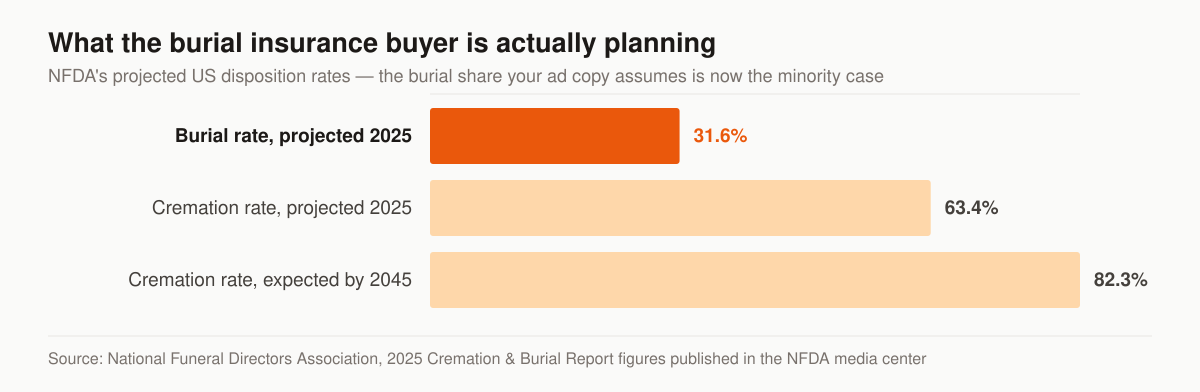
Chart: projected US disposition rates published by the National Funeral Directors Association, which puts the 2025 cremation rate at 63.4% and the burial rate at 31.6%, and expects cremation to reach 82.3% by 2045.
The product is called burial insurance and the NFDA’s projection puts actual burial at 31.6% of dispositions in 2025, against a 63.4% cremation rate that it expects to reach 82.3% by 2045. That is not an argument against the product — the policy pays a cash benefit whatever the family chooses. It is an argument about copy. An ad built entirely around a casket-and-plot picture is speaking to under a third of the market as the NFDA projects it, while the money question a cremation-planning family has is the same one: who writes the check, and how fast.
This is a build-side advantage that rarely gets counted. A vendor’s creative is written to maximize form fills across every agent buying that lead type, so it is generic by construction. Your own creative can name the actual costs in your state and speak to cremation-planning families directly. That is also the raw material for the content side of the funnel — content ideas for final expense agents works through what to write when the topic is this sensitive.
The break-even question, as a formula you can run
Stop arguing about which path is cheaper in the abstract and write down the crossover. It only needs numbers you already have.
Blended cost per lead = (vendor spend + ad spend + amortized build and management) ÷ total leads from both sources
Run it monthly for two quarters and the answer emerges without a debate. Three things make the line move:
- Volume. The build’s fixed cost divides across more leads every month it grows. Nothing else in the formula improves with scale the way that denominator does.
- Exclusivity. Bought leads and built leads are only comparable per-lead if both are exclusive. If your vendor leads are shared, you are comparing an exclusive record to a fifth of one, and the fix is to run the comparison on cost per issued policy instead — the method is set out in lead cost versus true cost per sale.
- Time in market. The build’s cost is front-loaded and its output is back-loaded. A three-month horizon flatters buying; a two-year horizon flatters building. Pick your horizon before you run the numbers, not after.
The formula also settles a question agents ask backwards. “Is my in-house CPL good?” is unanswerable in isolation. “Is my blended CPL falling month over month while total volume holds?” is answerable from your own dashboard, and it is the only version of the question that tracks whether the build is working.
What breaks an in-house burial funnel
We keep a short list of the failures we see when an agent’s own funnel underperforms, and we treat them in this order. This is our diagnostic sequence rather than a ranked survey of the market.
- The funnel never cleared the learning phase. Covered above. If the ad set has been learning limited since launch, no amount of creative testing fixes it, because the platform was never optimizing in the first place.
- The page is doing a website’s job. A funnel page has one job and one action. An agency homepage with a menu, a carousel and four service links is a website, and it converts like one.
- Speed to lead collapsed. A first-party lead has the same decay curve as a purchased one. A form fill from your own ad that sat for an hour is not better than a purchased lead dialed in minutes. Our insurance lead follow-up cadence sets out the attempt structure that keeps contact rates up.
- Nobody is measuring by source. If in-house and purchased leads land in the same bucket with no source tag, the blended-CPL formula above cannot be run, and the build-vs-buy decision reverts to opinion. This is a tracking problem before it is a marketing one, and it is the first thing we fix.
None of those four is exotic. They are the reasons an agent tells us their in-house funnel “didn’t work” and then, on inspection, turns out never to have been given the conditions to work.
Compliance moves to your side of the table when you build
This is the part of the trade agents price at zero, and it is not zero. When you buy a lead, the vendor generated it and the consent record is theirs to produce. When you generate your own, you are the party who captured the consent, and your form’s wording is the artifact anyone will ask to see.
What that means in practice:
- Your form is the consent record. Whatever your landing page says above the submit button is what you are relying on later. Keep the exact wording, timestamped, alongside the record itself.
- Your ad account carries the risk. Ad platforms enforce their own creative rules on top of the law, and a suspended account stops the pipeline instantly — with no vendor to call for a replacement batch. The platform-side rules for insurance creative are covered in Facebook ads for insurance agents.
- Do-not-call and consent obligations follow the caller, not the lead’s origin. Generating the record yourself changes who documents the consent; it does not change who has to have it. The rules that apply either way are in TCPA compliance for insurance agents buying leads.
We’re a marketing provider, not your compliance counsel. Agents are the licensed parties — confirm your consent language and scrubbing process with your own compliance review.
The blended approach most scaling agents use
The agents who grow past a single producer rarely pick one path. They run both:
- Buy to keep the calendar full today while the funnel is still in its learning phase.
- Build in parallel so blended cost-per-lead falls month over month.
Over two or three quarters, in-house volume takes over the easy, cheap appointments and purchased leads cover overflow and new markets. Your blended CPL drops without ever leaving you with an empty calendar. This is the same conversion discipline we apply across our senior-market clients — captured in detail on our burial insurance marketing page, the hub for everything covered here.
There is a sequencing point inside that, and it is the one worth getting right. Buying is what funds the build. If you cut the vendor spend the week you launch ads, you have a learning-phase funnel and an empty calendar at the same time, and the pressure of the empty calendar is what makes agents edit the ad set daily and restart the learning clock. Keep the vendor line item running until the in-house channel has cleared the platform’s threshold and held it for a month. Then taper it, one step at a time, and watch the blended number rather than either source on its own. If you are still choosing a vendor for that interim period, our map of final expense lead generation companies sorts them by what they actually sell.
A 90-day test that settles it with your own numbers
If you would rather decide from evidence than from a table on a marketing site, run this. It is the sequence we use when an agent asks us which way to go.
- Fix your baseline first. Pull the last 90 days of purchased leads. Calculate cost per lead, contact rate, and cost per issued policy for each vendor separately. Without that number, nothing you build has anything to beat.
- Pick one channel to build, not three. The channel table above is a choice, not a checklist. Splitting a small budget across Facebook, search and mail guarantees all three sit under the platform thresholds.
- Budget the learning phase as a fixed cost, not a result. Meta’s own guidance is that cost per action runs higher during it. Decide the number you are willing to spend before it stabilizes, write it down, and do not judge the channel until it is spent.
- Do not touch the ad set. Significant edits restart the clock, which is why Meta’s own guidance for the learning phase opens with “Wait to edit your ad set until it’s out of the learning phase.” Change creative on a schedule you set in advance, not in response to a bad Tuesday.
- Tag every lead by source from day one. In-house or vendor, and which vendor. A CRM makes this automatic; a spreadsheet makes it optional, which means it will not happen. Our CRM comparison for insurance agents covers what to look for.
- Judge on issued policies at day 90, not on cost per lead at day 30. The build’s CPL is at its worst in the first month by design. The only fair comparison is a full quarter of issued business against the same quarter’s total spend.
Whichever way that test comes out, you will end it with a number instead of an argument — and with a source-tagged pipeline, which is worth having regardless of which path you pick.
A quick decision rule
If you remember one thing, make it this:
- Under ~30 leads/month, no time, testing a market → buy exclusive leads and dial fast.
- Steady volume, 6-12 month horizon, want lower CPL → build, and treat the first 4-8 weeks of spend as tuition.
- Scaling a team → do both, and let in-house volume slowly replace purchased volume.
A short note on compliance, because it’s a trust signal in this market: senior-targeted ads still need accurate, non-deceptive creative, and you are the licensed party making the sale. We provide the marketing; you own the compliance posture. Build the funnel right and that’s one less thing to worry about.
Next step
Want a straight read on whether to build, buy, or blend for your volume and state? Start with a free marketing audit — we’ll map your current cost-per-lead against what an in-house funnel would realistically run, using the same models behind our own campaigns. No pitch, just the numbers. And if you’d rather see how the whole picture fits together, the final-expense marketing hub is where the senior-market system lives.
The right answer isn’t “always build” or “always buy.” It’s knowing which one your next 90 days actually call for — and once the CPL math is on paper, the blend usually picks itself.
- Digital Marketing for Final Expense Agents: The Channels That Actually Produce
A practitioner's guide to digital marketing for final expense agents: which channels produce leads, what each costs, and how to sequence them by budget.
- Is Final Expense PPC Worth It? The ROI Math, Not the Hype
Is final expense PPC worth it? Published Google and Meta cost-per-lead benchmarks, carrier commission rates, and the close-rate math behind the answer.
- Free Final Expense Leads for Agents: What They Really Cost
An operator's honest breakdown of free final expense leads: where they come from, what they really cost you in time, and how to build cheap leads instead.
- The Final Expense Telesales Script That Holds Up Call After Call
A final expense telesales script with numbered structure, two rebuttal tables, the federal disclosures the call must carry, and the leads that close.