Who we serve
Marketing for Burial Insurance Agents
Marketing for burial insurance agents works best when you treat burial and guaranteed-issue final expense as one tight senior-market funnel: a simple offer, an honest application path, and disciplined ads. The buyer wants a small policy to cover a funeral, so the message stays plain and the follow-up stays fast.
Free · 15-minute teardown · no pitch deck
- We run our own final-expense book
- No pitch deck — we screen-share real numbers
- TCPA-aware · CMS/AEP-compliant · Meta Special Ad Category
- Core Web Vitals < 2.0s LCP
Burial insurance and guaranteed-issue final expense are the same product wearing two different names. Your buyers don’t care which label you use — they care that the funeral gets paid for. The agencies that win this market aren’t the ones with the cleverest tagline; they’re the ones whose math holds: a known cost-per-lead, a known close rate, and a funnel that doesn’t leak between the click and the application.
We can say that plainly because we run the operation. Our final-expense lead engine runs live campaigns every day — the systems on this page aren’t theory, they’re what we operate.
Why marketing for burial insurance agents is really final-expense marketing
The keyword data splits, but the funnel doesn’t. Some seniors search “burial insurance,” others search “final expense,” many search “funeral insurance” or “$10,000 whole life.” Running these as separate campaigns wastes budget. We run one pipeline with creative angles tuned to each phrase, so you capture the full demand instead of whichever slice your wording happened to match.
The sellers already treat the words as interchangeable. Choice Mutual’s guide to the product is titled Guaranteed Issue Final Expense Insurance, and one of its key takeaways reads: “Most companies offer a maximum of $25,000 in guaranteed-issue burial insurance coverage.” Both labels appear in one sentence describing one policy. Your campaign structure should match the buyer’s vocabulary rather than the carrier’s product sheet.
The product reality shapes the message:
- Guaranteed-issue policies skip medical questions but usually carry a graded death benefit for the first two to three years.
- Simplified-issue policies ask a short health questionnaire and can offer day-one full coverage at a lower premium.
- Your ad has to set the right expectation up front, or your close rate dies on the phone.
That last point is where the money leaks: you buy clicks for a benefit the prospect does not actually qualify for, then burn the lead correcting it on the call. We write the qualification into the creative instead, so the correction happens before you pay for the click rather than after.
Who is on the other end of a burial insurance ad
There are two buyers behind one search, and they behave differently. One is the senior buying for themselves. The other is an adult child researching on a parent’s behalf, often in a hurry, often after a death in the family has already happened once.
The NFDA’s 2024 Cremation & Burial Report puts the age concentration in commercial terms: individuals between the ages of 65 and 84 account for 41.9% of funeral service industry revenue, and individuals age 85 and older account for 31.1%. That is the same demographic block your burial-insurance targeting has to reach, and it is not a young audience discovering the category for the first time.
It is also not an offline audience. The same report’s 2024 consumer study found that 67.4% of consumers visited a funeral home website when they planned a funeral or memorial service, and 34.4% said their first interaction with a funeral home was online. Of consumers who use Facebook, 47.9% have visited a funeral home’s Facebook page, and 33.9% said they have used the services of a funeral home they found on Facebook. More than half, 51.1%, said an online review either solidified their decision and/or steered them toward a particular funeral home, and 48.3% called or visited more than one funeral home before deciding.
Table: what each published consumer behavior tells you to build into a burial insurance funnel.
| What the NFDA study measured | Figure | What it means for your funnel |
|---|---|---|
| Visited a provider website when planning | 67.4% | The page, not the phone, is the first impression |
| First interaction with a provider was online | 34.4% | Your ad has to answer before it asks |
| Facebook users who visited a provider’s page | 47.9% | The social profile is a landing page too |
| Used a provider found on Facebook | 33.9% | Paid social is a discovery channel here, not just retargeting |
| Said a review steered or confirmed the decision | 51.1% | Reviews are a conversion asset, not a vanity metric |
| Contacted more than one provider | 48.3% | Assume you are being compared while the tab is still open |
Those numbers describe how families shop for a funeral, not for a policy — but they are the same families, in the same week, on the same devices. A burial-insurance funnel that has no reviews, no price information and no way to get an answer without a phone call is asking a comparison shopper to behave differently than they behave everywhere else in this purchase.
What a funeral actually costs, and what that fixes in your offer
Burial insurance is sold against a number, so the number should be right. The NFDA’s 2023 General Price List Study, published in the 2024 Cremation & Burial Report, gives the national medians.
Table: 2023 median charges on NFDA-member general price lists, by what the family selects.
| Selected goods and services | 2023 median charge |
|---|---|
| Adult casketed funeral with viewing and ceremony followed by burial (vault not included) | $8,300 |
| Adult casketed funeral with viewing and ceremony followed by cremation | $6,280 |
| Immediate burial, container provided by funeral home | $3,720 |
| Immediate burial, container provided by family | $2,995 |
| Direct cremation, container provided by funeral home | $2,750 |
| Direct cremation, container provided by family | $2,645 |
| Metal burial casket | $2,500 |
| Urn | $295 |
The exclusions matter more than the headline. NFDA’s own definition of that $8,300 line says the figure “excludes vault, cemetery, monument marker, and miscellaneous cash-advance charges.” An ad that implies a $10,000 policy buys the whole event is setting up an objection your agent has to answer at the kitchen table. An ad that names what the policy covers, and says the cemetery and marker are separate, closes a smaller sale honestly and keeps the placement.
That is also the strongest reason to publish a cost page rather than a promise page. The searcher who types a burial-insurance query is usually mid-way through pricing a funeral. Our final-expense SEO work targets exactly that cost-shaped query set, and the same content feeds the AI-search answers those searchers increasingly read first.
Burial or cremation: the assumption in your creative
The word in your keyword is not the plan in your prospect’s head. NFDA’s media center, last updated September 29, 2025, publishes the 2025 Cremation & Burial Report projections: a 2025 cremation rate of 63.4%, a burial rate of 31.6%, and cremation expected to reach 82.3% by 2045.
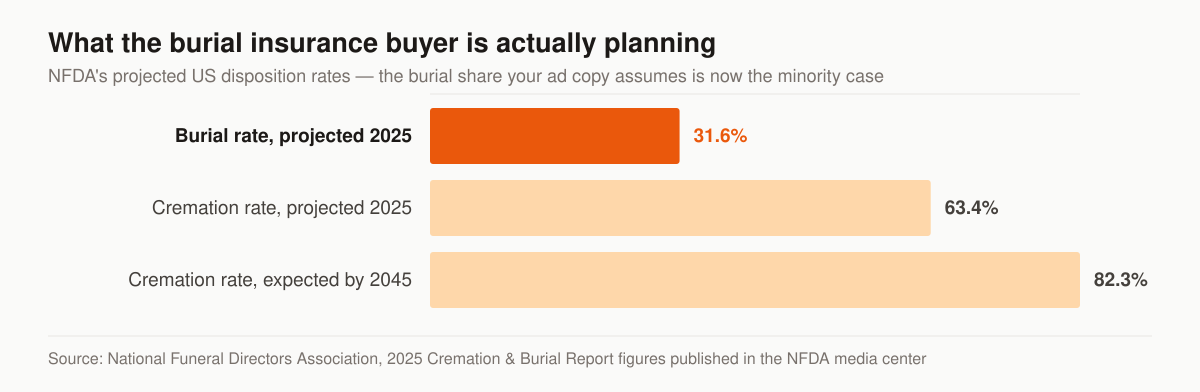
Projected US disposition rates, from the National Funeral Directors Association’s 2025 Cremation & Burial Report figures published in the NFDA media center.
The geography is moving too. The 2024 report states that “[i]n 2022, six states had burial rates above 50%, one fewer than in 2021. By 2025, only three are projected to maintain the majority of death dispositions as burials. By 2035, no states are predicted to have more than one-half of deaths dispositioned as burials.”
Two practical consequences for the creative. First, keep bidding on the word — buyers still type “burial insurance” regardless of what they intend to arrange, and the search demand is where the search demand is. Second, stop building the imagery and the copy around a graveside as though it were the default. Ad copy that says “covers the funeral, the cremation, and what the family is left holding” speaks to both halves of the market; copy built entirely on caskets and plots speaks to a shrinking minority of what families actually do.
Channels that move burial insurance leads
There’s no single best channel — there’s the right mix for your budget and how fast you close. Here’s how the three workhorses compare for senior-market agents.
Table: how the three main acquisition channels behave for a senior-market burial insurance offer.
| Channel | Best for | Lead intent | Speed to first lead |
|---|---|---|---|
| Facebook / Meta ads | Volume, retargeting, audience ownership | Lower (interrupt) | Days |
| Google PPC | High-intent “buy now” searches | Higher (active) | Days |
| SEO | Durable, compounding flow | Highest (organic) | Months |
We start an account with paid social campaigns plus one tight high-converting landing page, prove the unit economics, then layer in final-expense SEO so the pipeline compounds without rising ad spend. The whole machine — ads, page, follow-up — is what we package as a lead-generation system.
The channel choice also changes what the compliance work looks like, which is a point most channel comparisons skip. A Meta campaign puts your creative in front of people who were not looking for insurance, so the disclosure burden sits inside the ad. A search campaign catches someone already typing the product name, so the disclosure burden shifts to the landing page and the form. The mechanics of each live on our final-expense Facebook ads and final-expense PPC management pages.
Which underwriting tier your ad is actually promising
A burial-insurance headline implies an underwriting outcome, whether the writer meant it to or not. “No health questions” promises guaranteed issue. “No medical exam” promises something else entirely. Getting this wrong is an expensive creative error, because the prospect finds out on the call rather than on the page.
Table: what each underwriting tier lets an advertisement honestly say.
| Tier | What the buyer answers | Day-one benefit | What the ad may claim |
|---|---|---|---|
| Level, simplified issue | A short health questionnaire | Full face amount | No medical exam, subject to health questions |
| Graded | A short health questionnaire | Reduced, rising over the graded period | Coverage with a stated graded schedule |
| Modified | A short health questionnaire | Return of premium or a set percentage | Coverage with a stated modified schedule |
| Guaranteed issue | Nothing about health | Return of premium during the waiting period | Acceptance guaranteed within the issue ages |
Choice Mutual’s guaranteed-issue guide sets out the mechanics the creative has to respect: guaranteed issue requires no health questions and no exam, all guaranteed final expense policies carry a mandatory two-year waiting period, and death from natural causes inside that window returns the premiums rather than the face amount. The guide states it plainly: “Should you die during the waiting period from natural causes, the insurer will only refund your premiums, plus roughly 10% interest.” Accidental death is the exception, and pays the full benefit. Choice Mutual states that nearly all insurers cap coverage at $25,000, and lists the product as unavailable to those aged 86 or older.
The same guide warns about a phrase that is easy to blur: readers see the words no exam and take them to mean no health questions, which is not the case. If your campaign is selling simplified issue, the word “exam” is doing work that “questions” cannot do, and the two must not be blurred.
Price is the second thing the tier decides, and it moves fast with age.
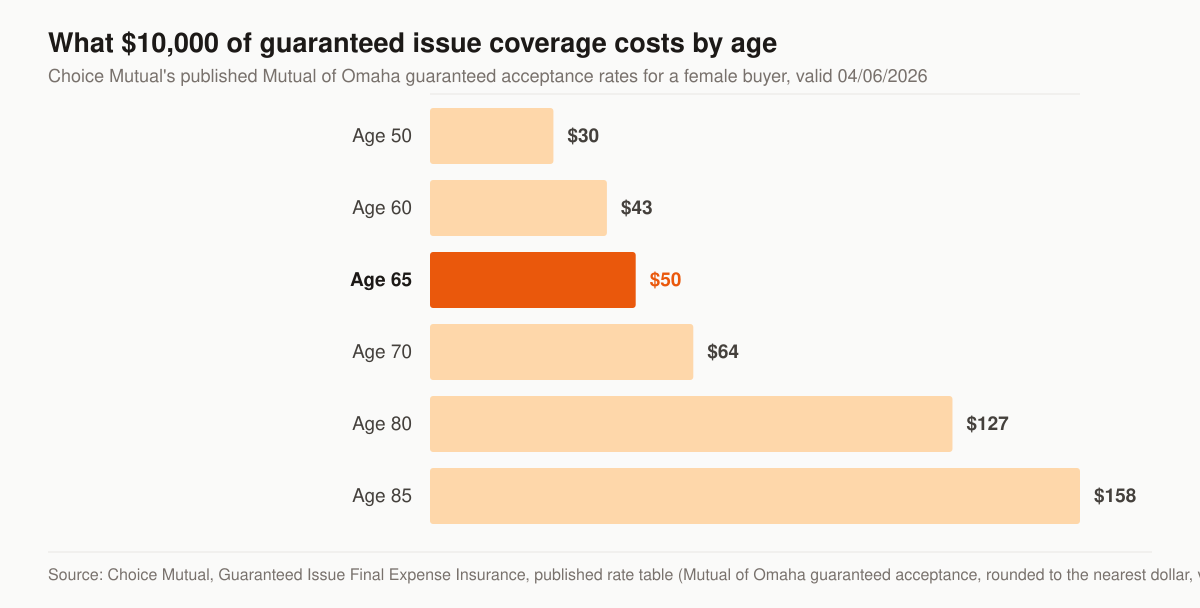
Published monthly premium for $10,000 of Mutual of Omaha guaranteed acceptance coverage, female buyer, from Choice Mutual’s rate table, rounded to the nearest dollar and valid as of 04/06/2026.
A “from $30 a month” hook is accurate for a 50-year-old and misleading for an 80-year-old on the same offer. Age-band your ad sets, age-band the creative, and put the age question early in the form so the quote the prospect sees is the quote the agent can write. Carrier selection matters at the same point, which is what our guide to choosing final-expense carriers works through.
What a state advertising rule requires of burial insurance creative
It is easy to treat compliance as a tone — be honest, avoid hype. In several states it is a format, with counted seconds and specified type sizes. Wisconsin’s rule is a published, specific example, and it is worth reading even if you never write a policy there, because it shows what one regulator considers the minimum.
The scope is broad. Wisconsin’s rule applies to “any person who makes, directly or indirectly on behalf of an insurer, fraternal benefit society, or intermediary, an advertisement, representation, or solicitation in this state” of the covered lines (Wis. Admin. Code Ins 2.16(2)(a)). That reaches the agency writing the ad, not only the carrier whose name is on the policy.
On graded benefits, the rule is specific: “An advertisement, representation, or solicitation for a policy containing graded or modified benefits shall prominently disclose this fact.” It then defines the disclosure it means. For television, “an announcement describing the graded or modified benefits to be displayed during the advertisement for at least 10 seconds.” For pre-printed advertisements intended for general distribution, “a written description of the graded or modified benefits printed on the first page of the advertisement and in at least 12 point bold type” (Ins 2.16(25)).
Table: Wisconsin’s advertising rules that bite hardest on burial insurance creative.
| Provision | What the rule requires | What it changes in the ad |
|---|---|---|
| Ins 2.16(25)(a) | An advertisement for a policy containing graded or modified benefits “shall prominently disclose this fact” | The waiting period is headline furniture, not a footnote |
| Ins 2.16(25)(b)3. | Pre-printed general distribution: first page, at least 12 point bold type | Mailer layout is constrained before design starts |
| Ins 2.16(26)(a) | Terms such as Nonmedical or No Medical Examination Required, where issue is not guaranteed, need a further disclosure “in close proximity thereto and with equal prominence” | The no-exam hook carries its own caveat at the same size |
| Ins 2.16(26)(b) | A policy name must include the words “life insurance” unless other language clearly indicates it is life insurance | “Burial insurance” alone is not a compliant product name |
| Ins 2.16(26)(c) | “An advertisement shall prominently describe the type of policy advertised” | Say whole life, and say it early |
| Ins 2.16(7)(d) | Immediate coverage or guaranteed issuance may be claimed “only if suitable administrative procedures exist so that the policy is issued within a reasonable time after the application is received” | Instant-approval language depends on real operations |
| Ins 2.16(8)(a) | “Each advertisement shall clearly identify the insurer” | Carrier-agnostic creative needs a named carrier |
| Ins 2.16(29)(b) | Insurers must require intermediaries to submit proposed advertisements for approval prior to use | Build carrier review into the production calendar |
| Ins 2.16(30) | Advertising file kept while in use and for three years after | Version and archive every ad you run |
Two of those deserve emphasis for this niche specifically. The no-exam provision, Ins 2.16(26)(a), says the terms must be “accompanied by a further disclosure in close proximity thereto and with equal prominence to the effect that issuance of the policy may depend upon the answers to the health questions set forth in the application.” Equal prominence rules out the standard trick of a large hook and small print. And Ins 2.16(26)(b) means the phrase your keyword research handed you is not, by itself, a legal product name — you can target the search term and still have to describe the policy as whole life insurance in the creative.
Responsibility is shared but not diluted. The rule places the content of an advertisement on the insurer “regardless of by whom designed, created, written, printed or used” (Ins 2.16(29)(a)), which is precisely why carriers police agency creative. Getting the carrier’s compliance desk a clean, pre-annotated ad is faster than getting a clever one rejected twice.
This is one state. Wisconsin’s provisions are not national law, and the requirements, thresholds and definitions differ elsewhere. Read your own state’s advertising rule, and your carrier’s advertising guidelines, before the first ad is built.
The consent record behind every burial insurance lead
A burial-insurance lead is a phone call waiting to happen, which makes the form a compliance artifact as much as a conversion asset. The federal definition is exact. Under 47 CFR 64.1200(f)(9), “prior express written consent” means “an agreement, in writing, bearing the signature of the person called that clearly authorizes the seller to deliver or cause to be delivered to the person called advertisements or telemarketing messages using an automatic telephone dialing system or an artificial or prerecorded voice, and the telephone number to which the signatory authorizes such advertisements or telemarketing messages to be delivered.”
The written agreement must carry a clear and conspicuous disclosure telling the signer that executing it authorizes those calls, and that “[t]he person is not required to sign the agreement (directly or indirectly), or agree to enter into such an agreement as a condition of purchasing any property, goods, or services.” An electronic or digital signature counts, to the extent it is valid under applicable federal or state contract law.
Three other paragraphs of the same rule shape the operation around the form:
- Calling hours. No telephone solicitation may be initiated to a residential subscriber “before the hour of 8 a.m. or after 9 p.m. (local time at the called party’s location)” (64.1200(c)(1)).
- Registry currency. The safe-harbor standard requires “a version of the national do-not-call registry obtained from the administrator of the registry no more than 31 days prior to the date any call is made,” with records documenting the process (64.1200(c)(2)(i)(D)).
- Revocation. A called party may revoke consent by any reasonable method, and the words “stop,” “quit,” “end,” “revoke,” “opt out,” “cancel,” or “unsubscribe” in reply to a text are a reasonable means per se. All revocation requests “must be honored within a reasonable time not to exceed ten business days from receipt of such request” (64.1200(a)(10)).
Read the scope of each paragraph before applying it. The written-consent definition governs telemarketing delivered by an automatic telephone dialing system or an artificial or prerecorded voice. The calling-hours and registry paragraphs govern telephone solicitations, a term the same rule defines to exclude a call “[t]o any person with that person’s prior express invitation or permission” and a call “[t]o any person with whom the caller has an established business relationship”. What that means for a marketing build is unglamorous and non-negotiable. Store the disclosure text that was on the page at the moment of submission, the timestamp, the page URL and the visitor’s IP alongside the record. Version the form so a changed disclosure does not silently overwrite the evidence for leads captured last month. Wire the revocation path into the same CRM the dialler reads from, not into an inbox nobody watches. We build that capture into every landing page and form we ship.
Compliance is a trust signal, not a hurdle
Guaranteed-issue copy fails when it overpromises. “Full coverage instantly, no questions” is both inaccurate and a fast way to draw carrier and platform scrutiny. We write factual creative — guaranteed acceptance within the issue ages, graded benefits stated plainly, no “get rich” or guaranteed-windfall framing. You’re the licensed party making the sale; our job is to bring you qualified seniors without exposing your book to reputational risk. Clean marketing converts better and lasts longer.
Build your own leads, or buy them?
This is the question every burial-insurance agent asks. Both answers are valid; they solve different problems.
- Build when you want exclusive contacts, owned retargeting audiences, and lower cost per acquisition once the funnel matures. You keep the data and the asset.
- Buy when you need volume today, you’re testing a new state, or you don’t want to own a marketing operation. It’s faster but you’re renting, not owning.
We build the generation system — that’s the service on this page. We do not sell leads here. If your need is buying burial leads, live transfers, or aged leads as a product, buy leads direct from getinsureleads, our sister brand. Keeping those clean means you always know whether you’re investing in an owned asset or buying inventory.
The decision is a volume question more than a philosophy question, and we work the arithmetic through in build versus buy for burial insurance lead generation and in the lead-type comparison on exclusive final-expense leads.
What to measure once the leads start arriving
Cost per lead is the number every vendor quotes and the number that decides the least. The chain that matters runs further: lead, contact, application, issued policy. A source that produces cheap records and no contacts is not cheap.
Track five things per source, per week, and refuse to judge a channel on any one of them:
- Cost per lead — what the record cost you, ad spend and management separated.
- Contact rate — the share of records that reach a live conversation, which is where speed of follow-up shows up.
- Application rate — the share of conversations that produce a submitted application.
- Placement rate — the share of applications that are issued and paid, which is where underwriting-tier honesty in the creative pays off or does not.
- Cost per issued policy — the figure that stays comparable when one source sells cheap records in bulk and another sells expensive pre-screened calls.
Placement rate is the diagnostic we add first when a burial-insurance campaign is reporting without one. If applications are high and placement is low, the creative is promising an underwriting tier the prospects do not qualify for, and the fix is in the ad rather than in the sales script. We take that comparison apart in cost per lead versus true cost per sale, and the phone-side mechanics in selling final expense over the phone.
What running this costs
The build and the management are priced openly so you can compare them against a lead invoice before you commit. Programs run at $2,500 a month at the Foundation tier, $3,500 at Growth and $5,500 for Full-Funnel, with a one-time website or landing-page build of $2,500 to $8,000. Ad spend is billed separately and goes straight to Meta or Google at cost, so the platform’s number and ours never blend into a single opaque figure. The full tier comparison sits on the pricing page.
Which tier fits depends on how much of the funnel you already own. An agent with a working site and no traffic needs different work from an agent with traffic and a page that does not convert. If you would rather talk it through than read a table, get in touch and we will tell you which tier we would put you in and why.
What working with operators looks like
You get the same conversion systems and ad discipline that run our own senior-market book — not a deck. We start by auditing where your burial-insurance funnel leaks, then fix the highest-leverage gap first, whether that’s creative, the landing page, or follow-up speed.
- See the proof: our final-expense marketing operation and how the funnel is built.
- Compare approaches: is final-expense PPC worth it and how to market guaranteed-issue final expense.
- Fix the page first if that’s the leak: final-expense website design.
- Start here: grab a free marketing audit and we’ll show you your numbers before you spend a dollar with us.
Marketing for burial insurance agents isn’t about louder ads. It’s about a funnel where every number — CPL, close rate, cost per acquisition — is visible and improving. That’s the operator’s view, and it’s the only view that pays.
Guides that go deeper