Is Final Expense PPC Worth It? The ROI Math, Not the Hype
Final expense PPC is worth it when your fully-loaded cost per acquired client stays below the first-year commission that client pays. LocaliQ's 2026 benchmarks put the average Finance and Insurance search lead at $74.44. Whether that clears depends on your close rate, your carrier's grid rate and your average premium.
“Is final expense PPC worth it?” is the wrong question if you ask it without numbers attached. PPC is a machine that turns ad dollars into leads, leads into clients, and clients into commission. Whether it is “worth it” is just whether that machine runs at a profit for your agency. So instead of a yes-or-no opinion, here is the cost structure and the math, drawn from a final-expense lead operation we actually run and from the published benchmarks anyone can check.
What final expense PPC actually costs
There are two paid channels FE agents use, and they cost very differently because they do different jobs.
Google Ads captures people who are already typing “final expense insurance” or “burial insurance near me.” High intent, high cost. Final expense and burial keywords sit in the same auction as every carrier and aggregator bidding on senior life insurance.
Facebook (Meta) Ads creates demand. You run a form-fill ad; the person was not searching, so each lead is cheaper but colder. Volume is the strength here.
Here are the only published, checkable cost benchmarks that cover this territory — read them as the floor you plan against, not as final expense figures specifically. LocaliQ’s 2026 Search Advertising Benchmarks report a Finance and Insurance row drawn from Google Ads and Microsoft Ads accounts. WordStream’s 2025 Facebook Ads Benchmarks break out Meta by campaign objective; Finance and Insurance appears in the traffic-objective tables but not in the leads-objective tables, so the leads-objective column below is the all-industry figure.
| Metric | Google/Microsoft search, Finance & Insurance | Meta traffic ads, Finance & Insurance | Meta lead ads, all industries |
|---|---|---|---|
| Average cost per click | $3.39 | $1.22 | $1.92 |
| Average click-through rate | 9.83% | 0.98% | 2.59% |
| Average conversion rate | 2.64% | not reported | 7.72% |
| Average cost per lead | $74.44 | not reported | $27.66 |
Sources: LocaliQ / WordStream, 2026 Search Advertising Benchmarks and WordStream, Facebook Ads Benchmarks 2025, whose leads-objective sample is 726 US campaigns running April 1, 2024 to June 30, 2025, with “averages” reported as medians to account for outliers.
Two numbers in that table decide everything. The insurance search click is cheaper than the $5.42 all-industry average and gets clicked more often than average — 9.83% against 6.64%. Then the conversion rate falls to 2.64%, the lowest of the 23 categories LocaliQ reports, and the cost per lead lands at $74.44 against a $66.69 average anyway. You are not losing to the auction. You are losing after the click.
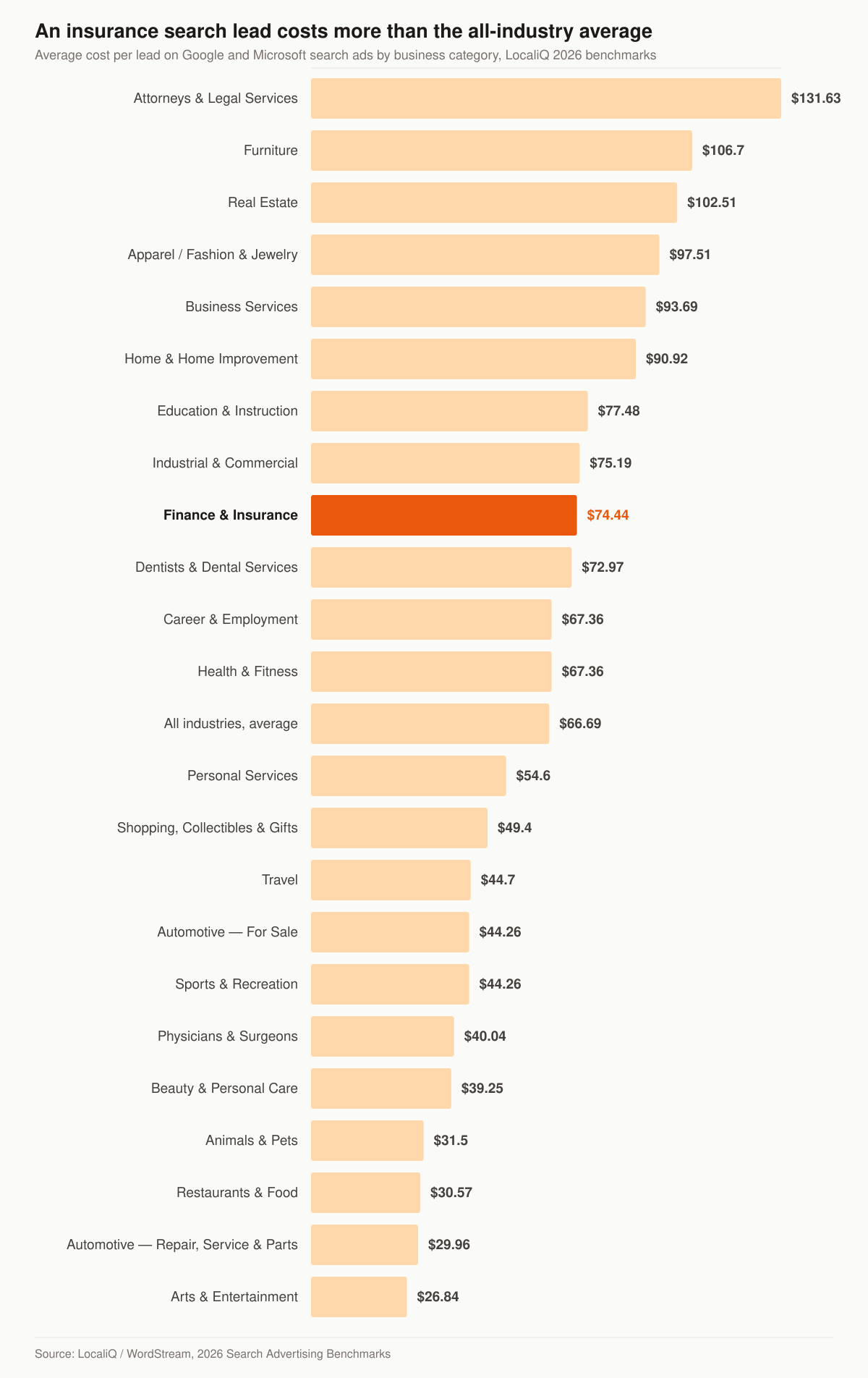
Average cost per lead on search ads by business category. Source: LocaliQ / WordStream, 2026 Search Advertising Benchmarks.
The second table is the one people skip, and it is what actually decides your channel mix. Cost is a number; job is a decision.
| Google/Microsoft search | Meta lead ads | |
|---|---|---|
| What it does | Captures existing demand | Creates demand |
| Lead intent | High — active search | Low to medium — demand generation |
| Lead volume at a fixed budget | Low | High |
| Targeting control (US insurance) | Keyword and location | Constrained by Special Ad Category |
| Best use | Bottom-funnel intent | Cheap top-funnel volume |
The only ROI formula that matters
Cost per lead is a vanity number until you connect it to a sale. The chain that decides whether final expense PPC is worth it has four links:
- Cost per lead — what you pay per form fill.
- Close rate — how many leads become clients.
- Cost per acquisition (CPA) — CPL divided by close rate.
- First-year commission — what one client is worth in year one.
Run the arithmetic at the published benchmarks. Close rate is your input, not a benchmark — nobody publishes a credible final expense close rate, so use your own from the last 90 days:
- Google search: $74.44 per lead. At a one-in-six close, CPA = $74.44 × 6 = $446.64 per acquired client.
- Meta lead ads: $27.66 per lead. At a one-in-twelve close, CPA = $27.66 × 12 = $331.92 per acquired client.
Both of those are arithmetic on a published average, not a promise about your account. Swap in your own numbers and the shape of the answer is the same: the channel with the higher cost per lead can still win, and the channel with the cheaper lead can still lose, because the multiplier sits in the close rate.
That is the whole game. Final expense PPC is worth it when CPA stays comfortably under first-year commission — and it stops being worth it the moment CPL climbs, close rate slips, or you call leads slowly enough to let them go cold. The math is the same logic we lay out in our final-expense PPC management approach, where every campaign is judged on tracked cost per acquisition, not clicks.
What one final expense sale is actually worth
The right-hand side of the equation is where agents guess, and there is no need to. Your first-year commission is your annualized premium multiplied by your contract rate, and contract rates are published.
The spread on a single new-agent grid is wider than agents expect, which means two agents writing the same premium can have very different PPC economics. These are first-year rates on the 2026 FEX Contracting new-agent commission grids, published January 2026.
| Carrier and product | First-year rate on the 2026 FEX new-agent grid |
|---|---|
| Gerber, guaranteed issue | 60% |
| Aetna, Protection Series | 90% |
| Mutual of Omaha, Living Promise | 120% |
| Transamerica, Express | 130% |
| Transamerica, Immediate Solutions | 115% |
Source: FEX Contracting, 2026 new agent commission grids. Rates across the full grid run from 60% at the low end to 130% at the high end.
Issue age moves the rate too, inside a single carrier. On the United of Omaha final expense compensation schedule (form UN0096_0120), the level product pays 90% first year at issue ages 45 to 75, 85% at 76 to 80, and 45% at 81 to 85, while the graded product pays 65% across ages 45 to 80. An older or graded book earns materially less on the same premium, which is why an FE ad account that targets the oldest end of the market needs a lower cost per lead to clear the same bar.
Put it together with a stand-in premium. If your average annualized premium is $600 and you are contracted at the 120% Living Promise row, first-year commission is $720. Against the $446.64 Google CPA above, that clears — thinly. Against the $331.92 Meta CPA, it clears with room. Change the premium or the grid rate and the verdict changes with it. We break the contract side down further in our guide to final expense commission levels for agents.
Why FE agents conclude “PPC doesn’t work”
When an agent says paid ads failed, these are the four leaks we check before we look at the platform:
- No tracking to the sale. They measured CPL, never CPA. They have no idea if a $30 lead closed at 1-in-5 or 1-in-20.
- Slow follow-up. A form-fill lead called back the same minute and one called back the next afternoon are the same lead with two different outcomes. We treat speed-to-lead as the first fix because it costs nothing to change; the sequence we hand agents is in our insurance lead follow-up cadence.
- A weak landing page. Sending paid clicks to a generic homepage instead of a focused, fast page tanks conversion. With the insurance search conversion rate sitting at 2.64%, the page is where the money is.
- Underfunded testing. $500 of spend cannot optimize anything. Google’s own guidance for evaluating Target CPA is to “measure performance for the last 30 days, including at least 30 conversions.”
Fix those four and the same ad account that “didn’t work” frequently turns profitable — because the unit economics were always fine, the execution wasn’t. That execution discipline is exactly what transfers across our final-expense marketing system: the lead operation behind our proof tokens is built by people who actually generate insurance leads, and the same conversion mechanics apply whether we run the ads or you do.
Where a final expense search budget leaks
Final expense search has two waste patterns that are specific to the niche, and neither shows up in a CPC benchmark.
The query pool is contaminated. “Final expense” and “burial insurance” sit next to queries from people looking for funeral financial assistance, charity burial programs, county indigent burial, and customer service for a policy they already own. Those people click. They do not buy. Every one of them is charged at the same click price as a real prospect, against a $3.39 Finance and Insurance average. A negative keyword list is the direct fix, and it has to be built from your own search terms report rather than copied from a template.
The long tail will not run. Agents build tightly themed ad groups around specific personas and then find them sitting idle. Google’s definition is explicit: “A keyword with a low search volume will be inactive until its search traffic increases, when the keyword can start triggering your ads to appear.” The system “evaluates the number of searches on a given keyword worldwide over the past twelve months” before it pulls a keyword out of the auction, and the status is “unrelated to quality score, bid, or creatives, so editing these won’t change the status.” Raising the bid does nothing. Google re-checks and reactivates on its own if volume returns.
Here are the query themes worth checking first when a final expense account is spending without converting. Pull the search terms report, sort by cost, and read the top fifty.
| Query theme | Why it appears | What it costs you |
|---|---|---|
| Funeral financial assistance, help paying for a funeral | Same vocabulary, opposite intent | Full click price, near-zero close |
| Free burial, county or state burial programs | Benefit-seeking, not insurance-buying | Full click price, near-zero close |
| Existing-policy service, claims, cancel policy | Current policyholders of other carriers | Full click price, wrong audience |
| Careers, licensing, “become a final expense agent” | Recruiting intent inside a sales account | Full click price, no policy |
| Competitor brand and carrier names | Comparison shoppers mid-decision | Expensive, sometimes worth keeping |
Only the last row is a judgement call. The first four are negatives.
Two structural fixes follow from this. Route the informational half of the query pool to content rather than to a quote form, so a click that was never going to convert today at least enters your list — that is the argument in our final expense sales funnel guide. And feed offline conversions back to the platform, so the bidding algorithm optimises toward issued policies instead of raw form fills. Cost per click by line, across every insurance vertical, is broken out in insurance PPC cost per click by line.
Meta changed the rules for insurance ads in 2025
The 2025 change is a targeting change rather than a cost change: it removes the audience controls final expense advertisers had built their campaigns around.
Meta introduced a “Financial products and services” Special Ad Category in October 2024, replacing the previous Credit category. Meta’s help centre says: “Examples of financial products and services ads include those promoting insurance, bank accounts, investment services and payment services.” And: “Starting January 21, 2025, using the Special Ad Category designation is required for advertisers based in the United States or reaching audiences in the United States running financial products and services campaigns. Ads may be rejected if the advertiser does not choose an appropriate Special Ad Category.”
Selecting it costs you your targeting. Meta’s guidance on audience selection for these ads states that “Certain audience options are limited or unavailable for these ads for advertisers based in or reaching the US and advertisers reaching Canada and certain countries in Europe: age, gender, ZIP code or postal code, exclusion targeting, lookalike audiences and saved audiences.” Some interests become unavailable as well, and “Audiences based on city or pin drop locations will include an expanded radius.” Meta’s own instruction is to “broaden—not restrict—your audience.”
For final expense that is a structural change. The classic FE Facebook setup — a tight age band over 50, a narrow ZIP radius, a lookalike built from your buyer list — is no longer available to a US insurance advertiser. What is left to differentiate with is creative, offer and copy: the ad itself now has to do the qualifying that targeting used to do. A senior-facing image, plain language about coverage that pays for a funeral, and a form that filters age in the questions rather than in the audience. We build these under the insurance Facebook ads service, and the wider platform comparison sits in Facebook ads vs Google ads for insurance agents.
The practical read: if your FE Meta cost per lead jumped and your lead quality dropped somewhere after January 2025, and nobody on your team can say which Special Ad Category the campaign is running under, start there before you touch the budget.
What TCPA consent has to look like on a final expense lead form
If you are going to call or text the leads your ads generate, the form is a compliance artifact, not just a conversion element.
47 CFR 64.1200(f)(9) defines prior express written consent as “an agreement, in writing, bearing the signature of the person called that clearly authorizes the seller to deliver or cause to be delivered to the person called advertisements or telemarketing messages using an automatic telephone dialing system or an artificial or prerecorded voice, and the telephone number to which the signatory authorizes such advertisements or telemarketing messages to be delivered.” The written agreement must carry a clear and conspicuous disclosure that by executing it the person authorizes those calls, and that the person “is not required to sign the agreement (directly or indirectly), or agree to enter into such an agreement as a condition of purchasing any property, goods, or services.” Signature includes an electronic or digital signature where that is valid under applicable federal or state contract law.
Two details matter operationally. First, revocation. Under 47 CFR 64.1200(a)(10), a consumer may revoke using any reasonable method, and the rule names words that count on their own: “stop,” “quit,” “end,” “revoke,” “opt out,” “cancel,” or “unsubscribe” sent in reply to an incoming text message. A reply using other words must still be honoured if a reasonable person would read it as a revocation. Revocation must be honoured “within a reasonable time not to exceed ten business days from receipt of such request,” and callers “may not designate an exclusive means to request revocation of consent.” If your dialer or CRM only recognises the literal word STOP, that is not enough.
Second, the rule that agents read about in 2024 and still ask about. The FCC’s December 2023 order would have required consent to name one seller at a time and to be logically and topically associated with the interaction that prompted it. On January 24, 2025 the Eleventh Circuit held in Insurance Marketing Coalition Ltd. v. FCC, No. 24-10277, that the FCC’s “new consent restrictions impermissibly conflict with the ordinary statutory meaning of ‘prior express consent,’” vacated that part of the order, and remanded to the FCC. One-to-one consent is not currently a federal requirement. The pre-existing definition quoted above is what applies. None of this is legal advice — the buying side of the same question is covered in TCPA compliance for insurance agents buying leads, and your counsel should review your actual form.
Do Medicare TPMO rules apply to final expense ads?
Agents who sell both lines ask this constantly, and the answer is cleanly bounded by the definition.
42 CFR 422.2260 defines a third-party marketing organization as “organizations and individuals, including independent agents and brokers, who are compensated to perform lead generation, marketing, sales, and enrollment related functions as a part of the chain of enrollment (the steps taken by a beneficiary from becoming aware of an MA plan or plans to making an enrollment decision).” Part 422 governs the Medicare Advantage program; Part D sits in Part 423.
Read the parenthetical. The chain of enrollment it describes is an MA plan enrollment. A final expense whole life policy is not a Medicare plan, so an ad that markets only final expense is not marketing inside that chain. The moment your ad, your landing page, or your call script also puts Medicare Advantage in front of the prospect, you are in TPMO territory and the disclaimer and recording obligations attach. In practice that means keeping FE campaigns, FE landing pages and FE call recordings separate from anything Medicare — not because the FE side is regulated by CMS, but so the boundary is provable. Our CMS Medicare marketing rules for agents guide covers the Medicare side in full.
How long before you know whether it works
The honest answer is: as long as it takes to accumulate enough conversions to read, and Google has published a number for that.
Google’s Target CPA documentation says advertisers “can start using Target CPA with no conversion history,” but for judging results it recommends you “measure performance for the last 30 days, including at least 30 conversions,” and repeats that “for more accurate results, it’s recommended to measure performance over periods that have at least 30 conversions.”
Thirty conversions is the read threshold. Price it at the published benchmarks and the budget question answers itself: 30 × $74.44 is $2,233 of search media in a month, or 30 × $27.66 is $829.80 of Meta lead-ad media. That is arithmetic on two published averages, not a quote for your market — a cheaper lead lowers it, a more expensive one raises it. What it establishes is the floor. A $500 test does not produce a verdict, it produces noise — and noise read as a verdict is how an account gets switched off before anyone has measured anything.
A 90-day read has three gates, and failing one early is useful information rather than a reason to quit.
| Window | What you are looking for | Decision if it fails |
|---|---|---|
| Days 1–30 | 30 conversions accumulated; search terms report cleaned of the four junk themes | Raise budget or broaden match before judging anything |
| Days 31–60 | Cost per lead stabilising; contact rate and speed-to-lead measured, not assumed | Fix follow-up and the landing page before touching bids |
| Days 61–90 | Tracked cost per acquisition against first-year commission | If CPA still exceeds commission, change the offer or the channel, not the bid |
Notice that only the last gate is about money. The first two are about whether you have earned the right to an opinion yet.
Build your own PPC, or buy leads?
There are two honest paths, and “worth it” depends on which you choose:
- Build (run PPC): Exclusive, real-time, first-call leads at a cost you control. Requires ad spend, landing pages, and ongoing management. Higher ceiling, more setup.
- Buy (purchase leads): Skip the build entirely; pay per lead or live transfer. Less control, often shared or aged data, but instant volume.
If you’d rather skip the ad-building and purchase leads or live transfers as a product, that’s a different brand — you can buy leads direct from getinsureleads. On this side we build the lead-generation machine; we don’t resell leads. If you want the build done right, our paid search service for insurance agents and our work on high-converting final expense landing pages are where the CPL-to-CPA gap actually gets closed.
The comparison worth running before you decide is not price against price. It is cost per sale against cost per sale, which is a different ranking — we walk that arithmetic in final expense leads cost per lead vs true cost per sale, and the exclusivity tradeoff in exclusive versus shared final expense leads.
When final expense PPC is not worth it
A page that only argues the yes case is a sales letter. Here are the conditions under which we would tell an agent not to start.
You cannot fund thirty conversions a month. Below the read threshold you are buying leads at retail without buying the data that would let you improve. Buying leads outright is the better use of the same dollars until the budget grows.
You have no follow-up capacity. A paid lead that sits for a day is a donation. If you are a solo agent already at capacity on the phone, more leads is not the constraint and paid traffic will not fix it.
Your contract rate is at the bottom of the grid. At 60% first-year on a modest premium, the commission side of the equation is small enough that very few cost-per-acquisition outcomes clear it. Fixing your contract is a faster return than fixing your ad account. Our how to choose an FMO guide covers that decision.
You are unwilling to run a real landing page. With the insurance search conversion rate at 2.64%, a homepage that has to serve every visitor at once is the wrong destination for a click you paid for.
So — is final expense PPC worth it?
Yes, when three conditions hold:
- You can keep CPA under first-year commission — the $446.64 versus $720 comparison above, run with your own premium and grid rate.
- You track every dollar to a sale, not to a lead.
- You call leads fast and send them to a page built to convert, not a brochure.
Miss any one and PPC becomes a way to donate to Google and Meta. Hit all three and it becomes a client-acquisition channel a final-expense agent can scale on purpose rather than by luck.
If you want an outside read on whether your current numbers clear that bar, book a free marketing audit and we’ll model your CPL, close rate, and CPA against your commissions before you spend another dollar. Prefer to see proof first? Our final-expense agency case study shows the same math at work on a real book. To size a monthly number before you launch, see sizing a monthly marketing budget, and if you want to know what the management side costs before you ask, our pricing is published.
- Burial Insurance Leads: When Building Your Own Funnel Beats Buying Them
Burial insurance lead generation, build vs buy: when your own funnel beats bought leads, the CPL math involved, and how to decide on your own numbers.
- The Final Expense Telesales Script That Holds Up Call After Call
A final expense telesales script with numbered structure, two rebuttal tables, the federal disclosures the call must carry, and the leads that close.
- Digital Marketing for Final Expense Agents: The Channels That Actually Produce
A practitioner's guide to digital marketing for final expense agents: which channels produce leads, what each costs, and how to sequence them by budget.
- Final Expense Sales Tips That Actually Move Placed Policies
Final expense sales tips from a working book: lead routing, speed-to-dial, scripting, and the close mechanics that turn contacts into issued policies.