Case File · Final Expense Agency, TX
From Shared Leads to an Owned Engine in One Quarter
This illustrative composite example shows how a Texas-style final-expense agency moves off shared leads with slow follow-up. Rebuilding the engine — exclusive Facebook lead flow, a fast landing page, and a fixed follow-up cadence — is what cuts cost per lead and lifts close rate inside a single quarter.
- Cost per lead
- $31$9
- Organic leads / mo
- 12140
- Close rate
- 1 in 111 in 6
- Time to first contact
- 3 hrs4 min
Illustrative example modeled on real engagement patterns — verified client case files replace these as we publish them.
Illustrative composite. The figures on this page are a modeled composite showing how the method works — not verified results from a named client. Verified case data replaces this page as it is published.
The situation: shared final-expense leads and slow follow-up
In this composite, a Texas final-expense agency is doing what the shared-lead market is designed to produce: buying shared internet leads at ~$31 each, calling them whenever the day allows, and closing about 1 in 11. The leads aren’t the problem — the economics are.
Shared leads carry a structural penalty the invoice never shows. A shared final-expense lead is sold to more than one agent at a time, so the prospect fields several near-identical calls. The first agent to reach them sets the frame; everyone after is arguing against a decision already half-made. That dynamic quietly caps close rate no matter how good the script is, because the agent is competing on timing against buyers he can’t see. On top of that, the agency held no asset it could improve — no pixel learning who converts, no list it owned, no landing page it controlled. Every dollar rented attention and returned nothing durable. When we backed cost per lead into cost per issued policy, the real number was far worse than the invoice suggested: a 1-in-11 close on a shared, contact-delayed lead means most of the spend was funding conversations that were lost before they started.
What a final-expense lead costs before anyone answers the phone
Before diagnosing the agency’s numbers it helps to see the published market they were buying in. Two published guides list price bands openly, and the shape of both is the same: exclusivity and phone-readiness cost multiples of a shared record.
Insurance Leads Guide publishes a 2026 price range for each final-expense lead type, and the bands climb as the record gets more exclusive and more phone-ready.
| Final expense lead type | Published 2026 range |
|---|---|
| Social media leads | $12–$25+ |
| Shared leads | $15–$35 |
| Direct mail leads | $20–$40 |
| Telemarketed leads | $25–$60+ |
| Exclusive web leads | $30–$80+ |
| Live call transfers | $40–$120+ |
Source: Insurance Leads Guide, Final Expense Leads Guide, 2026 pricing table.
ActiveProspect’s cross-line guide reports the same structure from a different angle. Its general table puts shared web leads at $10–$45, exclusive web leads at $45–$120, live transfer leads at $80–$200+ and aged leads at $0.50–$15, and it states that exclusive web leads “cost roughly 2 to 3 times more than shared leads, but often convert better.” For life specifically it lists shared leads at roughly $20–$45, exclusive at $75–$150, real-time exclusive or live transfer at $80–$200+, and aged at $5–$15. The same guide notes that after close rates and follow-up time are factored in, total acquisition cost per life client “can easily reach $2,000 to $3,000.”
That last figure is the one the ~$31 invoice hides. Cost per lead is a purchase price. Cost per issued policy is a business result, and the two move independently — which is why the mandate on this account was never “find cheaper leads.” We work through the same arithmetic in more detail in cost per lead versus true cost per sale.
What we diagnosed first: the gap between lead and first call
Before touching spend, we traced where policies were actually dying. The leak wasn’t the top of the funnel — inquiry volume was fine. It was the gap between lead creation and first human contact, and the absence of any second, third, or fourth touch. Leads that didn’t answer the first dial were effectively abandoned. So the mandate became narrow: get exclusivity, collapse speed-to-lead, and make follow-up a fixed system rather than a mood.
Why the first dial is the lever we pull before the lead price
The published research on web-lead response timing is old, and it is still the clearest thing on the subject. In 2007 Dr. James Oldroyd, then a faculty fellow at MIT’s Sloan School of Management, and InsideSales.com examined three years of data across six companies that generate and respond to web leads, covering over fifteen thousand leads and over one hundred thousand call attempts. The study looked at contact and qualification ratios; it explicitly “did not address close ratios.”
Its response-time findings are the reason we treat first-dial latency as an engineering problem rather than a discipline problem:
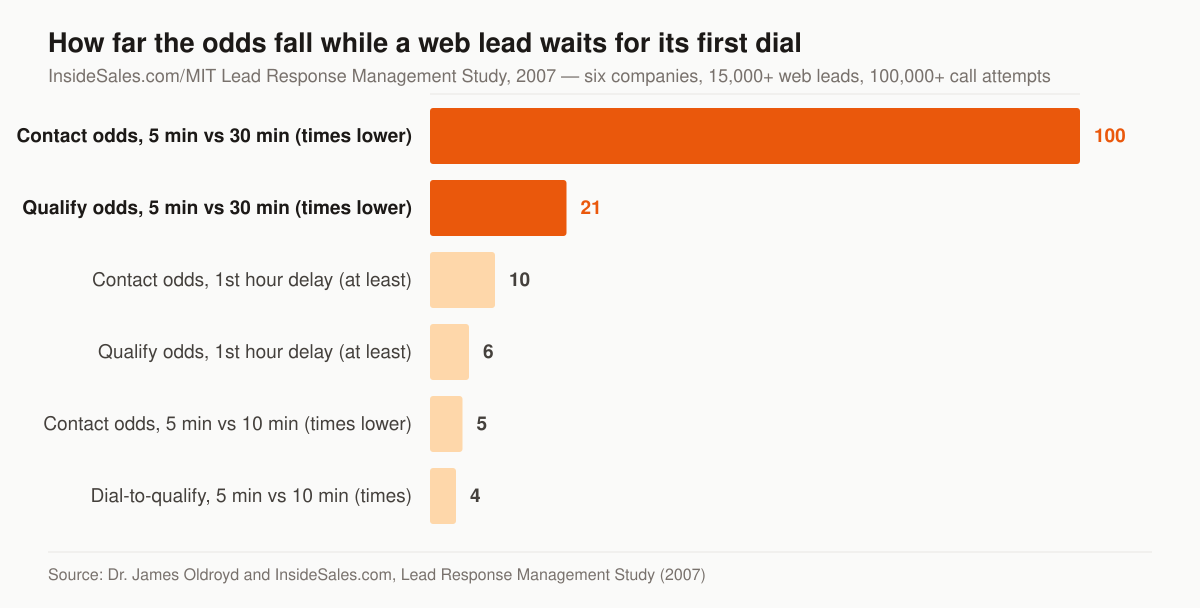
Chart: how far the odds fall as first-dial delay grows, from Dr. James Oldroyd and InsideSales.com, Lead Response Management Study (2007).
The headline numbers: the odds of contacting a lead called in 5 minutes versus 30 minutes drop 100 times, and the odds of qualifying drop 21 times. Inside that first half hour, moving from 5 minutes to 10 minutes decreases contact odds 5 times and dial-to-qualify odds 4 times. Across the first hour, the odds of calling to contact decrease by over 10 times and the odds of calling to qualify decrease by over 6 times. The study also reports a finding its authors did not expect: “After 20 hours every additional dial your salespeople make actually hurts your ability to make contact to qualify a lead.”
The same paper contains a first-hand test worth reading if you buy shared leads. The authors filled out insurance and mortgage lead forms with top providers and logged what happened. One mortgage lead produced seven calls; the first came in 30 minutes and the last came three days later. One rep filled out a health-insurance form at 8:30am and got his first call in 1 minute, his second in 3 minutes and his third an hour and 45 minutes later. Another filled one out at 10am, got a call in 2 hours, and never noticed another. That is the competitive field a shared lead lands in, described by people who measured it rather than guessed.
Set the ~$31 shared lead against a three-hour first dial and the picture resolves. The agency was buying into a race it entered late.
What we changed in the final-expense lead engine
- Moved spend from shared lists to exclusive Facebook lead flow under Meta’s Special Ad Category. Because final expense is a regulated financial product, the Special Ad Category strips the usual age and ZIP targeting levers, so we leaned on creative and offer framing — plain-language messaging aimed at the burial/final-expense mindset — to let Meta’s optimization find the right seniors instead of fighting the restriction.
- Built a single-purpose, fast landing page with clear consent capture. One offer, one action, no navigation to leak clicks, and a form that recorded explicit TCPA consent so every lead was legitimately callable.
- Installed a fixed follow-up cadence so speed-to-lead dropped from hours to minutes. New leads triggered an immediate first attempt, then a defined sequence of calls and texts across the following days rather than a single dial and a shrug.
- Reported on cost per issued policy, not cost per lead — so the whole team optimized toward money written, not vanity volume.
What the Special Ad Category takes away from a final-expense campaign
Meta’s own help center is specific about this, and it changed recently enough that older playbooks are wrong. Meta introduced a “Financial products and services” Special Ad Category, and states: “Starting January 21, 2025, using this category is required for financial products and services campaigns for advertisers based in the United States or showing ads to audiences in the United States. Ads may be rejected if an appropriate category is not chosen.” Meta’s list of what counts in the US names “Insurance products” directly, alongside banking services, prepaid cards, investment services and pension or retirement funds. The older Credit Special Ad Category was folded into it.
What that costs an advertiser is stated plainly on the same pages. For housing, employment and financial products and services ads reaching the US: “Certain audience options are limited or unavailable for these ads for advertisers based in or reaching the US and advertisers reaching Canada and certain countries in Europe: age, gender, ZIP code or postal code, exclusion targeting, lookalike audiences and saved audiences. Some interests will also be unavailable when you create your audience. Audiences based on city or pin drop locations will include an expanded radius.”
Read against a traditional final-expense buy, the restriction removes almost every dial an agent used to turn.
| Lever an FE campaign used to rely on | Status under the financial products and services category |
|---|---|
| Age band (for example 55–80) | Limited or unavailable |
| Gender | Limited or unavailable |
| ZIP or postal code | Limited or unavailable |
| Exclusion targeting (existing clients, past buyers) | Limited or unavailable |
| Lookalike audiences | Limited or unavailable |
| Saved audiences | Limited or unavailable |
| City or pin-drop radius | Allowed, but the radius is expanded |
| Creative, offer and landing-page match | Untouched — this is where the work moved |
Source: Meta Business Help Center, How to choose a Special Ad Category and About ads for financial products and services.
This is why the creative carried the campaign instead of the audience builder. When you cannot tell the platform who to find, the ad itself has to do the sorting: plain language about burial and funeral costs, a promise the page can actually keep, and a form short enough for a seventy-year-old on a phone. The mechanics of that are covered in our Facebook ads service page.
What the consent line on the form has to carry
A fast lead is worthless if you cannot legally dial it. The federal definition is short, and it is worth reading in full rather than paraphrasing. Under 47 CFR 64.1200(f)(9), “The term prior express written consent means an agreement, in writing, bearing the signature of the person called that clearly authorizes the seller to deliver or cause to be delivered to the person called advertisements or telemarketing messages using an automatic telephone dialing system or an artificial or prerecorded voice, and the telephone number to which the signatory authorizes such advertisements or telemarketing messages to be delivered.”
Two disclosures ride along with it. The rule requires that the written agreement include a clear and conspicuous disclosure informing the signer that “By executing the agreement, such person authorizes the seller to deliver or cause to be delivered to the signatory telemarketing calls using an automatic telephone dialing system or an artificial or prerecorded voice” and that “The person is not required to sign the agreement (directly or indirectly), or agree to enter into such an agreement as a condition of purchasing any property, goods, or services.” Signature includes “an electronic or digital form of signature, to the extent that such form of signature is recognized as a valid signature under applicable federal law or state contract law.”
Separately, 47 CFR 64.1200(c) bars telephone solicitations to a residential subscriber before 8 a.m. or after 9 p.m. local time at the called party’s location, and to numbers on the national do-not-call registry. The registry safe harbor is conditional: among other routine-practice standards, the caller must employ “a version of the national do-not-call registry obtained from the administrator of the registry no more than 31 days prior to the date any call is made,” with records documenting the process. Written procedures, personnel training and an internal do-not-call list are named in the same paragraph.
None of this is legal advice, and we are a marketing agency rather than a law firm — run your consent language and your dialer configuration past your own counsel. Our longer walkthrough of the buying side sits in TCPA compliance for agents buying leads.
The Texas rules that sit on top of the federal ones
Because this composite is a Texas agency, the state layer matters, and it is the part national playbooks skip. Texas runs its own no-call list under the Texas Telemarketing Disclosure and Privacy Act, Business and Commerce Code Chapter 304, administered by the Public Utility Commission. The list is a combined one: consumers who requested it, plus the Texas portion of the federal registry.
These are the state-specific mechanics an out-of-state vendor will not build into your process for you.
| Texas provision | What it says |
|---|---|
| Bus. & Com. Code §304.051(d) | The Texas no-call list is updated and published on January 1, April 1, July 1 and October 1 of each year |
| §304.052 | A telemarketer may not call a number published on the list more than 60 days after it appears on the current list |
| §304.053(a) | An entry expires on the third anniversary of first publication and may be renewed for successive three-year periods |
| §304.002(10)(C) | “Telephone call” includes a text or graphic message or image sent to a mobile number |
| §304.004(5) | A state licensee’s call is outside the chapter only if it is not made by an automated telephone dialing system, the transaction is not completed until a face-to-face sales presentation occurs with no payment required until after it, and the consumer has not asked the telemarketer to stop calling |
| §304.251(a) | The commission may impose an administrative penalty not to exceed $1,000 for each violation |
| §304.252(b) | If a court finds a wilfully or knowingly committed violation, the civil penalty may rise to not more than $3,000 for each violation |
| §304.253(b)(3) | A licensing agency may suspend or revoke a state licensee’s license for a wilfully or knowingly committed violation |
| §304.257(b) | In a private action for a wilfully or knowingly committed violation of §304.052, a court may award damages not to exceed $500 for each violation |
| §302.053(3) | Chapter 302 registration does not apply to “a person who holds a license issued under the Insurance Code if the solicited transaction is governed by that code” |
Source: Texas Business and Commerce Code Chapter 304, Telemarketing and Chapter 302, Regulation of Telephone Solicitation.
Three things follow from that table. The §304.004(5) carve-out for a licensed agent is written with three conditions joined by “and” — drop the manual-dial condition or the face-to-face condition and the carve-out is gone, which is exactly what happens when an agency bolts a power dialer onto a telesales desk. Chapter 302’s registration exemption is narrower than agents assume: §302.052 provides that an exemption “applies only to a seller” except as provided by §302.060, so a contracted call center dialing on your behalf is a separate question from your own license. And the state added §304.2581 effective September 1, 2025, making a violation of the chapter a false, misleading, or deceptive act or practice under Subchapter E, Chapter 17 — the Texas DTPA — which changes who can sue and under what theory.
The quarterly republication schedule is the operational detail worth writing into the calendar. A list that refreshes four times a year with a 60-day grace window is not something to scrub once at onboarding and forget.
How the switch to exclusive final-expense flow unfolded
The exclusivity and speed-to-lead changes moved fastest: once the prospect was talking to one agent minutes after raising a hand instead of the fourth agent three hours later, conversations got materially easier. The obstacle in the first weeks was operational, not strategic — the cadence only works if someone actually works it, so we had to make the first-touch trigger automatic and the follow-up steps unmissable rather than depending on discipline on a busy day. As the pixel accumulated conversion data over the quarter, the exclusive flow got cheaper and better-qualified on its own, which is the compounding an owned asset buys you and a shared list never can.
What the 90 days actually looked like
The sequence below is the build order we used, and the order matters more than the calendar — nothing downstream works until consent capture and routing are live.
| Weeks | What shipped | Why it came in this position |
|---|---|---|
| 1–2 | Landing page, consent language, lead routing into the dialer, first-touch trigger | Paying for leads that route into an inbox nobody watches reproduces the original problem at a higher price |
| 3–4 | Exclusive Meta lead flow launched under the financial products and services category, creative built to sort the audience the targeting no longer can | The category restriction is known in advance, so the creative brief is written around it rather than discovered after rejections |
| 5–8 | Cadence hardened: defined call and text steps across the days after inquiry, no lead exits without a logged disposition | Response-time gains evaporate if attempt two through five are optional |
| 9–12 | Reporting moved from cost per lead to cost per issued policy; spend reallocated toward the creative producing written business | Optimizing to lead volume buys you cheaper leads and no more policies |
The compounding claim on this page is narrow and worth stating plainly: what improves over the quarter is the pixel’s conversion data and the agency’s own list and landing page. Those are assets the agency keeps. A shared-lead invoice buys none of them.
The result: final-expense cost per lead and close rate
In this illustrative model, cost per lead falls from ~$31 to ~$9 and close rate rises from 1-in-11 to 1-in-6 — and the agency ends the quarter owning the pixel, list, and funnel, so the asset keeps compounding.
The market this model was built for
Two published datasets frame the opportunity, and both are worth quoting with their limits intact.
On the product side, LIMRA and the Life Insurers Council report that US final expense life insurance new annualized premium increased 16% year over year to $1.05 billion in 2024, from 2024 sales data reported by 28 life insurance companies. Those participants reported 1.06 million policies sold, up 10% year over year. Simplified-issue policies were 85% of sales, with an average face amount of $14,535; guaranteed-issue policies were the remaining 15%, averaging $9,786. Independent distribution sold 86% of the policies reported. LIMRA states the limit itself: the survey “is not a comprehensive view of the U.S. final expense market, but offers a snapshot of sales trends for participating companies.”
On the geography side, the Census Bureau’s QuickFacts for Texas put the state’s July 1, 2025 population estimate at 31,709,821, with persons 65 years and over at 14.9% and median household income (in 2024 dollars, 2020–2024) at $78,476. Households with a broadband internet subscription are 91.4%. A senior population of that size, at that connectivity rate, is why an owned digital funnel is a reasonable bet in this state rather than a coastal-market luxury.
Those figures also explain why average face amount matters to a marketing budget. A simplified-issue policy averaging $14,535 in face amount cannot absorb the acquisition cost a large-face term case can, which is why the cost-per-issued-policy metric replaced cost per lead in the reporting the moment the engine was live. If you want the wider version of that argument, the final-expense marketing program page lays out the channel mix.
What this model does not fix
Three honest limits, because a case study that only describes wins is a brochure.
It does not fix a weak presentation. Exclusive flow and a four-minute first dial put a prepared prospect on the phone; what happens next is the agent’s. If the close rate is broken for reasons unrelated to lead quality, faster leads make the problem arrive sooner, not smaller.
It does not fix understaffing. The whole design is a promise to call quickly and keep calling. An agency that cannot staff the first attempt inside minutes should fix that before buying exclusivity, because it will be paying an exclusivity premium for the same delayed contact it had before. The tradeoffs between the two lead types are laid out in exclusive versus shared final expense leads.
And it does not make aged or shared data worthless. Different economics, different job. A shared record worked hard by a persistent caller is a real strategy; it is simply not the strategy this engine runs, and mixing the two without separate reporting makes both look mediocre.
What running an engine like this costs
We publish rates rather than quoting on discovery. The combination described on this page — managed paid ads on Google and Meta, landing-page CRO, marketing automation and CRM, full-funnel reporting — is the Full-Funnel tier at $5,500 per month, with ad spend billed at cost straight to the platforms. Foundation is $2,500 per month and covers the site, local SEO and Google Business Profile, on-page SEO and monthly reporting. Growth is $3,500 per month and adds the ongoing SEO and content engine, AI-search visibility, and reputation and reviews. A one-time website build runs $2,500–$8,000. Full detail, including what sits in each tier, is on the pricing page.
Which tier fits depends on the weakest link rather than on ambition. An agency with no owned funnel at all should not start by buying managed ads into a page that cannot convert.
How to replicate this on your own book
Work the order, not the list. Fix consent capture and lead routing first, because everything downstream inherits their failures. Instrument first-dial latency and treat it as a number with an owner, not a habit. Write the Meta creative brief on the assumption that age, ZIP, exclusions and lookalikes are unavailable, so the ad is doing the sorting. Put the Texas no-call refresh on the quarterly calendar alongside the federal 31-day scrub. Then change the reporting line from cost per lead to cost per issued policy and let the spend follow it.
If you would rather have someone measure your current version of this before you rebuild anything, that is what the teardown is for.
See the lead generation service behind this, get your own free teardown, or talk it through with us first.