Final Expense Sales Tips That Actually Move Placed Policies
Final expense sales tips that hold up start with a few disciplines: call leads within five minutes, work a fixed follow-up cadence, lead with the monthly premium instead of the death benefit, and handle price and health objections with a simple, repeatable script rather than pressure.
Ask an agent for final expense sales tips and you are usually being handed the wrong problem. The pitch is rarely what broke. What breaks is the operational discipline around the pitch: when they dial, how many times they follow up, and what they say in the first ten seconds. On our own book, tightening those mechanics is what moves the close rate and drops the cost per lead. The script matters less than people think. The system around it matters more.
This is a field guide, not theory. Work through it in order.
The 9 final expense sales tips that move numbers
-
Call within five minutes. Speed-to-lead is the most under-priced edge in this business. A lead that sits for an hour is harder to reach and harder to close than one you dial while the form is still on their screen. If you can’t dial fast, route leads to someone who can.
-
Lead with the monthly premium, never the face amount. Seniors on fixed incomes buy a payment, not a death benefit. “About a dollar a day” lands; “$15,000 in coverage” triggers sticker shock. Confirm the payment fits the budget first, then attach the coverage.
-
Confirm the budget before you quote. Ask what they can comfortably set aside each month before you name a number. Now you’re building inside their reality instead of negotiating down from yours.
-
Use a script, but sound like a person. A script keeps you from rambling and protects your disclosures. Memorize the structure, not the words. Read our breakdown of the final expense telesales script and the best leads to run it against for the exact framework.
-
Assume the sale at the draft date. Don’t ask “do you want to move forward?” Ask “do you want the draft on the 1st or the 3rd?” You move the decision from whether to which.
-
Follow up 6–8 times. Follow-up dies early on a lot of desks — one dial, one voicemail, done. The persistent agent closes the leads the impatient one abandoned. Vary call times; early morning and late afternoon catch different schedules.
-
Capture the beneficiary early. When a prospect names their beneficiary out loud, the policy becomes real and personal. It’s a quiet commitment device that makes the close feel like a formality.
-
Handle objections as questions, not rejections. “Let me think about it” is rarely a no. It’s an unanswered concern about price, the carrier, or whether the coverage pays. Surface which one, then resolve it.
-
Match the carrier to the health profile. Simplified-issue underwriting varies widely by carrier. Knowing which company forgives which condition is the difference between a placed policy and a declined app. Our guide to the best final expense carriers for agents covers the underwriting niches.
What a funeral actually costs, and how to use the number
Tip 2 is right about price and silent about need. Before a senior will discuss a monthly payment at all, they have to believe the bill is real. What makes it real is a published number they can check themselves.
The National Funeral Directors Association runs a General Price List study of its member firms. Its 2023 study — republished as a median table in the 2024 NFDA Cremation & Burial Report — puts the median adult casketed funeral with viewing and ceremony followed by burial at $8,300. That figure excludes the vault, the cemetery plot, the monument or marker, and cash-advance items such as flowers and the obituary, which is worth saying out loud on a call, because those are the line items a family discovers after the funeral home quote.
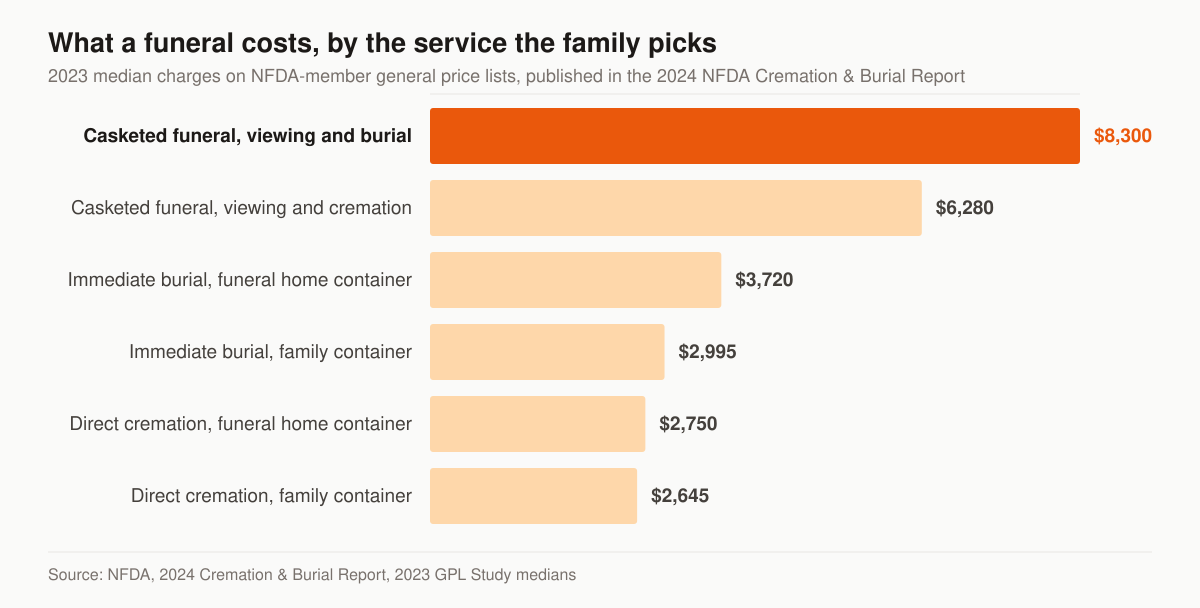
Chart: 2023 median charges on NFDA-member general price lists. Source: 2024 NFDA Cremation & Burial Report, reporting the 2023 NFDA GPL Study.
NFDA’s release on the study adds the trend line: the burial median rose 5.8% over two years, from $7,848 to $8,300, while overall inflation over the same two years ran 13.6%. That is a useful thing to know before you claim funeral costs are exploding — they rose, but slower than the rest of the basket, and a prospect who reads the news may push back if you overstate it.
The distance between what a family expects to receive and what the service costs is the entire conversation, and five published figures bracket it:
| Figure | What it is | Source |
|---|---|---|
| $8,300 | Median adult casketed funeral, viewing and burial, 2023 medians, vault and cemetery excluded | NFDA 2024 Cremation & Burial Report |
| $6,280 | The same service followed by cremation | NFDA 2024 Cremation & Burial Report |
| $2,645 | Direct cremation, container provided by the family | NFDA 2024 Cremation & Burial Report |
| $255 | Social Security lump-sum death payment | 20 CFR 404.390 |
| $1,500 | Cap on burial funds excluded from SSI resources, per person | 20 CFR 416.1231(b)(1) |
That $255 is not an estimate. 20 CFR 404.390 reads: “If a person is fully or currently insured when he or she dies, a lump-sum death payment of $255 may be paid to the widow or widower of the deceased if he or she was living in the same household with the deceased at the time of his or her death.” A prospect who believes Social Security handles the funeral is holding that $255 against the medians in the table above. You do not have to dramatize the gap; you can read them both out and let the prospect do the subtraction.
The $1,500 line is for a different prospect: the one on Supplemental Security Income who tells you they already set money aside. 20 CFR 416.1231(b)(1) excludes up to $1,500 each of funds specifically set aside for the burial expenses of the individual or spouse, and only where those funds are kept separate from other resources and clearly designated for burial. The same section reduces that exclusion by the face value of life insurance the person owns whose cash surrender value has already been excluded. That is a benefits question rather than a sales question, and it belongs with the prospect’s caseworker, not with you. Knowing the rule exists is still worth something: it stops you from talking past someone who has genuinely planned, and it keeps you from recommending a face amount that disturbs a benefit they depend on.
Qualify health before you quote a price
Tip 9 says match the carrier to the health profile. In call order, that means the health questions come before the number, because the health answers decide which kind of benefit you are quoting, not just the rate.
Final expense products sort applicants into benefit structures. The names are close to standard across the market; the terms inside them are not.
Sort the case into a structure before you quote it, because a cheap quote against the wrong structure becomes a decline or a replaced policy:
| Structure | What governs the early-death payout | When you reach for it |
|---|---|---|
| Level, or immediate benefit | Nothing — the full face amount is payable from issue | The applicant passes the health questions |
| Graded | The graded schedule printed in the policy | Conditions the carrier will take at a reduced early benefit |
| Modified | The return-of-premium formula printed in the policy | Conditions the carrier will not write on a graded basis |
| Guaranteed issue | The waiting-period provision printed in the policy | The applicant cannot answer the health questions, or has been declined already |
The waiting-period lengths, graded percentages and interest rates inside those provisions are set by carrier and by state. Read the contract you are actually appointed to sell rather than the version you memorized at a previous agency, and say the waiting period out loud on the call. Our page on marketing guaranteed issue final expense honestly covers why hiding it costs more than disclosing it.
For the knockout list, Ritter Insurance Marketing publishes a working set of conditions that can disqualify an applicant from simplified issue — AIDS, cerebral palsy, cancer, chronic obstructive pulmonary disease, dementia, diabetes, heart attack and ALS — and notes the list is “not limited to” those. Treat that as a prompt sheet for your own carrier grid rather than a rule: one carrier’s decline is another’s graded case, which is exactly why agents carry more than one contract.
Two habits follow from this. First, ask the health questions the way the application asks them, in the application’s own words, so the answer you record is the answer the underwriter will read. Second, never re-ask a knockout question hoping for a better answer. A rewritten answer is a direct route to a rescinded policy and a chargeback, and it puts your license in front of a regulator over a $40-a-month sale.
The budget question that gets a real number
“What can you afford?” gets you a shrug. Bracketing gets you a number.
Ritter Insurance Marketing publishes a version worth stealing: state amounts from highest to lowest and read the reaction, using what they call the 30-60-90 approach — “Can you easily afford $30, $60, or $90 per month?” The mechanic works because it converts an open question into a comparison, and because the prospect only has to react rather than volunteer a figure about their own finances to a stranger.
Ritter suggests a second route in the same guide: work backward. Ask whether they know how much end-of-life services cost, and if not, tell them — the NFDA medians above are the checkable version of that answer. Now the coverage amount is derived from a real service the family intends, not from a number you picked. That is also the honest version of the conversation — a family planning a direct cremation does not need a $10,000 policy, and quoting one loads a premium they will drop by month six.
Three things to keep straight while you bracket:
- Ask before you quote, always. Once you name a price, every later number reads as a discount, and discounts invite negotiation you cannot win on a fixed-rate product.
- Confirm the source of the payment. A premium that comes out of a check that arrives on the 3rd should draft on the 3rd or after. Persistency is mostly a calendar problem.
- Write the number down and repeat it at the close. “You told me $45 was comfortable. This is $43.80” ends the price conversation with the prospect’s own figure.
A simple objection-to-response table
Keep this within reach during dials. Each objection maps to one tested response.
| Objection | What it usually means | Your move |
|---|---|---|
| “I need to think about it” | An unresolved concern | “What part — the price, the company, or whether it pays out?” |
| “It’s too expensive” | Wrong face amount, not wrong product | Lower the coverage, keep the payment in budget |
| “I already have insurance” | May be a lapsing or thin policy | “Smart. Is it whole life or term, and will it cover today’s funeral costs?” |
| “Let me ask my kids” | Wants validation, fears burdening family | “This is exactly so they don’t carry the bill. Want me to add a child as point of contact?” |
| “Call me back later” | Soft brush-off | Book a specific time, not “later.” Put it on the calendar live. |
Notice the pattern: every response narrows the conversation instead of reopening it. That’s the core of final expense closing — you keep removing reasons to delay until the draft date is what is left to decide.
What the rules allow when you dial
Tip 6 tells you to vary your call times. Part of that variation has a ceiling written in federal regulation, and on a multi-state telesales desk the ceiling is easy to cross by accident. The other part of the rulebook applies no matter who you are calling, so it is worth knowing which paragraph is which.
Five requirements sit directly on the dial, each with a paragraph number and its own scope:
| Requirement | What 47 CFR 64.1200 says | Paragraph | Which calls it reaches |
|---|---|---|---|
| Calling window | No telephone solicitation to a residential subscriber “before the hour of 8 a.m. or after 9 p.m. (local time at the called party’s location)” | (c)(1) | Telephone solicitations |
| Registry freshness | The safe harbor requires “a version of the national do-not-call registry obtained from the administrator of the registry no more than 31 days prior to the date any call is made” | (c)(2)(i)(D) | Telephone solicitations |
| Written policy | A “written policy, available upon demand, for maintaining a do-not-call list” | (d)(1) | “Any call for telemarketing purposes” |
| Trained personnel | Anyone “engaged in any aspect of telemarketing must be informed and trained in the existence and use of the do-not-call list” | (d)(2) | “Any call for telemarketing purposes” |
| Internal do-not-call | Honor a request “within a reasonable time from the date such request is made. This period may not exceed ten (10) business days” | (d)(3) | “Any call for telemarketing purposes” |
That last column is the one a final expense desk gets backwards. Paragraph (c) opens on a telephone solicitation, and 47 CFR 64.1200(f)(15) defines that term to exclude a call “To any person with that person’s prior express invitation or permission” or “To any person with whom the caller has an established business relationship.” A prospect who submitted your form gave you the invitation, so the 8 a.m. clock in (c)(1) and the 31-day registry scrub in (c)(2)(i)(D) are aimed at cold solicitation rather than at the internet lead you just bought. Paragraph (d) carries no such carve-out: it opens on “any call for telemarketing purposes to a residential telephone subscriber,” which is every dial on the sheet, consented or not.
A sixth requirement is the one agents break casually. Paragraph (d)(4) requires that the caller provide “the name of the individual caller, the name of the person or entity on whose behalf the call is being made, and a telephone number or address at which the person or entity may be contacted.” Opening with a first name and a vague reference to “the coverage you requested” does not satisfy it.
The phrase to read twice in (c)(1) is local time at the called party’s location. An agent in New York working a cold list and starting the shift at 8:15 a.m. Eastern is dialing a California number at 5:15 a.m. local — well outside the window, no matter how reasonable the hour looked in the dialer. Sort your list by time zone before you sort it by lead age.
None of this replaces the consent question — it interlocks with it. Consent, or an established business relationship, takes a call out of paragraph (c) altogether, which is why the calling hours and the registry scrub bind cold solicitation while the (d) duties bind every telemarketing dial you place. Our own desk rule is to run the calling window, the identification line, the internal do-not-call list and the training as though all five applied to every call, because (d) already says four of them do and the fifth costs nothing to keep. Our TCPA compliance primer for agents buying leads covers the consent side, and insurance marketing compliance for agents covers the channels around the phone. We provide marketing services, not legal advice; the licensed agent is the responsible party on every call.
Teach the Funeral Rule and you stop sounding like a salesperson
Here is a tip that appears nowhere in the standard final expense training and changes how the second half of the call feels. Learn the FTC’s Funeral Rule and hand a piece of it to the prospect.
16 CFR 453.4 governs what a funeral provider may require a family to buy. Three provisions are worth knowing verbatim:
- It is an unfair or deceptive act or practice for a funeral provider, or a crematory, “to require that a casket be purchased for direct cremation,” and providers “must make an alternative container available for direct cremations, if they arrange direct cremations.”
- A provider may not “Condition the furnishing of any funeral good or funeral service to a person arranging a funeral upon the purchase of any other funeral good or funeral service, except as required by law or as otherwise permitted by this part.”
- The general price list must carry this disclosure: “The goods and services shown below are those we can provide to our customers. You may choose only the items you desire. If legal or other requirements mean you must buy any items you did not specifically ask for, we will explain the reason in writing on the statement we provide describing the funeral goods and services you selected.”
Two things happen when you mention this. The prospect hears something useful they did not know, delivered by someone with nothing to gain from it, which is a trust event that no rapport script manufactures. And the coverage conversation gets concrete: a family that intends a direct cremation is planning against a median of $2,645 or $2,750, so the right policy is small and cheap, and it stays in force. A family planning a viewing and burial is planning against $8,300, and the honest recommendation is larger. You are no longer arguing about a face amount; you are matching one to a service the family already chose.
Say it plainly and stay in your lane. You are not advising on funeral arrangements, and you should not name a specific funeral home. You are pointing at a federal rule and telling them the price list is theirs to compare.
Lock the beneficiary properly
Tip 7 gets the beneficiary named. Getting it right takes three more questions, and they take under a minute.
- Spelling, relationship and a reachable phone number. A misspelled surname or a dead phone number turns a two-week claim into a three-month one, and the family remembers who sold it.
- A contingent. Ask who receives the money if the primary beneficiary dies first. On a senior book, that is not hypothetical.
- How the money is meant to reach the funeral home. Some clients want a child to receive the benefit and pay the bill; some want to assign it. An assignment is a separate decision from the policy, made later with the funeral home, and it is worth flagging as separate so nobody assumes it happened automatically.
Then put a beneficiary review on your annual service call. Divorces, deaths and address changes all silently break the payout you sold, and the review call is also the natural place to ask for a referral — which is the cheapest lead you will ever get, and the subject of our page on growing a final expense insurance agency.
Where marketing decides the sale before you dial
Here’s the part agencies don’t want to hear. Your close rate is mostly set before you pick up the phone. It’s downstream of two things: lead intent and contact speed.
A prospect who filled out a clear, compliant form and expected your call answers differently than someone scraped onto a shared list. Cheap or recycled leads cap your numbers no matter how clean your script is. We’ve watched the same agent close far better on consented, well-targeted leads than on bargain-bin lists — same pitch, same voice.
Two operational rules protect this:
- Consent is non-negotiable. The TCPA still governs how you contact leads, and while the FCC’s one-to-one consent rule was vacated in January 2025, documented prior express written consent remains your shield. Buy and run leads accordingly — our TCPA compliance primer for agents buying leads walks through the standard.
- Build a cadence, not a habit. A written follow-up sequence beats memory every time. See the insurance lead follow-up cadence we run, then make it yours.
The agents who win treat the phone and the funnel as one system. Across our own live campaigns, the pattern holds: consented intent plus five-minute speed plus an eight-touch cadence beats raw talent on the phone almost every time.
The scoreboard that tells you which tip to fix
Every tip on this page is a fix for a specific leak. Without a scoreboard you cannot tell which leak you have, so you end up rewriting a script that was never the problem.
Track five ratios on a final expense desk; each one points at a different section above:
| Ratio | What it measures | Which fix it points at |
|---|---|---|
| Dials to contact | Whether you are reaching live humans at all | Speed-to-lead, time-zone sorting, lead age |
| Contact to presentation | Whether the opener survives the first ten seconds | Script structure, lead framing, caller identification |
| Presentation to application | Whether the quote landed inside the budget | Budget bracketing before the quote |
| Application to issued | Whether you underwrote the case honestly | Carrier fit and benefit-structure fit |
| Issued to still in force at month 13 | Whether the payment was ever affordable | Draft date, premium sizing, beneficiary clarity |
The last row is the one that pays you. An advance is a loan against premium the policy has not earned yet, so an early lapse takes it back — your carrier or upline contract states the schedule, and it is worth reading before you chase volume. The economics of that trade-off are laid out in final expense commission levels for agents, and the lead-side version — what a placed policy really costs you once you count the leads that never contacted — is in final expense leads: cost per lead vs true cost per sale.
Pick one ratio per month. Moving one ratio is a project; moving five is a wish.
A 30-day plan to lift your close rate
You don’t need to overhaul everything. Pick three changes and run them for a month.
- Week 1 — Speed. Set a hard rule: every new lead gets a dial within five minutes. Track your average contact time.
- Week 2 — Cadence. Build the 6–8 touch sequence in writing. Stop letting leads die after one call.
- Week 3 — Framing. Quote monthly premium first on every call. Watch your sticker-shock objections drop.
- Week 4 — Carrier fit. Pre-map three carriers to common health conditions so you place more apps without redoing them.
Measure one number through all of it: contacts-to-close. If it moves, the discipline is working.
Where to go next
Sales technique gets you part of the way. The other half is a lead flow that feeds you consented, in-market seniors at a cost that leaves room for profit. That’s the foundation under every tip on this page. See how we build it on our final expense marketing page, and if you want a second set of eyes on where your contacts are leaking, grab a free marketing audit. For more tactical reps, our deeper guide on how to sell final expense over the phone extends the telesales mechanics covered here. To zoom out from the individual sale to the whole operation, see how to grow a final expense insurance agency and the full marketing for final expense agents playbook.
If the dialing itself is the bottleneck rather than the closing, outsourced appointment setting puts qualified, consented prospects on your calendar so your phone hours are all presentation. And if you want the whole lead engine handled rather than assembled, our published retainers and what each tier includes are on one page — no discovery call required to see the number.
The agents who scale aren’t the ones with the slickest pitch. They’re the ones who dial fast, follow up longer than everyone else, and run leads that wanted to hear from them in the first place.
- Final Expense Telesales: How to Sell Final Expense by Phone, Call by Call
How to sell final expense insurance over the phone: a tested telesales process, rapport openers, a rebuttal table, draft-date timing, and the federal call rules.
- The Final Expense Telesales Script That Holds Up Call After Call
A final expense telesales script with numbered structure, two rebuttal tables, the federal disclosures the call must carry, and the leads that close.
- Guaranteed Issue Final Expense Marketing: How Agents Actually Sell It
How to run guaranteed issue final expense marketing that profits: who to target, compliant ad angles, and how to message the graded death benefit.
- Final Expense Commission Levels for Agents: What Your Contract Actually Pays
How final expense commission levels and contract levels work for agents, what the ranges mean, and how your contract changes your real cost per sale.