Who we serve
Final-Expense SEO That Ranks for the Searches That Convert
Final-expense SEO services get an agent's website ranking for the senior-market searches that actually produce policies — local 'final expense insurance near me' intent, informational questions seniors and families ask, and AI-search answers. Because no incumbent agency owns this niche term, a focused site with real proof and topical depth can rank with modest authority.
Free · 15-minute teardown · no pitch deck
- We run our own final-expense book
- No pitch deck — we screen-share real numbers
- TCPA-aware · CMS/AEP-compliant · Meta Special Ad Category
- Core Web Vitals < 2.0s LCP
Final-expense SEO is one of the most winnable corners of insurance marketing, for a simple reason: the giant lead vendors and carriers fight over broad, expensive head terms and ignore the niche, local, and question-shaped searches where seniors and their adult children actually start. That’s the gap.
This page is part of our final-expense marketing program; for the broader service mechanics see insurance SEO.
What we optimize
- Local SEO + Google Business Profile — so you appear for “final expense insurance near me” and map-pack searches.
- On-page + topical depth — answer the questions seniors and families ask, with the entity coverage Google expects.
- Technical + Core Web Vitals — a fast, crawlable, accessible site (this one loads in under two seconds for a reason).
- Schema markup — structured data that makes your local and AI-search signals machine-readable.
- AI-search visibility — citable content so you surface in ChatGPT, Perplexity, and AI Overviews. See AI search / GEO.
- E-E-A-T — named author, real credentials, real proof, because final expense is a Your-Money-Your-Life topic and Google weights trust heavily.
The keyword clusters a final-expense site can actually own
Head terms in this category are contested by carriers, national brokerages and lead vendors whose budgets an independent agent cannot match. The long tail underneath is not contested in the same way, and it separates into clusters that behave differently enough to deserve different pages.
Table: the five question shapes a final-expense site is built around, and what each one is really asking.
| Cluster | What the searcher is doing | The page that answers it |
|---|---|---|
| Local intent | Looking for a person they can call in their own town | A service page for the city or county, not a national page with a city name pasted in |
| Health-condition | Testing whether they are insurable at all with diabetes, COPD, a cardiac history | One page per condition, written around the underwriting reality rather than a promise |
| Age band | Typing their own age into the box: coverage at 72, at 80, at 85 | A page per band, since the product available changes across them |
| Cost | Pricing the thing the policy has to pay for | A funeral-cost page grounded in local price lists |
| Product definition | Working out what final expense, burial insurance and guaranteed issue even mean | Plain-language explainers that route to the money pages |
The condition and age pages carry a compliance obligation the others do not. Simplified-issue and guaranteed-issue products are not the same purchase — one asks health questions and can decline, the other cannot decline but imposes a waiting period. Content that blurs them to sound reassuring is the sort of thing a Your-Money-Your-Life reviewer is looking for. Our burial and guaranteed-issue page keeps that distinction explicit, and the condition pages should link to it rather than restate it loosely.
One more thing shapes the vocabulary: the disposition the family is actually buying for. The National Funeral Directors Association projects a 2025 cremation rate of 63.4% against a burial rate of 31.6%, and expects cremation to reach 82.3% by 2045.
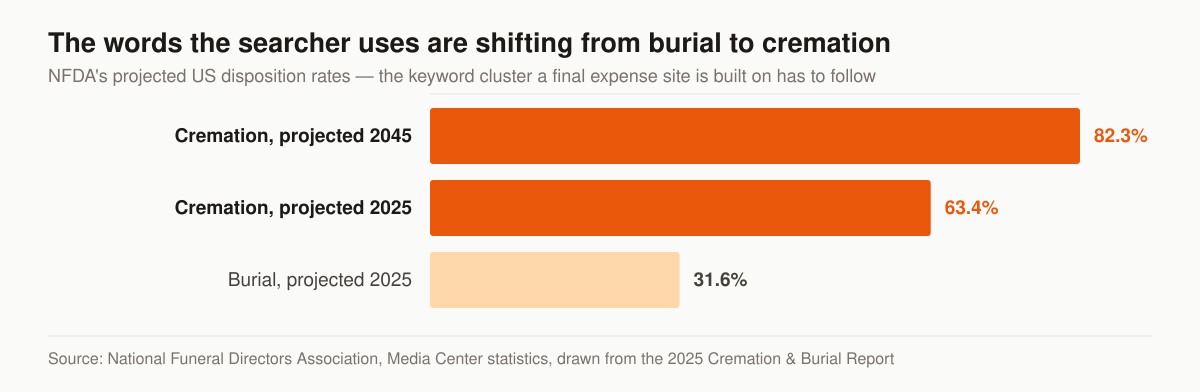
Projected US disposition rates. Source: National Funeral Directors Association, Media Center statistics, drawn from the 2025 Cremation & Burial Report.
A site whose entire vocabulary is “burial” is indexed for the smaller half of its own market. The fix is not to abandon the word — plenty of buyers still type it — but to build the cremation-cost and direct-cremation questions as their own pages instead of a paragraph inside a burial page. For a longer list of topics that fit this niche, see our content ideas for final-expense agents.
Local SEO and your Google Business Profile
Most final-expense intent is local and personal: a senior types “burial insurance [city],” or an adult child searches “final expense insurance near me” while sitting with a parent. Google answers a lot of those queries with the three-result map pack before anyone reaches the organic links, so the local layer is where the first click is won.
Winning it is concrete, unglamorous work:
- Claim and fully complete your Google Business Profile — the correct primary category, a name, address, and phone that match your website and every citation exactly, and an honest service-area definition.
- Write plain, senior-friendly service and product descriptions — describe burial and final-expense coverage the way a 72-year-old would say it, not in carrier jargon.
- Show a real office and a real person — photos of an actual location and the licensed agent, not stock imagery, because trust is the entire purchase.
- Build a steady flow of recent reviews and respond to every one — reviews are a heavy ongoing local ranking lever, and recency matters more than a one-time pile of them.
One niche detail worth designing around: because final expense is so often bought by an adult child for a parent, review language and page copy that mention helping families and handling the process gently convert the searcher who is buying on someone else’s behalf.
Whitespark’s 2026 Local Search Ranking Factors report asked 47 local search practitioners to score 187 factors. The primary Business Profile category came out at 227 and proximity of the address to the searcher at 225 — one of those you control completely, and the other you do not control at all.
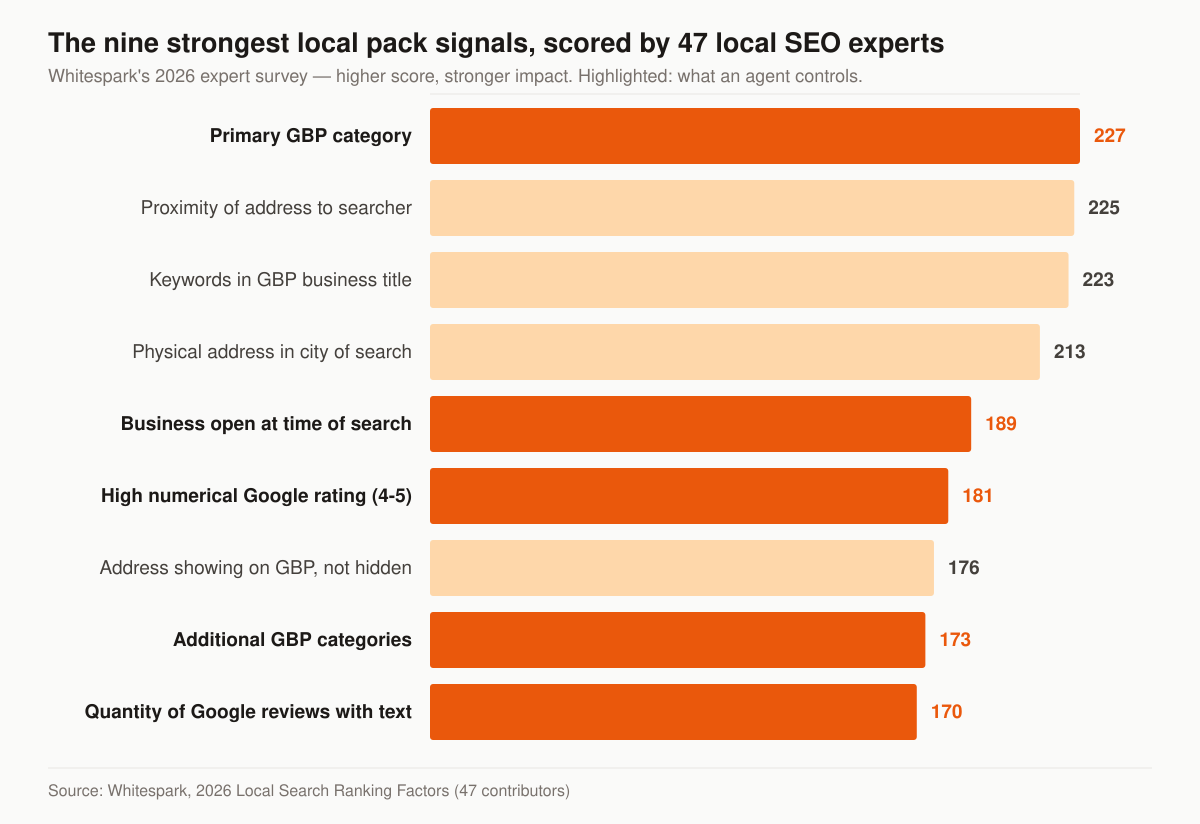
Local pack ranking factors, scored by 47 contributors. Source: Whitespark, 2026 Local Search Ranking Factors.
The organic half of local search rewards something else entirely. In the same report, “dedicated page for each service” scored 210 and geographic keyword relevance of content scored 190 — which is the survey’s way of saying that a single page listing eight products loses to eight pages that each answer one question. That is the architecture we build. See local SEO for insurance agents for the full build.
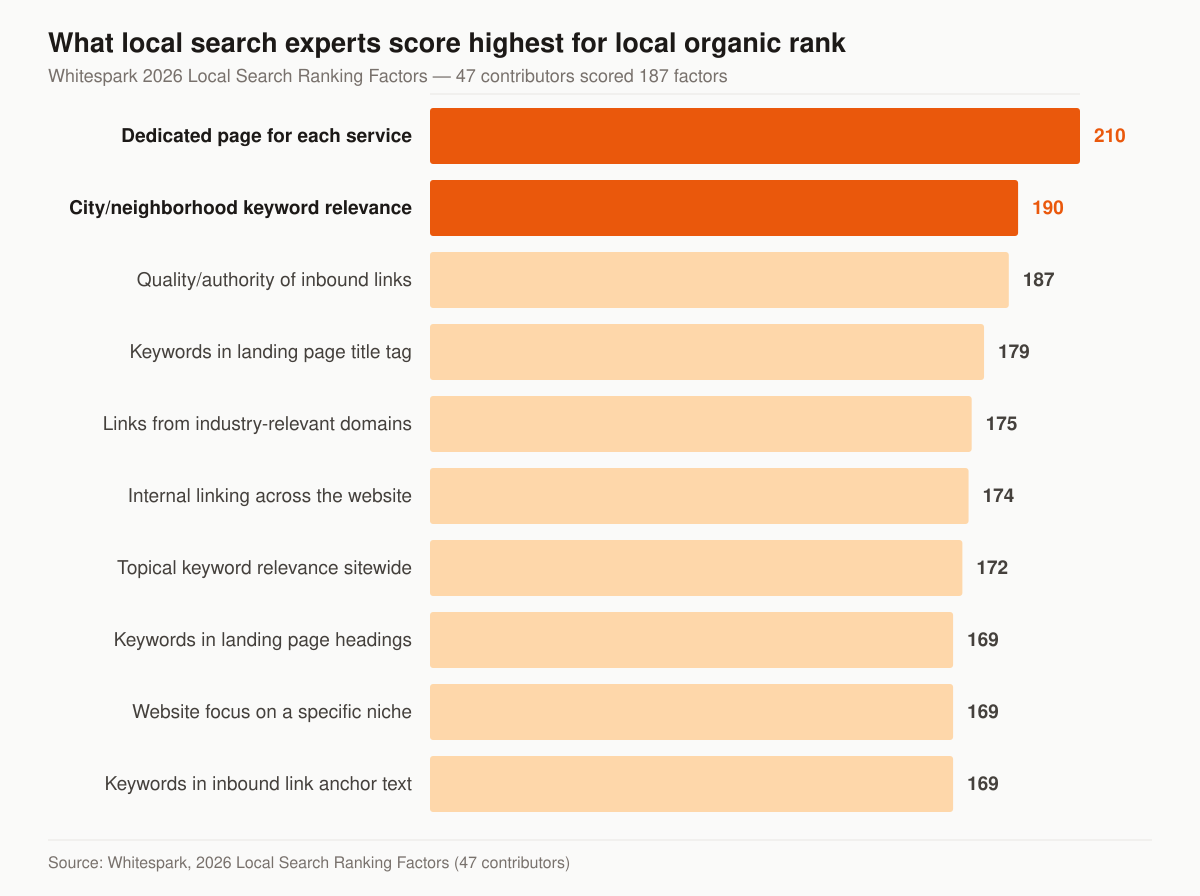
Local organic ranking factors, same survey. Source: Whitespark, 2026 Local Search Ranking Factors.
What Google’s own Business Profile rules let a final-expense agent do
Two factors in that survey sit directly on top of Google’s published guidelines, and where the two conflict the guidelines win. Keywords in the business title scored 223 with practitioners — and Google’s guidelines say that “Including unnecessary information in your business name isn’t permitted, and could result in the suspension of your Business Profile,” with “Service or product information” listed among the categories of unnecessary information. A profile named for the agency plus a product line is trading a ranking factor against the profile itself. The second is the address: the same survey scored a visible address above a hidden service-area address at 176, while Google’s instruction to a service-area business is to hide it. Neither is a loophole worth taking. If it goes, our note on a suspended Google Business Profile covers the reinstatement path.
Several other rules land specifically on how final-expense agents work.
Table: the Business Profile rules that decide how an agent’s listing gets built, in Google’s own words.
| Situation | What Google’s guidelines say | What it means for an agent |
|---|---|---|
| You work from home and drive to clients | “If you’re a service-area business, you should hide your business address from customers.” | Set a service area and clear the address rather than publishing your house |
| You want to cover a wide region | The service area “shouldn’t extend farther than about 2 hours of driving time from where your business is based” | One profile does not cover a whole state; earn the outlying cities with pages, not with a stretched radius |
| You rent a mailbox for a city address | “If your business rents a physical mailing address but doesn’t operate out of that location, also known as a virtual office, that location isn’t eligible for a Business Profile.” | The rented-address trick removes the profile rather than adding a city |
| You do have an office | “Businesses showing their address on Google should maintain permanent fixed signage of their business name at the address.” | Signage is a condition of showing the address, not a nice-to-have |
| You are a licensed agent under a brand | “Doctors, dentists, lawyers, financial planners, and insurance or real estate agents are all individual practitioners.” | You are eligible for your own profile as a practitioner |
| You are the only public-facing agent at a branded location | “Create a single Business Profile, named using the following format: [brand/company]: [practitioner name].” | Google’s own example is “Allstate: Joe Miller” |
| You sell for a corporation without your own book | “Sales associates or lead generation agents for corporations aren’t individual practitioners and aren’t eligible for a Business Profile.” | Captive downline agents may have no listing to optimize at all |
| You want a listing per product line | “A practitioner shouldn’t have multiple Business Profiles to cover all of their specializations.” | One profile, many pages on the site |
Categories follow the same logic. Google’s instruction is to “Select categories that complete the statement” — its wording is “This business IS a” rather than “this business HAS a” — to “Use as few categories as possible to describe your overall core business”, and specifically not to “use categories solely as keywords or to describe attributes of your business”. An insurance agency is an insurance agency; final expense is a product it sells, and the product belongs on the website.
The business description has its own limits that trip up copy written for conversion rather than for the profile. Google says a description must not “Focus on special promotions, prices, and offer sales,” and must not “Display links. No links of any type are allowed.” Advice you will find elsewhere — write a description that ends in a call to action and a free-quote offer — is advice to write a description that can be rejected.
The local asset worth building: what a funeral costs in your city
Ask a final-expense prospect what they are trying to solve and the answer is a number they have never actually looked up. That is a content gap with a primary source sitting underneath it, and it is the page we build first when an agent wants something a community site might link to.
The FTC’s Funeral Rule requires a general price list, and it is more prescriptive than it is usually described. Under 16 CFR 453.2(b)(4), the list must be given “for retention to persons who inquire in person,” must carry “The name, address, and telephone number of the funeral provider’s place of business,” a caption describing it as a “general price list”, and “The effective date for the price list”. It must itemize the price range for direct cremations and for immediate burials, with a separate price where the purchaser provides the container, plus embalming, transfer of remains, use of facilities and staff for viewing, hearse, and limousine, among others.
Note the scope limiter in that paragraph: the retention requirement attaches to an in-person inquiry. The provision that makes remote research possible is a different one. Under 16 CFR 453.2(b)(1), funeral providers must “Tell persons who ask by telephone about the funeral provider’s offerings or prices any accurate information from the price lists described in paragraphs (b)(2) through (4) of this section and any other readily available information that reasonably answers the question.” A phone call is a legitimate way to build a local price table. NFDA counts 15,401 funeral homes operating in the United States, so there are providers to call inside any service area an agent works.
Two rules for publishing what you collect. Quote the effective date the price list carries, because the rule requires the list to have one and prices move. And separate what you gathered locally from the national medians, which have their own source.
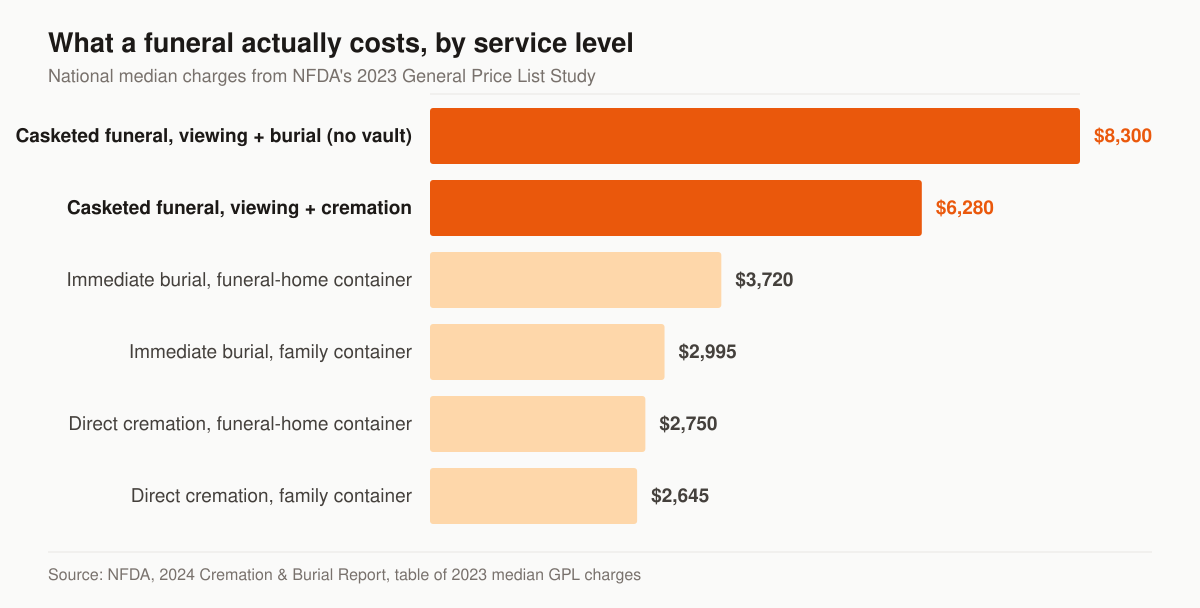
National median charges by service level. Source: NFDA, 2024 Cremation & Burial Report, table of 2023 median GPL charges.
A page like this does three jobs at once: it answers the cost cluster, it gives the coverage-amount conversation a factual footing, and it is the sort of local reference a community site will link to. Our content marketing service builds these; the final-expense website page covers where they sit in the site structure.
Reviews: the two rulebooks a senior-market agent is under
Reviews are a ranking factor and a conversion factor at once, and they are also the part of local SEO where the standard advice is most often unlawful. Two separate rulebooks apply, and neither one is Google’s ranking algorithm.
Google’s policy is the first. Merchants may not “Offer incentives – such as payment, discounts, free goods and/or services - in exchange for posting any review or revision or removal of a negative review”. They may not “Discourage or prohibit negative reviews, or selectively solicit positive reviews from customers”. And when soliciting, merchants “should not require or pressure users to leave ratings or write reviews while on the premises, nor should they request that specific content be included.” What is allowed is stated just as plainly: merchants may “Solicit or encourage the posting of content that does represent a genuine experience, without offering incentives to do so or attempting to influence the rating or the contents of the review.”
The second is federal. The FTC’s Rule on the Use of Consumer Reviews and Testimonials, 16 CFR Part 465, took effect in October 2024. Section 465.4 states that “It is an unfair or deceptive act or practice and a violation of this part for a business to provide compensation or other incentives in exchange for, or conditioned expressly or by implication on, the writing or creation of consumer reviews expressing a particular sentiment, whether positive or negative, regarding the product, service, or business that is the subject of the review.”
One definition in that rule is written for this audience by name. Section 465.1(c)(8) provides that “When the representation or sales practice targets a specific audience, such as children, the elderly, or the terminally ill, ‘ordinary consumers’ includes members of that group.” The clear-and-conspicuous standard the rule applies to disclosures is measured against the audience you are selling to — and this audience is named in the text.
Table: review practices a final-expense agency runs into, and which rulebook decides them.
| Practice | Google’s Maps content policy | 16 CFR Part 465 |
|---|---|---|
| Asking a satisfied client to review you | Allowed, if it reflects a genuine experience and you do not steer the wording | Generalized solicitations to purchasers sit outside §465.2(b) and (c) |
| A $25 gift card for a review | “Offer incentives – such as payment, discounts, free goods and/or services” is prohibited | §465.4 prohibits compensation conditioned on a particular sentiment |
| Asking only the clients you expect to be happy | “selectively solicit positive reviews from customers” is prohibited | Not addressed directly; Google’s policy is the one that applies |
| A review from your spouse or your sales assistant | Conflict-of-interest content is removed under rating manipulation | §465.5 governs insider reviews; §465.1(i) defines Immediate Relative as “a spouse, parent, child, or sibling” |
| Asking for the review at the kitchen table before you leave | Merchants “should not require or pressure users to leave ratings or write reviews while on the premises” | Not addressed directly |
| Threatening a client over a bad review | Removed as prohibited behaviour | §465.7 makes an “unfounded or groundless legal threat” to suppress a review a violation |
Two structural points from §465.5 are worth stating precisely, because the conditions matter. The insider provision does not ban an employee review outright; it turns on disclosure of the material relationship, and on whether the officer or manager encouraged the reviewer not to disclose it, failed to instruct that prospective reviewers disclose clearly and conspicuously, or knew or should have known the review appeared without disclosure and failed to take remedial steps. Ask for reviews the ordinary way, from actual clients, and none of this reaches you.
BrightLocal’s 2026 Local Consumer Review Survey of 1,002 US adults is the reason the honest route works anyway: 97% of respondents read reviews online, 94% said they are open to writing one, and 78% had been asked for a review in the previous twelve months. Willingness is not the constraint. Asking is.
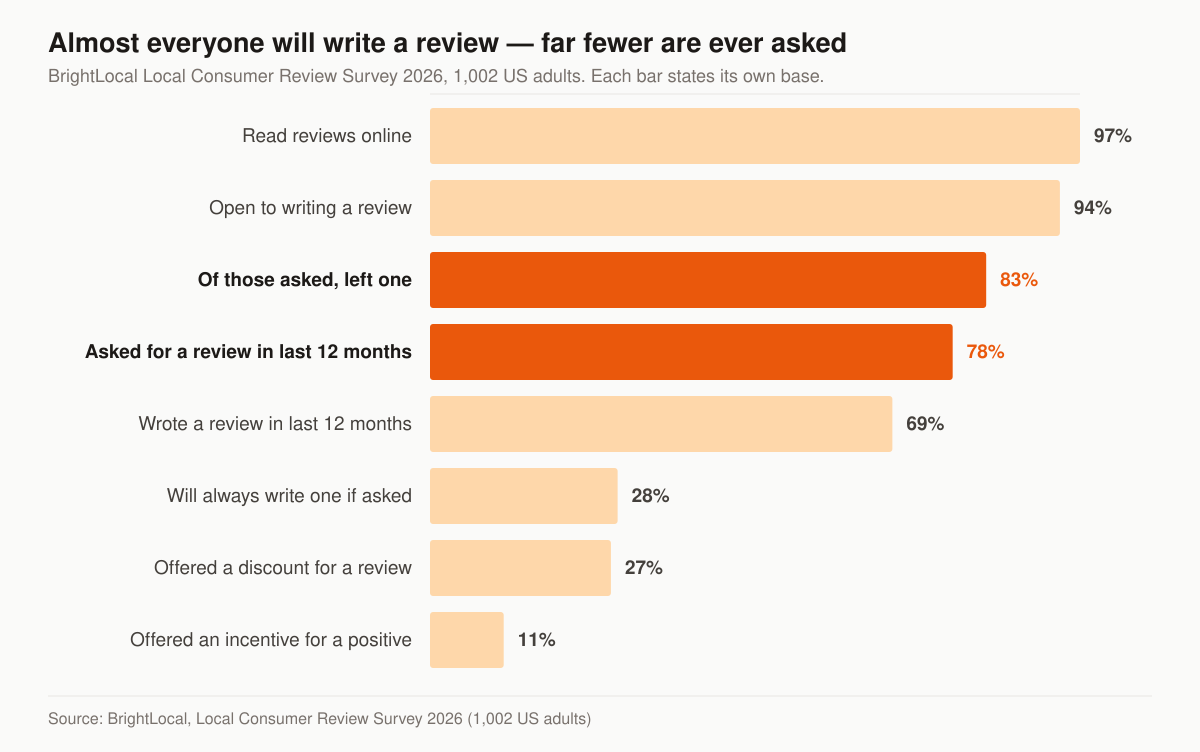
Consumer review behaviour, 2026. Source: BrightLocal, Local Consumer Review Survey 2026 (1,002 US adults).
The operational version of all of this is on our reputation management service page, and the ask-scripts are in how to get more Google reviews for insurance agents.
Schema markup: make the page machine-readable
Structured data (schema markup) hands a search engine or an AI model a machine-readable summary of your page instead of making it infer one. On a final-expense agent site the types that earn their keep are LocalBusiness or InsuranceAgency schema tied to your name, address, and phone; FAQPage schema on your question-and-answer content; and Organization or Person markup that connects your named author and credentials to the site.
Be careful about what FAQ markup now buys you. Google’s documentation changelog records the deprecation with a date: “This feature will no longer appear in Google Search starting May 7, 2026.” The following month’s entry records that the documentation itself was removed, because “The FAQ rich result feature is no longer shown in Google Search results.” Any agency still selling FAQ schema as a way to occupy more of the results page is selling a feature Google switched off. The markup is still worth keeping for machine readability — it labels which text is the question and which is the answer, which is exactly what an extractive system needs — but the deliverable is comprehension, not real estate.
Schema doesn’t rank you by itself, and it never did. It removes ambiguity from your local and AI-search signals — and in a Your-Money-Your-Life category built entirely on trust, being unambiguous is worth a great deal.
AI search and GEO for final-expense agents
More and more, the first “search” a family runs is a question typed into ChatGPT, Perplexity, or Google’s AI Overviews: “how does final expense insurance work,” “what’s the difference between burial insurance and life insurance,” “is guaranteed-issue final expense worth it.” Those engines answer by quoting sources they can parse and trust, and most of the final-expense field has written nothing they can quote.
To become the cited source, structure the page for extraction:
- Lead with a direct answer — a self-contained 40-to-60-word response at the top of each page, before the long-form.
- Use clean question-and-answer structure — headings phrased as the questions people actually ask, answered plainly underneath.
- Keep every claim factual and attributable — GEO rewards the same honesty seniors reward; hype gets filtered out.
- Stay crawlable — make sure the AI crawlers can reach the content and that your schema backs it up.
Aim it at the right person. Pew Research Center surveyed 5,123 US adults between 24 February and 2 March 2025 and found that 34% had ever used ChatGPT — 41% of adults aged 30 to 49, and 10% of adults 65 and older. In this niche that split is unusually meaningful, because the 30-to-49 group is the adult child who researches the purchase and the 65-plus group is the person whose name goes on the policy. The assistant is answering the researcher, not the buyer, and the content that gets cited should be written for someone handling a parent’s affairs.
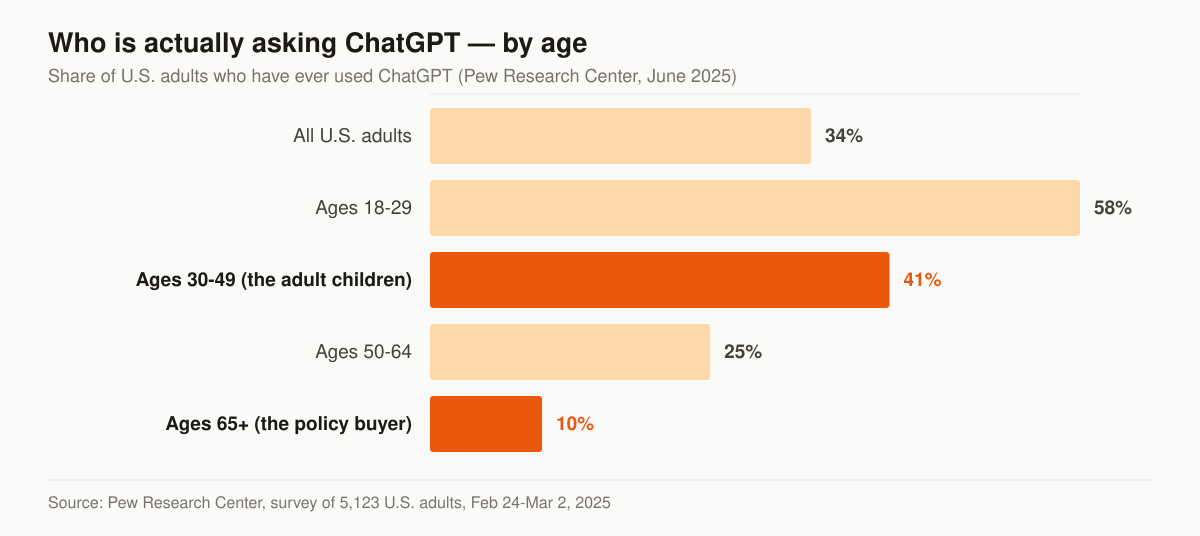
Share of US adults who have ever used ChatGPT, by age. Source: Pew Research Center, survey of 5,123 US adults, 24 February–2 March 2025.
Early movers in the final-expense niche can earn AI citations now, while national carriers keep ignoring the question-shaped long tail. That is a rare window. The mechanics are on our AI search and GEO service page, and the tactics in how to get cited by Perplexity and AI Overviews.
E-E-A-T on a Your-Money-Your-Life topic
Final expense is squarely a YMYL topic, so Google scrutinizes trust harder than it would for a hobby blog. A named author with real credentials, visible licensing, genuine proof, and clear contact and about information all feed the experience-expertise-authority-trust signals that decide whether a thin page or a credible one ranks. This is also why generic, unsigned content struggles here no matter how many keywords it stuffs.
The practical version is a short list, and most of it is administrative rather than editorial: a real author page for the licensed agent, the resident state and licence number where you are permitted to publish them, the carriers you are actually appointed with, a dated last-review stamp on anything that quotes a price or a rule, and a contact route that reaches a person. None of that needs a copywriter. It needs someone to sit down and fill it in.
Building the pages for the person who is actually reading them
Technical SEO on a senior-market site overlaps almost entirely with accessibility, which is convenient, because accessibility has a written standard and “senior-friendly” does not.
The relevant one here is WCAG 2.2 success criterion 2.5.8, Target Size (Minimum), at level AA: “The size of the target for pointer inputs is at least 24 by 24 CSS pixels,” subject to five named exceptions covering spacing, an equivalent control elsewhere on the page, inline targets inside a sentence, user-agent-controlled targets, and cases where the presentation is essential. W3C’s explanation of who it is for is direct: “Disabilities addressed by this requirement include hand tremors, spasticity, and quadriplegia.” One detail catches designers out — the requirement “is independent of the zoom factor of the page; when users zoom in, the CSS pixel size of elements does not change”. A small tap target cannot be excused by saying the visitor can pinch to enlarge it.
That is one criterion out of many, but it is the one that decides whether an unsteady hand lands on the call button. The audience is there: Pew’s National Public Opinion Reference Survey of 5,022 US adults, fielded 5 February to 18 June 2025, reports internet use at 90% among adults 65 and older, 96% at 50 to 64, and 99% below 50.
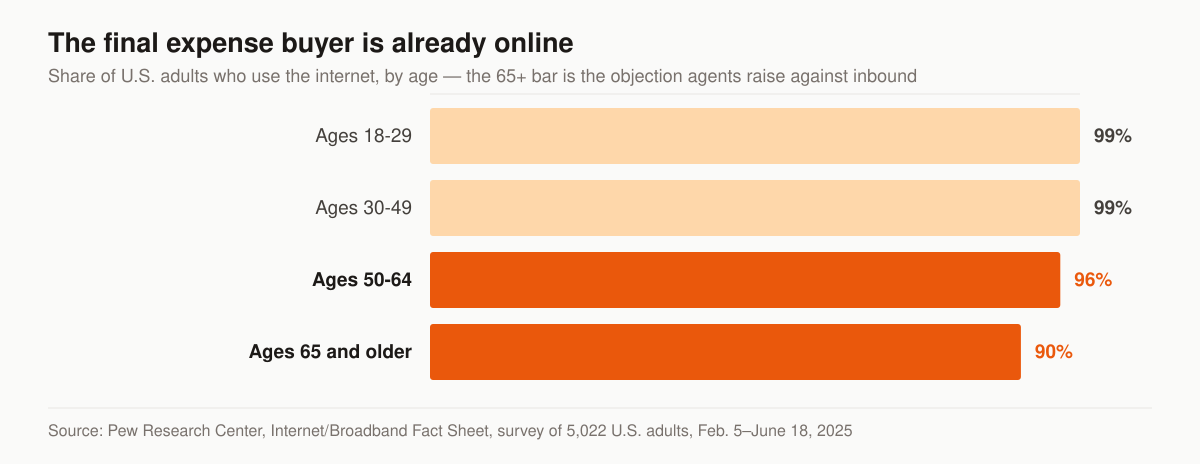
Internet use by age. Source: Pew Research Center, Internet/Broadband Fact Sheet, survey of 5,022 US adults, 5 February–18 June 2025.
The build items that follow from this are unremarkable and rarely done: tap targets that clear the 24-pixel floor with room to spare, a phone number wired as a real tel: link rather than typed text, text contrast that survives a sunlit kitchen window, and forms whose labels stay visible after the field is filled. The final-expense website page covers the rest of the build, and insurance web design covers it as a service.
The ranking targets that produce policies
| Search type | Example | Why it converts |
|---|---|---|
| Local intent | “final expense insurance [city]” | Ready-to-talk local buyer |
| Family research | “how does final expense insurance work” | Adult children buying for parents |
| Comparison | “best final expense carriers” | Late-stage, high-intent |
| Cost | “final expense insurance cost by age” | Price-shopping near decision |
How long it takes, and what it costs
The honest answer to “how long” is that the pages already ranking have been there a while. Ahrefs sampled 1.3 million US keywords and the top ten URLs for each, and found that 72.9% of top-ten pages were more than three years old, against 13.7% under a year old. That is the shape of the problem, not a reason to skip it — it is why an agent who starts now is buying a position that gets harder to take every year they wait.
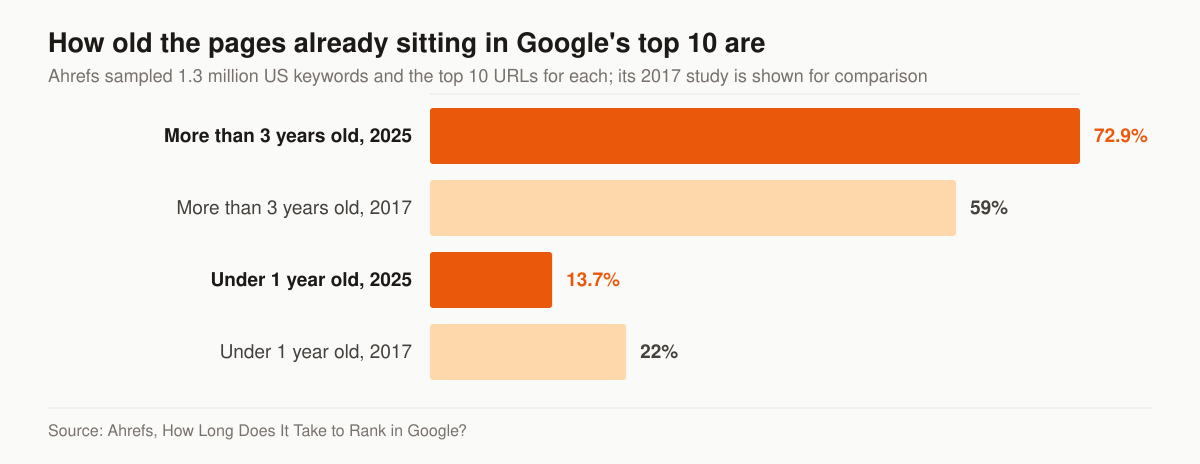
Age of pages ranking in Google’s top ten. Source: Ahrefs, How Long Does It Take to Rank in Google?
On price, the reference point we use is Ahrefs’ survey of 439 SEO providers, in which more providers reported a monthly retainer of $501 to $1,000 than any other band. Our tiers sit above that band, which is a claim we would rather make explicitly than hide: Foundation is $2,500 a month, Growth $3,500, Full-Funnel $5,500, and a one-time site build runs $2,500 to $8,000 where the current site cannot be repaired. Everything in this page — the cluster architecture, the local pages, the profile work, the review system, the accessibility floor — is delivery, not strategy documents.
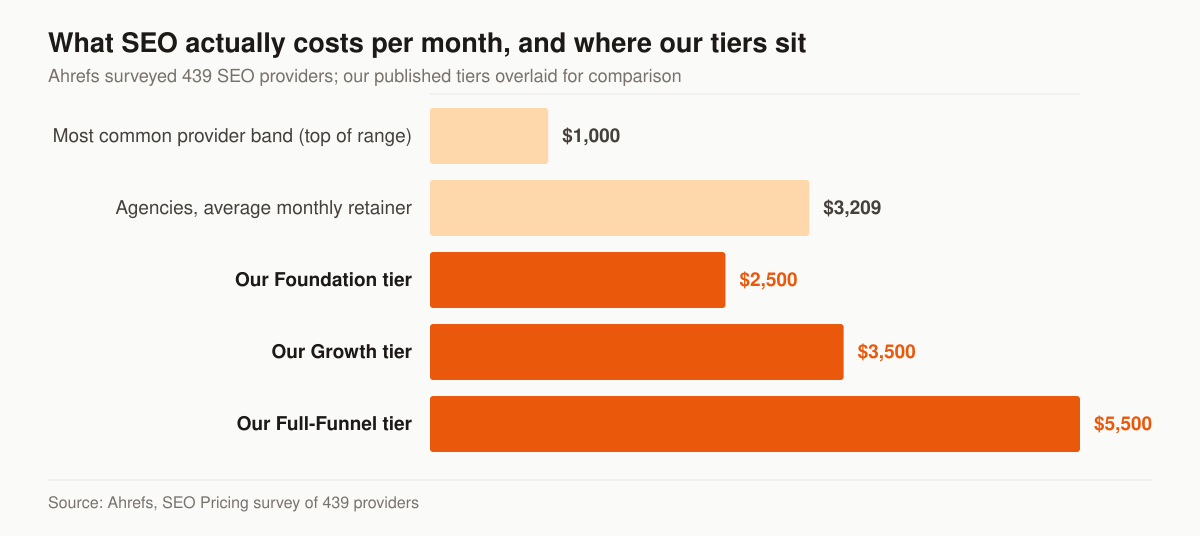
Monthly SEO retainers, with our published tiers overlaid. Source: Ahrefs, SEO Pricing survey of 439 providers.
Table: what a final-expense SEO engagement produces in each phase.
| Phase | What gets built | What you can check |
|---|---|---|
| Weeks 1–4 | Profile corrected against Google’s guidelines, technical and accessibility fixes, cluster map agreed | Search Console coverage, profile edits accepted |
| Weeks 5–12 | Local pages and condition pages published, funeral-cost research, review system running | Impressions appearing on the new pages |
| Weeks 13–24 | Depth on the clusters that show impressions, internal links tightened, AI-search formatting | Queries moving into the top twenty |
| Ongoing | New questions answered as they surface in Search Console, pages refreshed with dated updates | Position and click trend per cluster |
The full pricing table, including what sits in each tier, is on the pricing page. If you would rather see the map before the invoice, we will build it: get a free SEO and marketing audit, or contact us with the states you are licensed in.
What we report while the rankings build
SEO produces nothing visible for a while and then produces a curve, which makes it easy to fake progress on. The defence is to report on leading indicators that cannot be dressed up.
Impressions come first: a page that is being served to nobody is a page Google has not decided about yet, and Search Console says so before any ranking tool does. Then the query list — not the ones you targeted, the ones you actually appeared for, because that list tells you which cluster Google thinks the site belongs to. Then average position on the queries in positions eleven to twenty, which is where the next month’s work should go. Clicks and calls come last, and they come from the pages that already cleared the earlier gates.
Rankings on their own are the number to distrust. They move with the searcher’s location, they are personalised, and a first-place position on a phrase nobody types is worth less than page two on a phrase that ends in a phone call. We ranked our own lead pages for these before we offered the service. Want to see what’s winnable for your market? Get a free SEO and marketing audit.
The services behind it