Free Final Expense Leads for Agents: What They Really Cost
Free final expense leads for agents are rarely free. They cost you in resold contacts, recruiting strings, or unpaid hours of cold prospecting. The cheapest reliable lead is one you own: generated from your own ad account or content, where you control consent, exclusivity, and cost per sale.
Every final expense agent has searched “free final expense leads for agents” at least once, usually during a slow week. The pitch is everywhere: free leads, no cost, just sign here. This is an operator’s breakdown of what those words actually mean, where the cost hides, and how to build a lead flow you own for close to the price of “free.”
We sell final expense ourselves before we sell marketing. We run our own final-expense book on live campaigns, not theory. It is the math we run every week.
Where the cost hides in a “free” final expense lead
A lead has a cost no matter who pays the ad bill. The question is only who pays, and in what currency. When the dollar cost is zero, the cost moved somewhere you can see less clearly: your time, your contract terms, or your close rate.
Here is where “free” final expense leads usually come from, and what each one actually costs you.
| Source of “free” leads | What it really costs | Who controls the lead |
|---|---|---|
| IMO or agency lead program | Lower contract level or recruiting commitment | The agency, not you |
| Aged or resold vendor data | Resold to multiple agents; low intent | The vendor |
| “First 50 leads free” trials | A paid plan you forget to cancel | The vendor |
| Your own cold prospecting | Unpaid hours; opportunity cost | You, but slowly |
| Referral / orphan policies | Real, but limited and unpredictable | Carrier or upline |
None of these are scams by default. An IMO that bundles leads with a lower commission level is making a fair trade if the math works for you. The danger is treating “free” as actually free and skipping the math entirely.
The industry says this out loud when you read past the headline. Senior Market Advisors, an FMO writing about this exact search, puts it plainly on its own final expense leads page: “Some final expense lead vendors will actually offer free leads in order to attract and retain new agents and their business. Be sure to check the terms and requirements of receiving these free leads” (Senior Market Advisors). That is the whole game in two sentences. The leads are the acquisition cost of acquiring you.
What the FTC’s guide on the word “free” actually says
There is a federal document about this exact word, and it is worth reading before you accept an offer built on it. The Federal Trade Commission maintains 16 CFR Part 251, the “Guide Concerning Use of the Word ‘Free’ and Similar Representations,” published at 36 FR 21517 on 10 November 1971 and unchanged since.
Read the scope honestly before you use it. The guide is written for advertisers making offers to “the purchasing public,” not for a lead vendor recruiting licensed producers, and a guide is interpretive rather than a penalty rule you can point a vendor to. We are a marketing agency, not your lawyer, and this is not legal advice. What the guide is, though, is a published description of what the word is supposed to mean, which makes it a usable checklist for the offer sitting in your inbox.
Three passages carry the weight. On what “free” implies about the rest of the deal:
The public understands that, except in the case of introductory offers in connection with the sale of a product or service (See paragraph (f) of this section), an offer of “Free” merchandise or service is based upon a regular price for the merchandise or service which must be purchased by consumers in order to avail themselves of that which is represented to be “Free”.
That is 16 CFR 251.1(b)(1). Applied to a lead room, it says a free offer presumes there is a regular price for something else in the transaction. Your job is to find that something else and price it. In a lead-for-contract program, the something else is your commission level and your production. In a free trial, it is the subscription that starts when the trial ends.
On disclosure, paragraph (c) of the same section:
When making “Free” or similar offers all the terms, conditions and obligations upon which receipt and retention of the “Free” item are contingent should be set forth clearly and conspicuously at the outset of the offer so as to leave no reasonable probability that the terms of the offer might be misunderstood.
The phrase to notice is “receipt and retention.” Conditions that let you keep the free leads count as terms, not fine print. A program that ships leads and then claws them back, throttles them, or charges for them retroactively when you miss a production number has a retention condition, and the guide’s standard is that it belongs at the outset of the offer rather than in a contract addendum you sign in week three.
And on renaming, paragraph (i):
Offers of “Free” merchandise or services which may be deceptive for failure to meet the provisions of this section may not be corrected by the substitution of such similar words and terms as “gift”, “given without charge”, “bonus”, or other words or terms which tend to convey the impression to the consuming public that an article of merchandise or service is “Free”.
“Lead credit,” “lead bonus,” “lead bank” and “lead program” are the same offer wearing a different noun. Price them the same way.
One more line is worth holding in your head when a vendor’s free-lead banner has been running since you started in the business. Paragraph (h) says that so a free offer will be special and meaningful, a single kind of service should not be advertised with a free offer in a trade area for more than 6 months in any 12-month period, at least 30 days should elapse before another such offer is promoted in the same trade area, and no more than three such offers should be made in the same area in any 12-month period. A permanent free-lead offer is the opposite of what that paragraph describes.
This table turns each part of the FTC guide into a question you can ask a lead program before you sign anything.
| What the guide addresses | The question it hands you | A good answer sounds like |
|---|---|---|
| A regular price sits behind the free item (§251.1(b)(1)) | What is the priced thing in this deal, and what is its price? | A named contract level, a stated subscription, a stated production floor |
| Terms at the outset (§251.1(c)) | Where are the receipt and retention conditions written down? | A one-page term sheet you can read before contracting |
| Retention conditions (§251.1(c)) | What makes the leads stop, or become billable? | A specific number: policies per week, placed premium, persistency |
| Renaming does not cure (§251.1(i)) | Is “lead credit” the same as free, or is it a balance I can owe? | A clear statement of whether a negative lead balance can exist |
| Frequency of offers (§251.1(h)) | Has this free offer ever ended? | An actual start and end date |
The five free-lead models, and what each one asks for
“Free” is not one offer. It is five different trades, and they fail in different ways. Naming the model you are being handed is the first step to pricing it.
Model one: leads in exchange for a contract. You contract through an agency or IMO, and lead flow starts. The price is your commission level, your release terms, and often your downline. Our breakdown of how final expense commission levels are actually set shows how wide that spread runs on a single published grid, which is exactly why the trade is hard to eyeball. Before you accept it, read how to evaluate an FMO so you are comparing the whole package rather than the lead line.
Model two: free live transfers with a production requirement. This model is more explicit than the first, and the better operators publish their terms. One agency advertising “SOS is the only agency offering 100% free Final Expense Live Transfers to agents” lists on the same page what it is looking for: “Multiple non-resident life insurance licenses or are willing to get them (minimum of 5 states),” “At least 16 hours a week to write final expense live transfer business over the phone,” “Some computer knowledge to be able to write e-apps,” and “The ability to close sales.” It also states its own economics without hedging: “We don’t make money by selling final expense leads or final expense live transfers to agents. We make money when agents sell” (Saving Options & Solutions).
Read that as a price list, because it is one. Five non-resident licenses is five sets of application fees, appointments and renewals. Sixteen hours a week is two working days you are committing before you have written anything. Neither number is hidden, and neither is zero. A program that publishes its requirements this clearly is easier to evaluate than one that says only “free leads for the right agent.”
Model three: the free trial. A data vendor gives you the tool, then charges for the subscription. Salesgenie’s final expense page offers exactly this — “Sign up for your 100% free trial of Salesgenie, no credit card required” — and answers the price question in its own FAQ: “A Salesgenie subscription starts at just $149” (Salesgenie). Nothing wrong with a trial. Just note that this is 251.1(b)(1) in the wild: the regular price is published, it is simply on a different part of the page.
Model four: aged data at zero. A vendor clears old inventory into your dialler at no charge, because the alternative is deleting it. The cost is contact rate, intent and your hours. We wrote the full treatment in our guide to working aged final expense leads, and the short version is that aged data is a training asset with a known decay curve, not a pipeline.
Model five: your own unpaid time. Door knocking, calling your natural market, posting in groups, walking into funeral homes. There is no invoice, which is exactly why it gets mispriced. That one gets its own section below.
The three hidden costs agents miss
1. Exclusivity, or the lack of it
Most free and cheap leads are shared. The same name sits in five other agents’ diallers before lunch. We cover the gap in detail in our breakdown of exclusive versus shared final expense leads, but the short version: a shared lead closes far below an exclusive one, so you need more of them and more dial time to land the same sale.
There is a second-order effect worth naming. When five agents work the same record, the prospect’s first two conversations train them to say no to the third. You are not only splitting the contact rate, you are inheriting the objection handling of whoever dialled before you. That is why the resale count belongs in writing, as a number, in the same way you would ask a vendor for their published resale policy rather than for the word “exclusive.”
2. Consent you cannot see
If a lead is free, you usually cannot inspect the consent the consumer agreed to. Did they opt in to calls from you, or from “a licensed agent”? Did the form even capture consent? TCPA still governs how you contact people, even after the FCC one-to-one consent rule was vacated in January 2025. When you dial a list you did not generate, you inherit whatever consent risk came with it. Our guide to TCPA compliance when buying leads walks through what a clean consent record looks like.
3. Your hours have a price
Cold prospecting feels free because no invoice arrives. But if you spend 15 hours a week generating your own names by hand, and your time is worth even $40 an hour, that is $600 a week, or $31,200 a year, hidden inside “free.” Compare that to a campaign that produces fresh, exclusive, consented leads while you sleep.
If $40 feels arbitrary, there is a federal number you can substitute. The Bureau of Labor Statistics puts 2025 median pay for insurance sales agents at $62,280 per year, or $29.94 per hour, across 572,600 jobs. The lowest 10 percent earned less than $37,330 and the highest 10 percent earned more than $138,140. Inside insurance agencies and brokerages, the median was $61,550 (BLS, Occupational Outlook Handbook: Insurance Sales Agents).
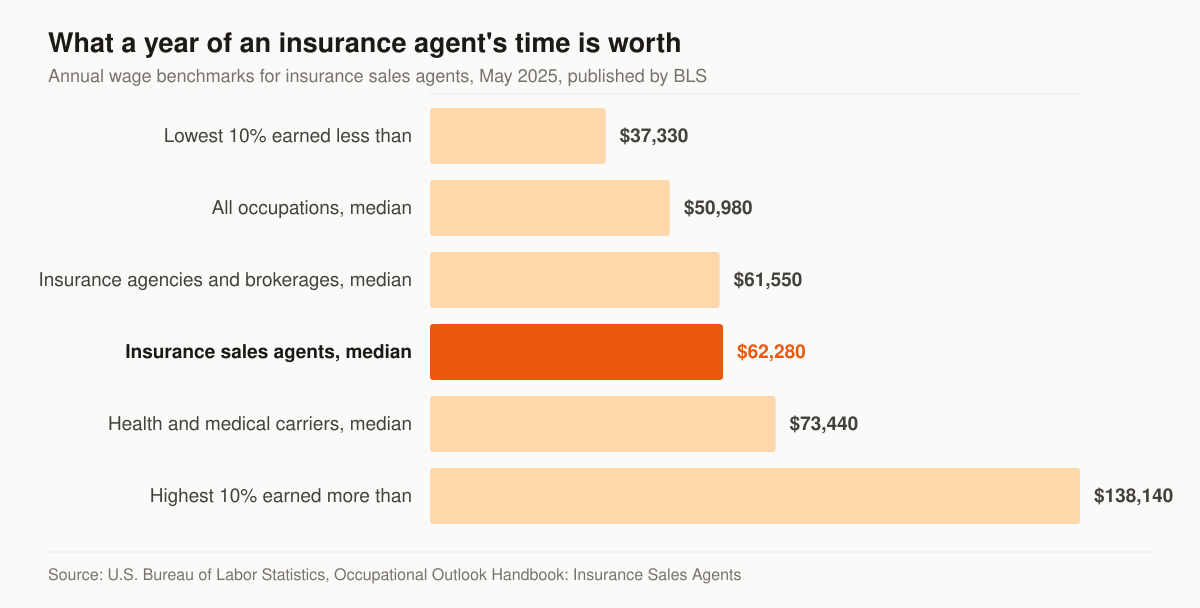
Chart: annual wage benchmarks for insurance sales agents, May 2025. Source: U.S. Bureau of Labor Statistics, Occupational Outlook Handbook: Insurance Sales Agents.
Two caveats belong with those figures, because BLS states them itself. The wage data are from nonfarm establishments and exclude self-employed workers and owners and partners in unincorporated businesses — the category an independent producer writing their own book sits in, and 12 percent of the occupation on the same source’s employment table. And commissions are included: “Tips, sales commissions, and bonuses for meeting production targets are included in wages; premium pay, such as overtime and shift differentials, is not.”
So treat $29.94 an hour as a floor for the conversation rather than your personal rate. If you are a self-employed producer, your hour is worth whatever your last four weeks of placed premium divided by hours worked says it is, and that number can land either side of the employee median. Either way, the point stands: the hour you spend hand-building a prospect list has a price, and free leads are billed in that currency.
Cost per lead is the wrong number
The metric that actually matters is cost per sale, not cost per lead. A $0 lead that closes at 2% can cost more per sale than a $25 lead that closes at 12%. We break the full calculation down in our piece on the true cost per sale of final expense leads, but the logic is simple:
- Take your cost per lead.
- Divide by your close rate on that lead type.
- That is your true cost to acquire one client.
A free lead at a 2% close rate still costs you roughly 50 dials and an hour of talk time per sale. Price that hour. The “free” lead just got expensive.
The table below is an illustration of the arithmetic, not a benchmark — the close rates are inputs you must measure in your own CRM before the columns mean anything. Run it once with your real numbers and the free column has to defend itself.
| Input | Free / aged record | Shared lead | Fresh exclusive lead |
|---|---|---|---|
| Cash cost per lead | $0 | your vendor’s price | your vendor’s price |
| Close rate | measure it separately | measure it separately | measure it separately |
| Leads worked per sale | 1 ÷ close rate | 1 ÷ close rate | 1 ÷ close rate |
| Dial time per sale | leads per sale × dials per lead × minutes | same formula | same formula |
| Hour cost applied | your rate, or the $29.94 BLS median | same | same |
| True cost per sale | cash + time | cash + time | cash + time |
The row that decides the argument is “dial time per sale,” and it is the row nobody fills in. Two lead types with identical cash cost can differ sharply in dials, and dials are hours. If you have never logged dials-per-issued-policy by lead source, that is the measurement to start this week; everything else on this page is downstream of it. A disciplined follow-up cadence is what keeps that number from drifting.
What a free list does to your call-compliance posture
This is the part of the free-lead trade that is hardest to price, because the bill arrives late or not at all. The federal telephone rules do not care what you paid for a record. They care what you can prove about it.
Start with the do-not-call registry. Under 47 CFR 64.1200(c)(2), no person or entity shall initiate a telephone solicitation to “A residential telephone subscriber who has registered his or her telephone number on the national do-not-call registry of persons who do not wish to receive telephone solicitations that is maintained by the Federal Government.” The rule then provides a safe harbor where a violation is the result of error and the caller meets five routine-business-practice standards — written procedures, trained personnel, a recorded internal list, a purchase-and-use restriction on the database, and a scrub that uses “a version of the national do-not-call registry obtained from the administrator of the registry no more than 31 days prior to the date any call is made.”
Read that 31-day clock against a free list. If the data was compiled last spring and scrubbed whenever the vendor last got round to it, the freshness of the scrub is a fact about the vendor’s process, not yours, and it is a fact you cannot document.
Then there is the internal list. Paragraph (d) of the same section requires anyone making calls for telemarketing purposes to a residential telephone subscriber to institute procedures for maintaining a list of people who ask not to be called, and sets minimum standards: a “written policy, available upon demand,” personnel who are “informed and trained in the existence and use of the do-not-call list,” requests recorded at the time they are made and honored “within a reasonable time,” a period that “may not exceed ten (10) business days from the receipt of such request,” and caller identification that gives the called party “the name of the individual caller, the name of the person or entity on whose behalf the call is being made, and a telephone number or address at which the person or entity may be contacted.”
One sentence in that paragraph is the whole argument for owning your data:
If such requests are recorded or maintained by a party other than the person or entity on whose behalf the call is made, the person or entity on whose behalf the call is made will be liable for any failures to honor the do-not-call request.
Outsourcing where the list lives does not outsource who answers for it.
Consent is the third piece, and it has a definition. In the same section, paragraph (f)(9) defines prior express written consent — for calls using an automatic telephone dialing system or an artificial or prerecorded voice — as “an agreement, in writing, bearing the signature of the person called that clearly authorizes the seller to deliver or cause to be delivered to the person called advertisements or telemarketing messages using an automatic telephone dialing system or an artificial or prerecorded voice, and the telephone number to which the signatory authorizes such advertisements or telemarketing messages to be delivered.” The written agreement must also disclose that signing authorizes those calls and that the person “is not required to sign the agreement (directly or indirectly), or agree to enter into such an agreement as a condition of purchasing any property, goods, or services.”
That is a document. Someone either has it or does not. When a lead is free, the honest question is not “is this compliant” but “who is holding the signed agreement, and will they produce it in eighteen months.”
Compiled data deserves its own warning here, because it is often what “free leads” turns out to mean. Salesgenie describes sourcing its records “from key public sources, trusted data providers, user submissions, and our own in-depth research,” and names its compliance standard as “CCPA and CAN-SPAM Compliance” (Salesgenie). Both of those are real regimes — California privacy and commercial email — and neither is the federal telephone-consent rule above. A compiled record of 72-year-old homeowners is a mailing list. Treat it as one, and read our telemarketing lead guide before you point a dialler at it.
The free sources that really are free, and what they cost in weeks
There is a version of “free leads” that works, and it is slower than anything a vendor will pitch you: channels where you spend effort instead of money and end up owning the asset. They are also the free leads that leave your name on the consent record.
This table lists the genuinely unpaid channels, what each one actually consumes, and what you are left holding when it works.
| Free channel | The unpriced input | What you own at the end | The first thing to fix |
|---|---|---|---|
| Google Business Profile and reviews | Weekly review requests, photo and hours upkeep | A local search asset tied to your name | Categories, service area, and a review-ask habit |
| Search content on your own site | Writing and publishing on a schedule | Pages that keep producing after you stop | One page per real question you get asked on calls |
| Referrals from placed clients | A scripted ask at delivery, not at close | Contacts that arrive already trusting you | Having an actual ask, in the same words, every time |
| Orphan and unassigned policies | Service work before sales work | A book you can round out | Getting the list from your upline in writing |
| Cross-sell in your existing book | Annual reviews you already owe clients | Second and third policies per household | A recall list you work by month |
The honest caveat: these are not fast, and we are not going to publish a made-up timeline for how quickly they produce. What we can say is what has to be true first. Local search does nothing until your profile is complete and reviews are arriving regularly; our guide to getting more Google reviews as an insurance agent is the starting point, and the mechanics of ranking that profile sit in our local SEO service page. Content does nothing until you publish against questions people actually type; we keep a running list of content ideas for final expense agents for exactly this, and the final expense SEO page explains how the cluster fits together.
Referrals are the outlier in this table: no spend, no wait, and no algorithm in the way. Timing is what makes or breaks them. A referral ask made at close competes with the client’s anxiety about the first draft. The same ask at delivery, with the policy in their hand and the worry gone, does not. Move the ask.
How to generate low-cost leads you actually own
Owned leads are the answer to the free-lead trap. They cost real money, but you control consent, exclusivity, and the data, so cost per sale drops and stays predictable. Here is the operator’s playbook.
- Run your own ad account. A simple Facebook lead campaign keeps the lead, the consent, and the timing in your hands. Read our walkthrough of Facebook ads for insurance agents first, because insurance falls under Meta’s Special Ad Category, which limits age and ZIP targeting.
- Send traffic to a real page, not a form-in-the-ad. A dedicated final expense landing page captures clean consent and lets you qualify before the call.
- Capture consent you can store. Your own form, your own checkbox, your own timestamp. That record is worth more than any vendor’s promise.
- Follow up in minutes, not days. Speed-to-lead is most of the game. Build a structured follow-up cadence so no lead goes cold.
- Reinvest the savings. Lower cost per sale means more budget for the next batch. That is how a book compounds instead of plateauing.
This is exactly the system behind our done-for-you final expense lead generation: exclusive, consented leads delivered into your pipeline at a predictable cost per lead, so you can do the math before you spend, not after.
If you would rather buy the build than run it, our published pricing is the comparison point for everything above. Foundation is $2,500 a month and covers the optimized site and landing pages, local SEO and Google Business Profile, on-page SEO and monthly reporting. Growth is $3,500 and adds the ongoing SEO and content engine, AI-search visibility and reputation work. Full-Funnel is $5,500 and adds managed Google and Meta ads, landing-page CRO and marketing automation. A one-time website build runs $2,500 to $8,000, and ad spend is billed at cost, straight to the platforms. Set those numbers against the hourly figure from the BLS table above and the free-lead question resolves itself quickly for anyone already working a full week.
There is a third option between “free” and “build it yourself”: paying a fair price for leads whose consent and exclusivity you can actually verify. That is a lead-purchasing transaction, so buy leads direct from getinsureleads, our sister brand built for exactly that. We don’t sell leads on this site; we build the systems that generate them.
Twelve questions to ask before you accept a free-lead offer
Print this. Ask them in order, and write the answers down, because a program that will not answer in writing has told you something.
- What is the priced thing in this deal — contract level, subscription, production floor, or downline?
- What is my commission level with the leads, and what would it be without them?
- Can I keep my contract level if I stop taking leads?
- How many agents receive each record, and is that number in the agreement?
- How old is each record when it reaches me, measured in days?
- Who generated it, and can I see the exact opt-in language the consumer saw?
- Is there a signed consent record, and will you produce a copy on request?
- When was this data last scrubbed against the national do-not-call registry?
- Who maintains the internal do-not-call list, and how do requests reach it?
- What ends the free flow — a date, a production number, or your discretion?
- Can a lead balance go negative, and can I ever owe you for leads already delivered?
- What is the release policy if I leave, and how long am I held?
Questions six through nine are the ones to press hardest, because a program can only answer them from records it actually keeps. If you would like a second reader on the answers you get back, that is part of what our free marketing audit does.
When free leads do make sense
To be fair: free or aged leads have a place. Use them as practice volume. If you are newer, a stack of aged leads is a cheap way to put reps on the phone and tighten your script without burning fresh, expensive leads. Just track close rates separately so you do not confuse practice volume with a sales plan. Our notes on working aged final expense leads cover how to do this without wasting your week.
Three rules make practice volume worth the hours. First, tag the source in your CRM before the first dial, so the close rate never gets averaged in with paid leads and flatters the wrong channel. Second, set a fixed weekly cap — a block of hours, not a lead count — so free volume fills dead time instead of displacing the calls that pay. Third, treat the objections as the deliverable. A week of aged dials that produces three new rebuttals you can use on live transfers has paid for itself, and our guide to selling final expense over the phone is where those rebuttals belong once you have them.
The failure case is the agent who works free records all month, closes two, and concludes that final expense does not work. The leads were the training set. The pipeline was never built. If that description is uncomfortably close, start with the fundamentals in how to generate final expense leads and rebuild from the source list up.
The operator’s bottom line
“Free” is a marketing word, not an accounting one. Every lead is paid for in dollars, time, contract terms, or close rate. The agents who scale are the ones who stop hunting for free and start owning their lead flow, because an owned lead has a known cost per sale and no strings.
The three numbers that settle it are all yours to measure: dials per issued policy by lead source, hours per week spent hand-building lists, and the commission points you are trading for flow. None of them appear on a vendor’s landing page. All of them are in your CRM and your contract, and they take an afternoon to pull.
If you want a second set of eyes on your current numbers, where your leads come from, what they actually close at, and what a switch to owned leads would do to your cost per sale, our free marketing audit runs the math with you, no pitch required. The higher-quality alternative to cheap or free lists is inbound flow — see insurance leads without cold calling.
- Digital Marketing for Final Expense Agents: The Channels That Actually Produce
A practitioner's guide to digital marketing for final expense agents: which channels produce leads, what each costs, and how to sequence them by budget.
- Guaranteed Issue Final Expense Marketing: How Agents Actually Sell It
How to run guaranteed issue final expense marketing that profits: who to target, compliant ad angles, and how to message the graded death benefit.
- Burial Insurance Leads: When Building Your Own Funnel Beats Buying Them
Burial insurance lead generation, build vs buy: when your own funnel beats bought leads, the CPL math involved, and how to decide on your own numbers.
- Final Expense Sales Tips That Actually Move Placed Policies
Final expense sales tips from a working book: lead routing, speed-to-dial, scripting, and the close mechanics that turn contacts into issued policies.