Final Expense Lead Generation Companies for Agents: A Buyer's Map
Final expense lead generation companies for agents fall into four categories: raw lead vendors, aggregator marketplaces, calling/appointment services, and done-for-you marketing engines. Each trades a different mix of price, exclusivity, and control. The right choice depends on your close rate and cost tolerance, not the headline price.
A list of final expense lead generation companies for agents sorted by per-lead price, low to high, points you at the wrong vendor. Price per lead tells you almost nothing until you know exclusivity, source, age, and your own close rate. This page maps the categories of companies you will run into, what each one actually sells, and where the real cost hides.
We will not name and rank specific vendors — partly because the same company can be excellent in one state and useless in another, and partly because the category you pick matters more than the logo. We run our own final-expense and senior-market lead operation, so the framing below comes from running this, not reviewing it.
The four types of final expense lead companies
Almost every provider falls into one of four buckets. Knowing the bucket tells you what you are really buying.
- Raw lead vendors — They generate direct-mail responses or digital form fills and sell you the record. You do all the calling, follow-up, and conversion. Cheapest per lead, most labor.
- Aggregator marketplaces — A platform that collects leads and resells each one to multiple agents. You compete on speed-to-dial. Volume is high; exclusivity is low.
- Calling / appointment services — They (or their dialers) qualify leads and hand you a booked phone appointment or transfer. You pay a premium for someone else’s labor.
- Done-for-you marketing engines — They build campaigns, landing pages, and follow-up under your brand, then deliver exclusive leads into your CRM. You own the assets and the data.
A fifth arrangement is worth naming because it does not look like a purchase at all: the FMO or IMO lead program, where an upline fronts leads or subsidises them against your contract level. The leads are real, but the price is embedded in a commission haircut rather than an invoice, which makes cost per issued policy nearly impossible to audit. If that is your situation, read how to choose an FMO before you evaluate the leads, because you are really evaluating a contract.
How the categories compare
The table below is the comparison most price lists hide. Numbers are directional ranges, not quotes — your market and carrier mix move them.
| Category | Typical exclusivity | Cost driver | You control the source? | Best for |
|---|---|---|---|---|
| Raw lead vendors | Shared or “semi-exclusive” | Per lead | No | High-volume callers who close fast |
| Aggregator marketplaces | Shared (3–8 agents) | Per lead + filters | No | Agents who want instant volume |
| Calling / appointment services | Varies | Per appointment / per hour | No | Agents who hate prospecting |
| Done-for-you engines | Exclusive | Ad spend + management fee | Yes | Agencies building a durable pipeline |
Notice the last two columns. The thing that separates a commodity lead from an asset is whether you control the source and own the data. Everything upstream of that — the price, the volume, the “exclusivity” label — is negotiable marketing.
What a final expense lead actually costs, by age and by source
Sticker prices in this category span two orders of magnitude. Aged Lead Store publishes its full final expense price list on its own product page, which gives this market a fixed public reference point instead of a quote by email.
This table reproduces one vendor’s published per-lead pricing by lead age, so you can see how steeply price decays as a record gets older.
| Lead age | Published price per lead | Vendor’s stated fit |
|---|---|---|
| 15–45 days | $1.50–$1.88 | Freshest aged inventory |
| 46–85 days | $0.62–$1.25 | Balance of cost and contact rate |
| 86–180 days | $0.40–$0.75 | Budget-conscious, high-volume dialers |
| 181–365 days | $0.25–$0.50 | Call centres, maximum-volume strategy |
| 365+ days | $0.15–$0.30 | Deep inventory for experienced teams |
Source: Aged Lead Store’s published final expense lead pricing.
Plotted, the decay is steep enough that a cheap file and an expensive file can describe the same person.
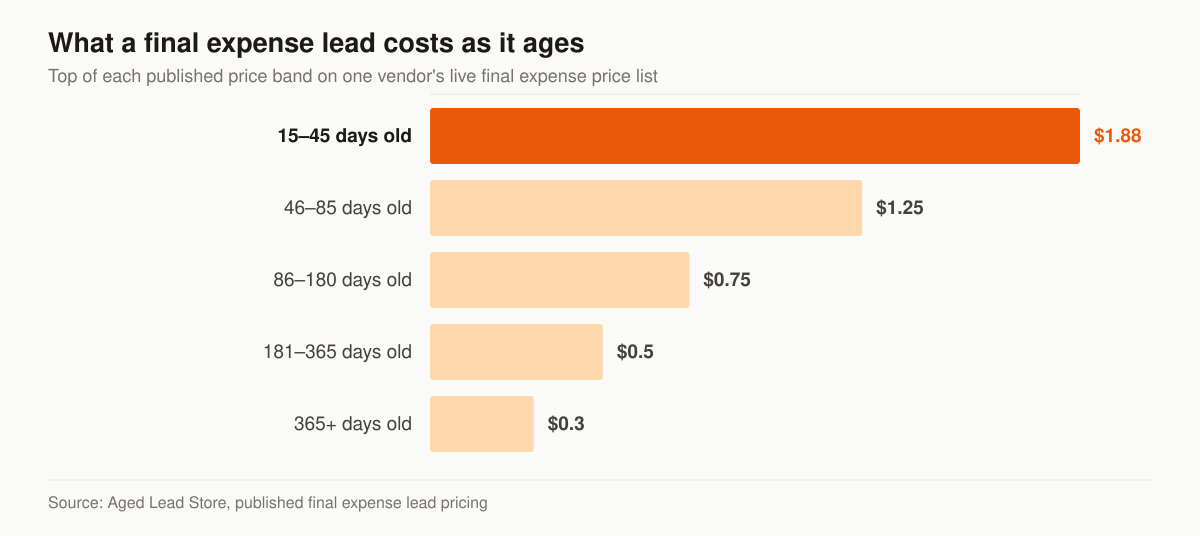
Chart: top of each published price band, from Aged Lead Store’s live final expense price list.
The same vendor puts fresh final expense leads at $20–$45 each against $0.40–$2.00 for aged records 30 to 90 days old, and states 5 to 20 callers on a fresh lead versus 1 to 2 on an aged one. Those are the vendor’s own published claims about its own market, not independent measurements, and you should treat them that way. What they are useful for is calibration: if a company quotes you $12 for a “fresh exclusive” final expense lead, you now know it sits well below the published fresh band, and the question to ask is which corner got cut — the source, the exclusivity, or the age.
Price tiers also map roughly onto sourcing method, and sourcing method is what actually predicts contact rate. Direct-mail response cards cost the most to produce and arrive with the strongest intent signal. Telemarketed leads sit in the middle and vary wildly with the call centre’s script discipline. Digital form fills, mostly Facebook lead forms, are the cheapest to generate at volume and the most sensitive to how the ad was worded. Co-registration records — where a consumer ticked a box on an unrelated page and may not remember asking about insurance — are the fourth channel, and the one we do not buy. Our breakdown of how agents source final expense leads at scale goes channel by channel.
Where the real cost hides
A $9 shared lead and a $35 exclusive lead are not the same product priced differently. They are different products. The number that reconciles them is cost per issued policy, and it depends on your close rate, not the sticker.
- A shared lead resold to six agents might contact at 25% and close at 5%. At $9 each, that is roughly $180 in leads per issued policy before you count your phone time racing five other agents.
- An exclusive lead that you reach first might contact at 45% and close at one-in-six. At $35 each, that is about $210 in leads per policy — but with far less wasted dialing and no price war on the first call.
Those two lines can flip depending on your follow-up discipline. That is the point: the company you pick matters less than the math you run on it. We walk through this calculation in depth in our breakdown of final expense lead cost versus the true cost per sale, and the exclusive-versus-shared lead trade-off is the variable we look at first.
Aged leads are a wrinkle worth a line: they are cheap because they have been worked, but a disciplined cadence can still mine them. If you go that route, treat them as a volume supplement, not a primary channel, and read up on working aged final expense leads before you buy a bulk file. The same scepticism applies at the other end of the price scale — anything advertised as free is being paid for somewhere, which is the subject of the truth about free final expense leads.
One routing note before you shortlist vendors. If your decision is simply which company do I buy from, that is a lead-purchasing transaction rather than a marketing engagement — you can buy leads direct from getinsureleads, our sister brand built for exactly that. We don’t sell leads on this site; we build the systems that generate them, which is a different purchase with a different payback curve.
The operating costs no lead company quotes you
The invoice from the vendor is not the cost of the channel. Dialing purchased leads pulls in a set of fixed costs that sit on your side of the ledger, and agents who skip them are comparing an incomplete number against their commission.
This table lists the recurring costs that attach to a bought-lead operation but never appear on a lead vendor’s price list.
| Cost line | Who pays it | What sets the number |
|---|---|---|
| National Do Not Call Registry access | You, as the seller | $85 per area code in FY 2027; first five free; $23,425 annual cap |
| Dialer or phone system | You | Seat count and whether you need call recording |
| CRM and lead routing | You | Record volume and automation depth |
| Litigator and DNC scrubbing | Usually you | Records scrubbed per month |
| Caller-ID reputation monitoring | You | Number of outbound DIDs in rotation |
| Record retention | You | Five years under the Telemarketing Sales Rule |
Those FTC registry figures are published, not estimated. The Commission set the FY 2027 fee at $85 for a single area code, an increase of $3 over FY 2026, with a maximum charge of $23,425 to any single entity for nationwide access, up from $22,626 — and the first five area codes are free (FTC, August 26, 2026). A statewide final expense operation working eight or ten area codes therefore carries a few hundred dollars of registry cost before a single dial. A multi-state telesales desk carries thousands.
Record retention is the line agents forget. The Telemarketing Sales Rule requires sellers and telemarketers to keep scripts, call records, do-not-call requests, the registry version used, and all verifiable authorizations or records of express informed consent or express agreement for five years (16 CFR 310.5). If your vendor holds the consent artefact and you hold nothing, you have a five-year obligation you cannot personally satisfy. Ask for the consent record to be delivered with the lead, not stored on the vendor’s server.
If you are choosing systems to carry all this, our comparison of the best CRM options for insurance agents covers which platforms actually store source, consent timestamp, and disposition as first-class fields rather than free-text notes.
Compliance is not optional — it is a filter
How a company sources a lead is a buying criterion, not a footnote. TCPA still governs how you can dial and text, even after the FCC one-to-one consent rule was vacated in January 2025. Meta’s Special Ad Category limits how insurance ads can be targeted, which shapes what a digital vendor can actually deliver. Ask any vendor where the consent comes from and get it in writing.
Four rules set the floor, and every one of them is published:
- The one-to-one consent rule is gone, and that changes what “consent” a vendor can sell you. On January 24, 2025 the Eleventh Circuit granted the Insurance Marketing Coalition’s petition, vacated Part III.D of the FCC’s 2023 order, and remanded — striking a restriction the court described as meaning “a consumer cannot consent to receive telemarketing or advertising robocalls from multiple entities unless the consumer consents to each caller separately” (Insurance Marketing Coalition Ltd. v. FCC, No. 24-10277). Note the scope: what was vacated governed prior express consent for telemarketing and advertising robocalls and robotexts, not every dial you make by hand. Multi-seller consent language on a lead form is lawful again at the federal level. It is still a quality signal: a form that named a long list of partners produced a prospect who does not remember you.
- Revocation must be honoured within ten business days. A called party may revoke prior express consent “by using any reasonable method to clearly express a desire not to receive further calls or text messages from the caller or sender,” and all such requests “must be honored within a reasonable time not to exceed ten business days from receipt” (47 CFR 64.1200). The same section requires a do-not-call request to be honoured for five years. If a vendor keeps selling you records for prospects who opted out of its earlier campaigns, that clock is yours to answer for.
- The registry scrub has a 31-day shelf life. To claim the Telemarketing Sales Rule’s safe harbour for an inadvertent call, a seller must show it accessed the national registry no more than 31 days before calling any consumer, alongside written procedures, training, monitoring, and a company-specific do-not-call list (FTC, Q&A for telemarketers and sellers). A file of leads bought six weeks ago is not covered by a scrub you ran when you bought it.
- An inquiry buys you three months, not forever. The established business relationship exemption runs 18 months from the consumer’s last purchase, delivery, or payment, and only three months from the date a consumer makes an inquiry or application — and it evaporates the moment the consumer asks that company not to call. Calling after a specific request can draw a penalty of up to $53,088 per violation, per the same FTC guidance.
On the digital side, Meta requires the financial products and services Special Ad Category for insurance campaigns run by advertisers based in or reaching the United States as of January 21, 2025, and says ads may be rejected if an appropriate category is not chosen. Selecting it makes age, gender, ZIP code, exclusion targeting, lookalike audiences, and saved audiences limited or unavailable (Meta Business Help Center). That constraint is why a digital vendor cannot promise you “65-plus homeowners in these three ZIPs” — if one does, either the ad is not flagged correctly or the targeting claim is fiction. The mechanics of running compliant senior-market campaigns are covered in our guide to final expense Facebook ads.
A short due-diligence list before you wire money to any of these companies:
- Source proof — direct mail, Facebook lead form, search, or co-registration? Get the channel named in writing before the first order.
- Consent trail — can they show the opt-in language and timestamp?
- Exclusivity terms in writing — “exclusive” with no resale clause is just a word.
- Replacement / credit policy — for bad numbers and wrong-state records.
- Volume consistency — can they hold your daily count without quality collapse?
- Scrub responsibility — who runs DNC and litigator scrubbing, and how recently?
- Consent delivery — does the consent artefact travel with the record, or stay on their server?
If a vendor stumbles on the consent question, that is your answer. For the full framework, our guide to TCPA compliance when buying insurance leads covers what to demand from every source. We provide marketing services, not legal advice — confirm your scripts, disclosures, and state obligations with your own compliance counsel.
Where dialing draws the most complaints
Complaint density is not evenly spread across the country, and it is a variable you can filter on when you set a vendor’s state mix. The FTC’s Do Not Call Data Book for fiscal year 2025 records 2,618,077 complaints for the year — 1,601,611 about robocalls, 802,144 about live callers, and 214,322 where the consumer did not report the call type — against 258,515,050 active registrations as of September 30, 2025 (FTC, National Do Not Call Registry Data Book 2025). That live-caller line is the one that concerns a final expense agent dialing by hand: more than 800,000 complaints a year come from calls with a human on the other end, not from a prerecorded message.
This table lists the five states with the most Do Not Call complaints per capita in the last full fiscal year on record.
| State | Do Not Call complaints per 100,000 people, FY 2025 |
|---|---|
| Arizona | 1,028 |
| Tennessee | 1,017 |
| Nevada | 960 |
| Illinois | 943 |
| Florida | 933 |
Source: FTC, National Do Not Call Registry Data Book for Fiscal Year 2025.
Two things follow for a lead buyer. First, a vendor that ships you a heavy Arizona, Tennessee, Nevada, Illinois, or Florida mix is putting you into the most complaint-prone dialing environments in the country, and your scrub discipline needs to match. Second, several of those states also carry their own telemarketing statutes on top of the federal rules, which is why state mix belongs in your vendor agreement rather than being left to the vendor’s inventory of the week.
The contract terms that decide whether the relationship works
Lead vendor agreements are short, which fools people into skimming them. Five clauses do almost all the work. What follows is what we tell agents to negotiate for, not a survey of what vendors currently offer.
This table shows what each key contract term looks like when it favours you, and the version to push back on.
| Term | The version you want | The version to negotiate out |
|---|---|---|
| Exclusivity | Named window in days, plus a no-resale clause covering aged files | “Exclusive” with no definition and no resale bar |
| Replacement | Money or account credit, with a reporting window measured in business days | Replacement leads only, with a reporting window measured in hours |
| Minimum commitment | Test order with no minimum, then a monthly floor you choose | A bulk minimum on the first order, before you have any data |
| Data ownership | You keep and can export every record and its consent artefact | Records accessible only inside the vendor’s portal |
| Pause and cancel | Pause with a few days’ notice; cancel at the end of a cycle | Auto-renewing term with a cancellation fee |
The exclusivity window matters more than the word. A lead sold to one agent today and resold as an aged record in 45 days was exclusive for 45 days, which may be fine — but you should be the one who decided that, not the one who discovered it. Ask for the resale policy as a number.
Data ownership is the clause that separates renting from building. If you cannot export the record, you cannot take your book’s marketing history with you when you leave, and your cost per issued policy for the past year lives on someone else’s server. That is the structural reason agencies eventually build their own engine, and it has nothing to do with lead quality.
How to run a vendor test that actually tells you something
A test that changes the vendor, the script and the cadence at the same time cannot tell you which one moved the result. A test that produces a decision looks like this.
- Buy one vendor at a time. Concurrent tests contaminate each other, because your energy goes to whichever file is dialing better this morning.
- Buy enough volume that a bad week cannot decide it. Contact rate stabilises before close rate does; issued-policy counts lag the purchase by weeks because underwriting takes time.
- Hold the script and the cadence fixed. Use the same opener and the same touch schedule you already run. Our insurance lead follow-up cadence and the final expense telesales script are the two documents to freeze before the test starts.
- Record five fields on every lead. Source vendor, generation date, first-dial timestamp, disposition, and outcome. Without the first-dial timestamp you cannot separate a bad lead from a slow response.
- Judge on placed business, not submitted applications. A vendor whose leads submit well and place badly is selling you prospects who cannot pass underwriting, which is a sourcing problem you will only see at the placement step.
- Write the decision rule before you start. Decide in advance what cost per issued policy makes the vendor a keeper. Deciding afterwards means deciding emotionally.
The failure mode to watch for is a vendor whose quality drifts after the test. We treat a first order as unrepresentative until a second measurement agrees with it, because the file a new account is shipped and the file a six-month account is shipped are not guaranteed to be the same inventory. Re-measure at month three against the same fields, and keep a second source running so you have a comparison when it drifts.
Which category fits where you actually are
There is no universally best category, but there is usually a right one for a given stage.
This table matches agent stage to the vendor category that tends to fit, and names the failure mode of each match.
| Where you are | Category that usually fits | The failure mode to watch |
|---|---|---|
| New agent, unproven close rate | Aged or shared leads, small volume | Burning capital on premium leads while learning the script |
| Producing solo agent | Exclusive raw leads, one or two vendors | Buying more volume than you can dial in a day |
| Agent who hates prospecting | Appointment setting or live transfers | Paying a premium for appointments that do not hold |
| Small agency with a proven script | Mixed: exclusive base plus aged supplement | No source tagging, so nobody knows which half works |
| Agency scaling past a producer’s capacity | Done-for-you owned engine | Underfunding the ramp and cancelling before it compounds |
Read the middle column as a starting point, not a verdict. The right-hand column is the part that gets skipped, and it is where the money goes.
Red flags that predict a bad vendor
Some warning signs show up before you spend anything, in the first sales conversation.
- A guaranteed close rate. Nobody can guarantee your close rate, because it is mostly your script and your speed to dial.
- No written source description. If they will not say in writing whether a record came from direct mail, a Facebook lead form, search, or co-registration, assume co-registration.
- A hard first-order minimum. A vendor confident in its inventory will let you test small.
- Consent that cannot be produced per record. “All our leads are TCPA compliant” is a slogan. The artefact is a timestamp, an IP or call recording, and the exact opt-in language.
- Pricing that sits far below the published market. A “fresh exclusive” at a fraction of the published fresh band is a claim about one of the three words that is not true.
- Volume that arrives in bursts. Ask what changed: inventory dumped in batches can be aged records repackaged, and your contact rate will show it within a week.
Why final expense keeps drawing agents in
The demand under all of this is not soft, which is worth stating plainly because it is the reason so many companies are competing to sell you a lead in the first place. LIMRA reports that whole life “remained the largest product line in the U.S. market, representing 36% of total new annualized with excess premium sold in the first quarter” of 2026 — $1.6 billion, with the number of policies sold up 6% against the first quarter of 2025. LIMRA’s own commentary attributes the growth directly: “Final expense continued to drive WL growth,” said Karen Terry, Corporate Vice President and Head of LIMRA Insurance Research, who added that distribution capacity “continues to expand in the final expense and instant/express markets” while “many traditional WL carriers are seeing flat to negative growth” (LIMRA, June 12, 2026).
Expanding distribution capacity is good news for carriers and mixed news for you. It means more agents chasing the same prospects, which is exactly the pressure that makes shared-lead economics deteriorate and makes an owned source worth more each year. It is also why the lead vendor market is crowded enough to sustain vendors at $0.15 and vendors at $45 for records that describe the same person.
When buying leads stops making sense
Buying leads is renting access to demand. It works, and it is the right call when you are starting out or scaling fast. But every shared lead you buy is one you are sharing, and every price hike is one you cannot control.
At a certain volume, building your own engine wins. When you run campaigns under your own brand — your ad account, your landing page, your CRM — the leads are exclusive by definition and the cost curve bends in your favor over time instead of against it. That is the model behind our own lead operation: owned, not rented. It is also slower and harder than swiping a card with a vendor, so it is not for everyone.
The honest split:
- Buy leads when you need volume now, you are testing a market, or you do not yet have the budget to fund an owned campaign through its ramp.
- Build an engine when your close rate is proven, your budget can absorb a 60–90 day ramp, and you are tired of competing on speed-to-dial for the same lead.
A build is a different kind of purchase, and it should be priced as one. Our managed lead generation service runs inside published tiers — $2,500 a month for Foundation, $3,500 for Growth, $5,500 for Full-Funnel, with a one-time site build at $2,500–$8,000 where the current site cannot carry the program. The full breakdown of what sits in each tier is on the pricing page. Direct mail still has a place in that mix for agents whose market responds to it; our final expense mailer templates cover the offer structures that pull.
If you want the build-it route mapped out, start with our overview of done-for-you final expense lead generation, which is the alternative to everything in the table above. And if you are not sure which side of that line you are on, we will pull the numbers for your market and tell you straight in a free marketing audit — no pitch if buying leads is genuinely the better move for you right now.
The best final expense lead generation companies for agents are the ones whose math survives contact with your actual close rate. Pick the category that fits where you are, demand the consent trail, and measure cost per issued policy — not the price on the list.
- Telemarketing Insurance Leads: What Still Works in 2026
An honest guide to telemarketing insurance leads: telemarketed vs direct-mail vs live-transfer, DNC and TCPA compliance, and whether to buy or generate them.
- Aged Final Expense Leads: What They Are and When the Math Works
Aged final expense leads cost a fraction of fresh leads. Here's what they are, the ROI math that decides if they work, and when to skip them.
- Exclusive vs Shared Final Expense Leads: A Cost-Per-Sale Breakdown
Exclusive vs shared final expense leads, compared on real cost-per-sale math, contact rates, and close rates so agents can pick what actually pays.
- How to Get Insurance Leads Without Cold Calling
How to get insurance leads without cold calling: inbound systems, paid channels, cost-per-lead math, and the follow-up cadence that makes them convert.