Group Life Insurance Marketing Strategies: Selling Employee Benefits to Employers, HR, and CFOs
The group life insurance marketing strategies that fill a B2B benefits pipeline focus on three buyers inside one company — HR who owns the program, the CFO who owns the cost, and the owner who owns the decision — and feed each different proof at different moments. It is a longer, multi-stakeholder, account-based sale.
Marketing group life the way you market personal life fails in B2B, because you are not selling to a person having a moment — you are selling to a business managing a budget, a renewal, and three people who each have a veto. The group life insurance marketing strategies that fill a real benefits pipeline are account-based, renewal-timed, and built to lower an employer’s perceived risk of switching brokers.
We run our own lead operation on the senior-market side, so this comes from live campaigns, not theory. Group benefits is a different animal — longer cycle, multiple stakeholders — but the same discipline transfers: define the buyer precisely, time the outreach, and let the numbers do the persuading.
This page is the strategy layer: who the buyers are, what earns their attention, and the sequence that reaches them at the only moment they can act. The execution layer — list building, LinkedIn mechanics, CAN-SPAM, ERISA safe harbours, measurement — lives on our group life and employee benefits marketing services page, and the two are meant to be read together.
Why group life is a different sale than individual life
In personal life, one buyer decides, often within days. In group, a single account contains three buyers with different fears:
- HR / benefits manager — owns the program and the admin headache. Wants less work and happier employees.
- CFO / controller — owns the cost. Wants predictability and no surprises at audit.
- Owner / CEO — owns the decision. Wants retention, recruiting, and a broker who won’t create problems.
Your marketing has to feed each role its own proof. HR gets “fewer enrollment headaches.” The CFO gets a total-cost breakdown. The owner gets retention data. One generic message that tries to please all three pleases none.
There is a second structural difference that shapes every asset you build. In personal life the buyer and the insured are the same person, so the message can be emotional. In group, the buyer is a company and the insureds are its staff — so the persuasive material is about the program, not the death benefit. Nobody at the employer is imagining their own funeral. They are imagining an audit, a renewal increase, an open enrollment week, and a resignation letter from someone hard to replace.
The three buyers and what each one needs
The table below sets the three seats in one account side by side, with the fear each brings to the meeting and the asset that answers it.
| Buyer | Primary fear | Content that moves them | Best channel |
|---|---|---|---|
| HR / benefits manager | More admin, unhappy employees | Enrollment-simplification guides, plan comparisons | LinkedIn, email, referral |
| CFO / controller | Cost surprises, compliance exposure | Total-cost-of-benefits models, ERISA/ACA explainers | Email, gated PDFs, direct |
| Owner / CEO | Turnover, recruiting losses | Retention framing tied to the cost of replacing a role | Referral, LinkedIn, events |
The takeaway for employee benefits marketing: build a small library of role-specific assets once, then deploy the right one at the right moment in the account — right through to the open enrollment announcement to employees that HR has to send the moment a plan is chosen.
What the employer is actually buying
The employer is not thinking about “life insurance.” They are thinking about four different line items on one bill. Getting that vocabulary right is a marketing decision rather than a technical one, because each layer has a different buyer and a different objection.
- Basic group-term life. Employer-paid, usually written as a flat amount or a multiple of salary, with no individual underwriting up to a guaranteed issue limit. This is the layer the CFO sees as a cost and HR sees as table stakes.
- Supplemental or additional life. Employee-paid coverage on top of the basic layer, elected at enrollment. It costs the employer almost nothing and is where participation — and your renewal story — actually gets made.
- Dependent life. Coverage on a spouse or child. Section 79 does not reach it: the regulation at 26 CFR 1.79-3(g)(2) states that the cost of group-term life on the life of a spouse or other family member “is not subject to the provisions of section 79 since it is not on the life of the employee.” Different tax treatment, different explainer, different enrollment email.
- AD&D. Cheap, frequently bundled, and easy for an employee to read as a substitute for life coverage when it is not one. Clearing that up is an enrollment-content job.
The Bureau of Labor Statistics measures how much of this is already in place. In March 2025, 59 percent of private industry workers had access to life insurance benefits, 58 percent participated, and take-up among those with access was 98 percent. Split by establishment size, 39 percent of workers at establishments with 1 to 49 workers had access, against 87 percent at establishments with 500 or more (BLS National Compensation Survey, table 5). Those two ends of the market need opposite campaigns — one creates a plan, one unseats a broker — and the size-band breakdown is charted in full on the niche services page.
The $50,000 line in the tax code that gives you a reason to call
We treat cold outreach to HR as a relevance problem rather than a wording problem. Our opening move with an employer that already has a plan is to raise something inside that plan they have not looked at — and Internal Revenue Code section 79 is sitting there in every payroll run in the country.
26 U.S.C. 79(a) is short enough to read in full: “There shall be included in the gross income of an employee for the taxable year an amount equal to the cost of group-term life insurance on his life provided for part or all of such year under a policy (or policies) carried directly or indirectly by his employer (or employers); but only to the extent that such cost exceeds the sum of—” (1) “the cost of $50,000 of such insurance, and” (2) “the amount (if any) paid by the employee toward the purchase of such insurance.”
The word doing the work there is “cost,” and it does not mean the employer’s premium. Section 79(c) says the cost “shall be determined on the basis of uniform premiums (computed on the basis of 5-year age brackets) prescribed by regulations by the Secretary,” and those uniform premiums are Table I at 26 CFR 1.79-3(d)(2).
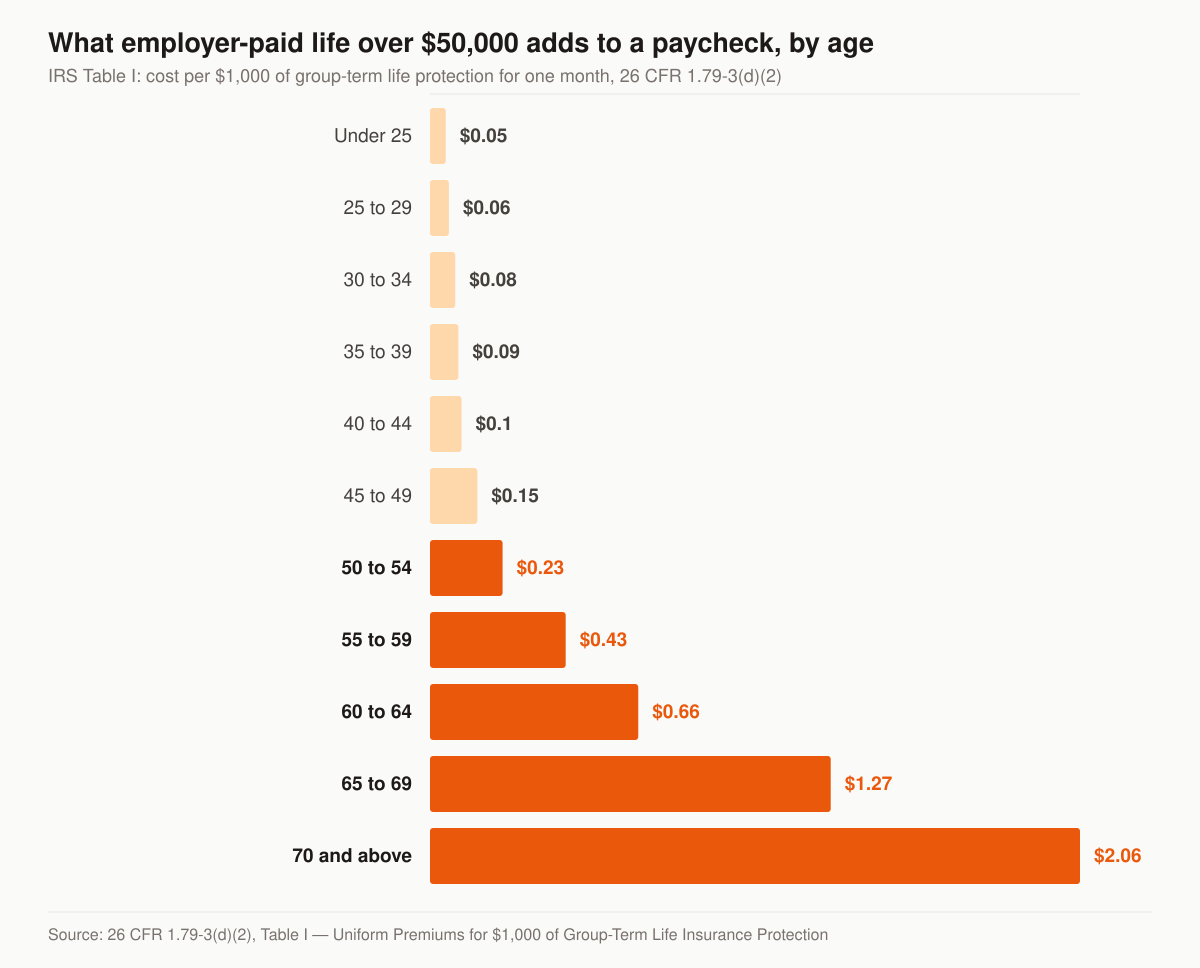
IRS Table I, cost per $1,000 of group-term life protection for one month, by five-year age bracket. Source: 26 CFR 1.79-3(d)(2).
Three things in that chart change how you write to an employer. The rate at 70 and above is $2.06 against $0.05 under 25 — the same coverage schedule lands very differently on an older workforce than a younger one. The curve steepens rather than climbs evenly, so an employer whose staff is aging into the 55-plus brackets sees imputed income appear on payroll without changing anything about the plan. And the brackets are fixed by age, so an employer with a “three times salary” schedule has a growing payroll-reporting item they did not choose.
The regulation also prescribes the arithmetic, which means you never have to guess at it in a piece of content. Under 1.79-3(b)(1), the portion taken into account is the death benefit “less $50,000 of such insurance.” Under 1.79-3(d)(1), the monthly cost “is obtained by multiplying the number of thousand dollars of such insurance computed to the nearest tenth which is provided during such period by the appropriate amount set forth in Table I.” And the bracket is set by the employee’s age “on the last day of the employee’s taxable year.” An employer can check your worked example against their own payroll register, which is exactly why it earns a reply.
IRS Publication 15-B puts the treatment plainly: the cost of coverage beyond $50,000 goes into the employee’s wages, income tax does not have to be withheld on it, and social security and Medicare taxes do apply (IRS Publication 15-B). For HR that is a payroll-coding question. For the CFO it is a reporting exposure. For you it is a plan-review conversation that does not start with a price.
The nondiscrimination test that turns an owner into a buyer
Section 79 has a second half that speaks directly to the owner — the seat that actually signs.
Under 26 U.S.C. 79(d)(1), where a plan is a discriminatory group-term life insurance plan, “subsection (a)(1) shall not apply with respect to any key employee.” Read that against subsection (a): (a)(1) is the $50,000 exclusion. Lose it and the key employee’s whole employer-paid benefit becomes includible, and 79(d)(1)(B) values it at the greater of the cost determined without regard to subsection (c) — the Table I basis — or the cost determined with it.
What makes a plan discriminatory is spelled out. Section 79(d)(2) defines the term as any plan unless it “does not discriminate in favor of key employees as to eligibility to participate” and “the type and amount of benefits available under the plan do not discriminate in favor of participants who are key employees.” Eligibility is tested against four alternatives in 79(d)(3)(A) — a plan can qualify if it “benefits 70 percent or more of all employees of the employer,” or if “at least 85 percent of all employees who are participants under the plan are not key employees,” or under a classification the Secretary finds non-discriminatory, or, where it sits inside a cafeteria plan, by meeting section 125. Section 79(d)(3)(B) allows certain people to be left out of that count, including “employees who have not completed 3 years of service” and “part-time or seasonal employees.”
The benefits test is stricter: under 79(d)(4), a plan fails “unless all benefits available to participants who are key employees are available to all other participants.” But 79(d)(5) leaves the standard design intact — a plan does not fail “merely because the amount of life insurance on behalf of the employees under the plan bears a uniform relationship to the total compensation or the basic or regular rate of compensation of such employees.” A salary-multiple schedule is fine. A flat, far larger amount for the owners than for everyone else is the shape that invites the question.
We treat that as the owner-facing asset in the library, not the HR-facing one, because it is the part of a benefits review where the person signing has personal money at stake. It also pairs naturally with the business-continuity conversation covered in key person and buy-sell insurance marketing — same seat, same meeting, second product. None of this is tax advice, and the determination belongs to the employer’s counsel and accountant; a marketing asset’s job is to raise the question with the citation attached, then get out of the way.
Target by firmographics, then by renewal date
Volume is the wrong metric here. A precise list of 200 right-fit employers beats 5,000 random ones. Filter on:
- Company size — the 10-to-250-employee band is usually the sweet spot; big enough to need real coverage, small enough that the owner is reachable.
- Industry — pick verticals where you already have proof or a referral path.
- Location — license and service footprint.
- Renewal window — the filter we weight above the other three.
Group benefits run on renewal dates. The practical outreach window is 90 to 120 days before renewal, when HR is reviewing options and the incumbent hasn’t re-locked the account. Build a calendar of prospect renewal dates and time your cadence to it. This is the B2B equivalent of T65 timing in Medicare — you market to the moment, not to the masses.
Size band does more work than producers expect, because it decides what the message has to accomplish. Against the BLS figures above, an employer under 50 workers is far more likely to have no life plan at all, so the asset is an explainer about whether to offer the benefit and what it costs. An employer over 500 almost certainly has one, so the asset is a review of a plan that already exists and a service comparison against a broker who already has the relationship. Selling “should you offer group life” to a 900-person employer reads as ignorance of their business, and it is the same email that works two size bands down.
A renewal-timed outreach system that compounds
Here is the cadence we’d run to market group life to a targeted account list:
- T-120 days: LinkedIn connection + a value asset (a one-page total-cost-of-benefits model), no pitch.
- T-90 days: email with a plan-comparison guide aimed at HR.
- T-75 days: a CFO-facing piece — compliance and cost predictability.
- T-60 days: offer a no-obligation benefits review against their current plan.
- T-45 days: referral or case-study touch — proof from a similar employer.
This works because every touch reduces perceived risk instead of adding pressure. Pair it with a website that ranks for benefits-broker terms and a landing page built to capture the “request a benefits review” intent. Our insurance SEO program and landing pages built to convert are the two assets that turn this cadence from outbound-only into a system that also pulls inbound.
The cadence only compounds if the dates are stored where the sending happens. A renewal calendar kept in someone’s head produces a Q4 scramble; the same calendar as a field on the CRM record produces a send that fires on the prospect’s schedule instead of yours. That is the job of the email and marketing automation build, and it is why the first month of a benefits engagement is spent collecting plan-year dates rather than writing copy.
For the full vertical build — positioning, creative, and the B2B funnel end to end — see our group life and employee benefits marketing services. If your accounts skew toward owner-dependent businesses, the adjacent key person and buy-sell insurance angle often opens the door faster, because the owner feels that risk personally.
Displacing the incumbent broker without a price war
At establishments with 500 or more workers, 87 percent of private industry workers had access to a life benefit in March 2025, so an account of that size is nearly always already served by somebody. That is the real competitive situation, and it is why “we’ll shop your renewal” is a weak opening line — the incumbent gets to hear the number you found and match it, and you have spent your one meeting doing free work for a competitor.
The change itself is administrative: the employer signs a broker of record letter naming the new agency, and the carrier updates the servicing agent on the case. Because the final step is a signature rather than a bid, everything that decides the outcome happens before the paperwork — which is where the marketing has to do its work, and why we aim it at whether the employer feels underserved rather than overcharged.
The table below is the displacement frame we use — what the incumbent is doing, what the employer feels, and the marketing asset that names it.
| Where the incumbent is weak | What the employer experiences | The asset that names it |
|---|---|---|
| Renewal work starts late | Too little time to shop, so they re-sign by default | A dated renewal timeline that starts at 120 days |
| Plan design never revisited | Schedules and limits set years ago, never re-tested | A plan-design review against section 79 and the guaranteed issue limit |
| Enrollment handed back to HR | HR writes the emails, participation drifts down | A written enrollment communication plan with dates |
| Voluntary lines never marketed | Employees do not know the coverage exists | Per-pay-period education built for the employee, not the plan sponsor |
| Service is reactive | Nobody calls unless something breaks | A published service calendar with named touchpoints |
Notice that none of the five rows is a price. Price is what an incumbent can fix in a phone call; a service model is what they would have to rebuild. Write the marketing to the row the employer will recognize, and the price conversation happens after you already have the meeting.
Content that converts a CFO
CFOs don’t respond to “protect your team.” They respond to numbers and downside protection. The assets that earn the meeting:
- Total-cost-of-benefits model — line-item, not a brochure.
- Compliance explainers — factual ERISA and ACA obligations; no scare tactics, no “guaranteed savings.”
- Retention math — tie benefit quality to turnover cost in dollars, using the employer’s own replacement costs rather than a borrowed statistic.
- A payroll-reporting read — what section 79 is putting into wages today at the current schedule, with the Table I bracket named.
Keep the tone numerate and plain. A factual, operator’s voice signals you understand their business — which is what lowers the perceived risk of firing the incumbent broker. The finance seat is also the one that checks your citations, so every figure in a CFO asset should link to the primary source rather than to a blog post that links to a blog post.
The messaging library: one asset per role, per stage
A benefits practice does not need forty pieces of content. It needs nine, each written to one role at one point in the cycle, and then reused across every account on the list. Build them once and the cadence above stops being a writing project.
The table below is the nine-asset library we build for a benefits producer, mapped to the role it addresses and the moment it ships.
| Stage | HR / benefits manager | CFO / controller | Owner / CEO |
|---|---|---|---|
| Before the window (T-120) | Enrollment workload explainer | Total-cost-of-benefits model | Plan-design review against section 79(d) |
| In the window (T-90 to T-60) | Plan comparison and census request | Payroll and imputed-income read | Continuity and key-person brief |
| Decision (T-45 to bind) | Dated enrollment communication plan | Renewal timeline with named service dates | One-page summary of what changes |
Three rows, three columns, nine assets. Each one is short, each one cites something checkable, and each one exists so that the next touch in the cadence has something to carry. Producing them is the ongoing job inside insurance content marketing, and the same nine pieces feed the site pages that make the outbound credible in the first place.
Where employer buyers look before they answer your email
An HR director who gets a cold LinkedIn message from a benefits producer does one thing before replying: they search the name. What they find decides whether the reply happens. This is why the inbound and outbound halves of a benefits program are not separate budgets — the site is the reference check on the outreach.
Two surfaces matter, and they now work differently. Traditional search still rewards a page that answers a specific employer question well, which is what an insurance SEO program is for. The newer surface is the answer engine: an HR lead asking an assistant how imputed income on group life works, or what a broker of record letter does, gets a synthesized answer that may name firms. Being the source that answer is built from requires content structured to be quoted — a direct answer near the top, primary citations, and definitions written as definitions. That is the job of our AI search and GEO service, and a citation-backed benefits page has an advantage on that surface that a page of generic advice does not.
The practical consequence for a producer is small and cheap: every claim in the nine-asset library should be traceable to a public source, and every asset should exist as a page on your own domain, not only as a PDF attached to an email. A PDF persuades one prospect. The same words on an indexed page persuade that prospect and get found by the next one.
The compliance guardrails on benefits marketing
Benefits marketing carries rules that consumer life marketing does not, and two of them shape the assets you just built.
Business-to-business email is fully in scope for CAN-SPAM. The FTC’s compliance guide states it plainly — “The law makes no exception for business-to-business email” — and its requirements read as a checklist you build into the template once rather than clean up later: “Don’t use false or misleading header information.” “Don’t use deceptive subject lines.” “Identify the message as an ad.” “Tell recipients where you’re located.” “Tell recipients how to opt out of receiving future marketing email from you.” On timing, the guide is specific: “Any opt-out mechanism you offer must be able to process opt-out requests for at least 30 days after you send your message. You must honor a recipient’s opt-out request within 10 business days.” And it closes the outsourcing loophole with “Monitor what others are doing on your behalf.”
The second guardrail lands on the enrollment collateral rather than on the email. Voluntary and worksite lines can sit outside ERISA under the safe harbor at 29 CFR 2510.3-1(j), and its third condition is the one a marketer can break with a sentence: the sole functions of the employer with respect to the program must be, “without endorsing the program, to permit the insurer to publicize the program to employees or members, to collect premiums through payroll deductions or dues checkoffs and to remit them to the insurer.” Publicizing and endorsing are different acts, and the line between them runs through whose voice the flyer is written in. The determination is fact-specific and belongs to the plan sponsor’s counsel; what a marketing partner owes is enrollment assets drafted in the insurer’s voice by default. Both rules are unpacked at greater length on our group life and employee benefits marketing services page.
The broader advertising rules a licensed producer works under — carrier approval, state advertising regulations, what can be claimed about a product — are covered in insurance marketing compliance for agents. We provide the marketing systems; the licensed producer and the plan sponsor remain the responsible parties for representations about a specific plan.
What running this costs
A benefits marketing program is a retainer question, not a project question, because the renewal calendar never stops. We publish the rates rather than making a producer sit through a discovery call to learn the band.
The table below shows the published monthly tiers and the kind of benefits practice each one fits.
| Tier | Monthly | What it runs | The practice it fits |
|---|---|---|---|
| Foundation | $2,500 | Optimized site and landing pages, local SEO with Google Business Profile, on-page SEO, monthly reporting | A producer whose site does not survive a CFO’s search before the meeting |
| Growth | $3,500 | Everything in Foundation, plus the ongoing SEO and content engine, AI-search visibility, reputation and reviews | A benefits practice that needs the nine-asset library and answer-engine presence running together |
| Full-Funnel | $5,500 | Everything in Growth, plus managed paid ads on Google and Meta, landing-page CRO, marketing automation and CRM, full-funnel reporting | An agency running paid reach and renewal-timed automation across a named account list |
| One-time build | $2,500–$8,000 | A credible B2B site, built once | A producer whose site is the reason employer meetings stall |
Growth is the usual starting point for a benefits practice, because the employer buyer researches before responding and content is what earns the meeting. Media sits in Full-Funnel and the spend is billed at cost, straight to the platforms. The tier detail is on the pricing page, and how to size the number against a case this large is worked through in the insurance agency marketing budget guide.
Build your pipeline or buy your way in
You can generate group benefits opportunities yourself — content, LinkedIn, referrals, renewal-timed outreach — which builds a durable asset you own and that compounds quarter over quarter. That’s what the system above does. It’s slower to start and far cheaper at scale.
Buying leads or appointments is the other lever: it puts you in front of employers while your owned pipeline is still small. We build the generation systems here on this site; we do not sell leads. If you want to buy benefits leads or appointments direct, that’s a separate product through our sister brand — buy leads direct from getinsureleads. If the constraint is dial capacity rather than list quality, appointment setting sits between the two.
Doing both is a common pattern: buy to bridge the gap now, build to remove the dependency later.
Five ways a benefits pipeline stalls
Every one of these is a fixable process failure rather than a creative one.
- No renewal dates on the records. Without a plan-year field, the cadence has no send date and collapses into a newsletter.
- One message for every size band. The same email that opens a 30-life account reads as unserious to a 600-life one.
- Assets that live only in email. A PDF nobody can find in search does no work after the first send.
- Contact with HR only. HR can advance you and cannot sign; the account stalls at the seat that has no budget authority.
- Follow-up measured in leads. A three-month, three-seat sale judged on cost per lead gets killed in month two. Judge it on meetings with the right title, then on proposals issued — a discipline covered in the insurance lead follow-up cadence.
Next step
If you’re serious about a B2B benefits pipeline, start by auditing what you already have — site, list quality, and renewal-date coverage. Grab a free marketing audit and we’ll map your account list against renewal windows and show you where the next ten meetings come from. Prefer to talk it through first? Get in touch and we’ll look at your renewal calendar together. Want to see how the proof side works first? The whole network is built by people who actually generate insurance leads — start at the final-expense lead operation that funds the playbook or browse the full menu of insurance marketing services. Within business life, the highest-intent wedge is covered in key person and buy-sell insurance marketing.
- Key Person Insurance Marketing Ideas That Actually Reach Business Owners
Key person insurance marketing ideas for agents who sell to business owners: targeting, offers, buy-sell agreement marketing, and a lead system that runs.
- AI Search for Annuity Agents: The GEO Playbook to Get Cited, Not Skipped
AI search for annuity agents: a GEO playbook for getting cited by ChatGPT, Perplexity, and Google AI Overviews, with structure, schema, and proof tactics.
- How to Generate IUL Leads With Marketing
How to generate IUL leads with your own marketing versus buying them. Published lead prices, the consent rules on a bought lead, and the channel plan.
- How to Get Annuity Clients With Marketing (Without Buying a Single Lead)
How to get annuity clients without buying leads: a numerate, repeatable system for annuity client acquisition you can run week after week.