Who we serve
Key Person Insurance Marketing for Agents
Key person insurance marketing for agents reaches business owners and CFOs with a specific, fundable worry, what happens to the company if a founder, top producer, or co-owner dies, and turns it into a booked meeting. It is B2B: the channels are LinkedIn, targeted search, referral partners, and direct outreach.
Free · 15-minute teardown · no pitch deck
- We run our own final-expense book
- No pitch deck — we screen-share real numbers
- TCPA-aware · CMS/AEP-compliant · Meta Special Ad Category
- Core Web Vitals < 2.0s LCP
Key person insurance marketing for agents is a different game than chasing consumer life leads, and the agents who treat it like one usually struggle. You are not marketing to a worried spouse. You are marketing to a business owner or CFO who carries a specific, fundable risk on the balance sheet: if the founder, top producer, or a co-owner dies tomorrow, what happens to revenue, lender covenants, and the ownership split? Frame the marketing around that question and the cases get larger and the competition thinner.
This page sits inside our group life and employee benefits marketing program. The engine that produces the meetings — targeting, offers, follow-up — is the same one detailed in our insurance lead generation service.
Two layers, two pages. This one is the execution layer: how the list is built, which channels reach an owner, what the outreach is allowed to do, and what you measure while a case takes months to close. The product and tax layer — the Internal Revenue Code definition of a key person, the SBA lender language, the Connelly decision and the notice-and-consent paperwork — sits in key person and buy-sell insurance marketing ideas. Read that one when you need the substance of the collateral; read this one when you need the machine that distributes it.
Who you are actually marketing to
Two products, one audience, slightly different triggers:
- Key person (key man) insurance — protects the company against the financial hit of losing an employee whose departure would dent revenue or operations. The buyer is worried about continuity and cash flow.
- Buy-sell agreement insurance — funds the agreement that lets surviving owners buy out a deceased partner’s stake. The buyer is worried about who ends up owning the business — and whether the cash exists to make the transfer clean.
In both cases the decision-maker is an owner, partner, or finance lead. That single fact reroutes your entire plan away from consumer tactics.
How many businesses are actually prospects, and which ones
A key-person campaign is easy to plan against the wrong denominator. The headline count of U.S. businesses is not the count of businesses that could buy this product, and the Census Bureau publishes both.
In its November 2025 release, there were 36.4 million U.S. employer and nonemployer businesses in 2023. Of those, the 2023 Nonemployer Statistics by Demographics counted 30.4 million nonemployer businesses — firms without paid employees — and the 2024 Annual Business Survey, which covers reference year 2023, counted approximately 5.9 million U.S. employer firms.
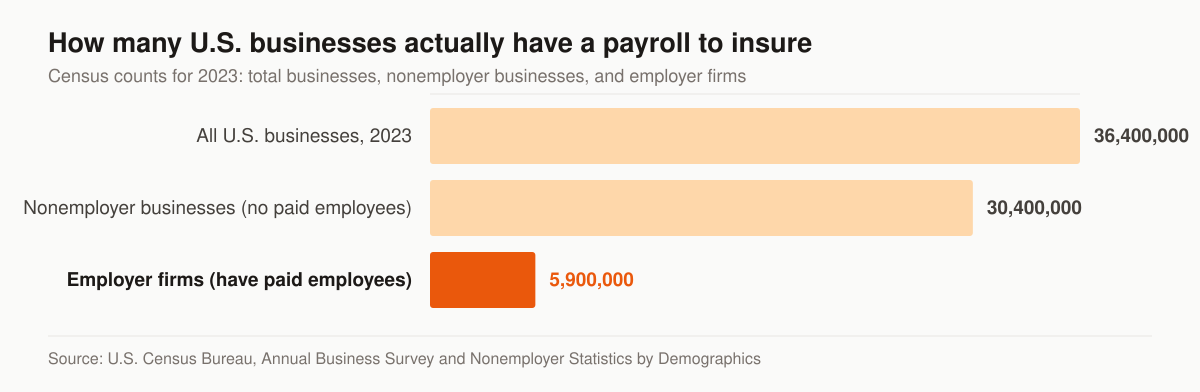
U.S. business counts for 2023. Source: U.S. Census Bureau, Annual Business Survey and Nonemployer Statistics by Demographics.
Read those three counts as a targeting instruction. An audience built on the word “owner” — on any ad platform, in any purchased list — is weighted toward the nonemployer group, because the nonemployer count is 30.4 million against 5.9 million employer firms. A key person case on someone other than the owner requires a payroll for that person to sit on, and the employer-firm count is the ceiling on how many businesses have one.
That does not make nonemployer firms worthless, and it is worth being precise about why rather than writing them off. Pacific Life’s own guide names the sole-owner scenario directly: if you are the sole owner and plan to close the business at your death, coverage gives your beneficiaries the cash “to pay off your debts and shutter the company.” That is a real case. It is also a different conversation, with a different headline and a different sizing method, and mixing it into the same campaign as a rainmaker-concentration message is how owner campaigns end up converting nobody.
The practical split we run is three audiences, not one: employer firms with a single dominant revenue producer, employer or nonemployer firms with more than one owner and an agreement to fund, and firms of any size that are mid-loan. The first is a key person conversation, the second is a buy-sell conversation, and the third is a deadline. Each gets its own landing page and offer, because the owner arriving from a lender search will not read past a headline about succession.
B2B channels that fit the buyer
The table below sets the four channels that reach an owner side by side with the reason each one fits a business buyer and the kind of pipeline it produces.
| Channel | Why it fits | What it produces |
|---|---|---|
| Referral partners (CPA, attorney, banker) | They are in the room when continuity comes up | Warm, pre-qualified meetings |
| LinkedIn targeting | Filter by company size, title, industry | Right-title reach at scale |
| Search / SEO | Owners research “buy-sell funding” themselves | Inbound, high-intent inquiries |
| Direct outreach | Named accounts, sized to your market | Controlled, repeatable pipeline |
Referral partners do the heaviest lifting. A CPA or business attorney already advises owners on succession and tax; a steady, useful drip to that bench produces better meetings than any cold ad. LinkedIn and a B2B-grade agent website give the partner something credible to point at when your name comes up.
Building the target list: the signals that predict a key-person case
We treat the list as the first thing to fix on an owner campaign, ahead of the creative. A continuity explainer only argues something to a company that carries the exposure it describes; sent to a list assembled on nothing but the word “owner,” it argues a risk the reader has no particular reason to recognize. So the work starts by deciding what can be read about a company from outside it.
Two of the signals below come straight from a carrier’s own published list of reasons a business takes out this coverage. Guardian names, among others, a business “named after the owner or other key person,” a company “significantly linked to a person’s reputation, skillset, or financial viability,” a lender or investor requiring coverage as collateral, and a partnership where “each partner wants funds to buy out the other’s shares in case of an untimely death.” Those are not marketing inventions — they are the carrier describing its own buyer, which makes them a defensible screen.
The table below is the six-signal screen we apply before a company goes into an owner sequence, with where each signal is read and why we treat it as predictive.
| Signal | Where it is read | Why we treat it as predictive |
|---|---|---|
| Two or more named owners or members | State business registry, the firm’s about page | Buy-sell exposure is impossible with one owner and near-automatic with two who have never funded the agreement |
| The firm carries a person’s name | The business name itself | Guardian lists a business named after the owner or a key person as a reason to consider coverage |
| One named practitioner or producer in all the marketing | The website, the bio page, the review responses | Guardian also lists a company significantly linked to one person’s reputation or skillset |
| A recorded secured loan | UCC-1 financing statements in the state registry | The lender trigger is the fastest-moving one, and a filing is a public record of the borrowing that created it |
| Paid employees rather than none | Careers page, LinkedIn employee count, job postings | Coverage on someone other than the owner needs a payroll for that person to sit on |
| An ownership or partnership change announced | Press page, LinkedIn company updates, local business press | A new agreement is drafted at exactly the moment the funding question is open |
Notice what is absent from that list: revenue, industry, and anything about how the business is doing. Those are useful for sizing a case once you are in the room, and close to useless for deciding whether to send anything. What predicts a meeting is an exposure you can see from the outside, and all six of these are visible without a data purchase.
We would rather work two hundred names screened this way than five thousand bought. That is also the honest reason this line resists automation: the screen is a research task before it is a sending task, which is why we run it as part of appointment setting rather than as an ad-platform audience.
Reaching owners on LinkedIn without falling under the audience floor
LinkedIn lets you address an owner by the role on their own profile rather than by an interest inferred from behavior, which is what makes it the paid channel that fits this buyer. It also carries a published minimum audience size, and an owner-shaped audience is the kind that falls under it.
Campaign Manager organizes targeting into facets. On the company side the useful ones are Company Size, Company Industry, Company Revenue, Company Growth Rate and Company Name; on the person side, Job Title, Job Function, Job Seniority, Years of Experience and Member Skills. Matched audiences let you upload your own company list, which is how the six-signal screen above becomes an actual audience rather than a spreadsheet.
The constraint that decides whether an owner campaign runs is on LinkedIn’s own targeting options page: “The minimum audience size required to run an ad set is 300 member accounts.” That floor binds much harder for owners than for HR. We plan on the assumption that an owner audience is close to one member per company rather than a multiple of it, because a company has one owner or two and many employees. Stack a metro, an industry and an owner-level seniority filter, and the ad set can sit under the floor while the company list behind it looks perfectly healthy.
Our rule when that happens is to widen geography before widening titles. An owner two metros away is still an owner; a marketing manager in your own city is not, and loosening seniority to clear the floor buys reach by spending it on the wrong people. When the market genuinely is too small for paid reach, stop paying for it and run the same list through direct outreach and referral instead. Paid is the wrong first channel in this niche anyway — it is the one you add once the content engine has something worth pointing an owner at.
Calling business owners: read the paragraph before you dial
Phone outreach to owners often runs on a half-remembered summary of the rules. The relevant rules are at 47 CFR 64.1200, and their paragraphs are scoped differently from one another, which is the whole point.
Two of them are written as duties owed to a residential subscriber. Paragraph (c)(1) bars a telephone solicitation to “Any residential telephone subscriber before the hour of 8 a.m. or after 9 p.m. (local time at the called party’s location).” Paragraph (c)(2) bars a telephone solicitation to “A residential telephone subscriber who has registered his or her telephone number on the national do-not-call registry of persons who do not wish to receive telephone solicitations that is maintained by the Federal Government,” and adds that “Such do-not-call registrations must be honored indefinitely, or until the registration is cancelled by the consumer or the telephone number is removed by the database administrator.” Paragraph (d) requires internal do-not-call procedures before “any call for telemarketing purposes to a residential telephone subscriber,” with a written policy available on demand, trained personnel, and recorded requests.
One of them is not scoped that way at all. Paragraph (a)(1)(iii) is written around the line rather than the subscriber: absent an emergency purpose or the prior express consent of the called party, no person may initiate a call using an automatic telephone dialing system or an artificial or prerecorded voice “To any telephone number assigned to a paging service, cellular telephone service, specialized mobile radio service, or other radio common carrier service, or any service for which the called party is charged for the call.” Paragraph (a)(2) raises the bar for the marketing case specifically: a call that “includes or introduces an advertisement or constitutes telemarketing,” placed by those means to those same lines, needs the prior express written consent of the called party.
Read those paragraphs together and it is tempting to conclude that a business owner sits outside the do-not-call paragraphs, because an owner is not a residential subscriber. The paragraph that follows them closes that gap. Paragraph (e) provides: “The rules set forth in paragraph (c) and (d) of this section are applicable to any person or entity making telephone solicitations or telemarketing calls or text messages to wireless telephone numbers to the extent described in the Commission’s Report and Order, CG Docket No. 02-278, FCC 03-153, “Rules and Regulations Implementing the Telephone Consumer Protection Act of 1991.””
That matters here more than anywhere else, because the premise of an owner list is that the number you have is a mobile. A small-business owner’s working number is very often exactly the line type paragraph (a)(1)(iii) names, and (a)(1)(iii) asks nothing about whether the subscriber is residential. Paragraph (e) then carries the (c) and (d) duties onto wireless numbers on the terms that Report and Order sets, rather than leaving the residential wording as a clean exemption. How far it reaches on a particular call is a question for counsel; what it rules out is treating “they are a business, so the registry does not apply” as a plan.
What we build around that, and this is our operating rule rather than legal advice:
- Manual dialing on owner lists. No power dialer, no autodialing platform, no ringless voicemail, no prerecorded drop. The consent standard for those tools on a mobile number is the written one.
- Registry scrubbing before the list is worked, not as an argument about whether it was owed. Paragraph (e) extends the (c) and (d) duties to wireless numbers, which is the reason not to treat an owner list as exempt from them.
- Referral introductions before cold dials. The definition at paragraph (f)(15) excludes from “telephone solicitation” a call “To any person with that person’s prior express invitation or permission” and a call “To any person with whom the caller has an established business relationship.” A CPA’s introduction is the cleanest route to the first of those, which is a compliance argument for the referral bench on top of the conversion argument.
- One record per contact, with the source of the number written down. If you cannot say where a number came from, you cannot defend the call.
- An internal do-not-call list you actually maintain, kept for the five years paragraph (d)(6) sets for honoring a request. Building it is cheap; arguing about whether you owed it is not.
State telemarketing statutes add their own restrictions on top of the federal rules, and the scope questions above are legal ones. We build the campaign; your compliance counsel signs off on it. The broader set of advertising rules a licensed producer works under is covered in insurance marketing compliance for agents, and the consent trail that matters when you buy rather than generate contacts is in TCPA compliance for insurance agents buying leads.
The one asset that feeds every channel
You do not need ten pieces of content. You need one sharp one: a plain-English explainer that shows an owner the dollar gap a death would open on their balance sheet, and the funding mechanisms (cross-purchase vs. entity-purchase) that close it. That single asset works as a LinkedIn post, a leave-behind for referral partners, a landing-page magnet, and the backbone of an insurance content marketing engine. Build it once, distribute it everywhere.
Putting a number on the page without inventing one
Every owner who reads your explainer arrives at the same question: how much coverage. Answer it with a carrier’s published rule and a citation, not with a figure of your own, and the asset gets more credible rather than less.
Two carriers publish their starting points openly. Pacific Life’s guide states: “As a general rule of thumb, the amount of key person coverage should be 5 to 10 times the key employee’s annual salary.” Guardian offers a different construction for when the impact is hard to quantify: add the person’s salary to their direct financial contribution to the company’s bottom line, “then multiply the result by at least five.” Both also name the simple case — where the policy is collateral for a loan or an investment, the amount needed is the amount that repays it. Pacific Life puts it plainly: “the amount you need is simple: enough to repay the loan or cover the investment.”
The table below turns those three published rules into what each one can honestly say on a page, and where each one stops.
| Sizing basis | What the carrier publishes | What a page can say | Where it stops |
|---|---|---|---|
| Salary multiple | Pacific Life: 5 to 10 times the key employee’s annual salary as a rule of thumb | A range, attributed to Pacific Life, with a link | It ignores contribution that is not paid as salary |
| Salary plus contribution | Guardian: salary plus direct contribution to the bottom line, multiplied by at least five | A worked example an owner can run on their own numbers | The contribution figure is the owner’s estimate, not a measured one |
| Loan or investment amount | Both name the collateral case as the straightforward one | A specific number, because the loan document supplies it | It sizes the debt, not the revenue loss |
Two things belong next to that table on any page you publish. The first is that the numbers are rules of thumb published by carriers, not quotes and not underwriting decisions — the carrier’s own financial underwriting sets what will actually be issued. The second is consent. Guardian states that before a company-owned policy can be taken out on a key employee, “life insurance companies require the written consent of the person being insured,” and Pacific Life describes the product as purchased by a business on an essential employee “with the employee’s written consent.” A headline implying an owner can insure a rainmaker without that person knowing is describing something both carriers say does not happen, and the tax consequences of getting the paperwork wrong are covered in the notice-and-consent section of our key person and buy-sell marketing guide.
Written this way, the sizing block does double duty. It answers the owner’s real question, and it is the kind of cited, extractable passage that AI search and GEO work is built to get quoted, because it names the source of every number in it.
The referral bench, run as a process rather than a hope
CPAs and business attorneys sit closest to these conversations. The version of the channel that produces is the one with dates on it. Three lunches in January and nothing again until October is not a channel; it is a memory of one.
The premise is simple. A buy-sell agreement can be drafted by an attorney and valued by an accountant and still have no money behind it, and neither professional is licensed to fix that. Your offer to them is not “send me referrals.” It is a piece of their own client conversation that you complete.
The table below is the quarterly bench cadence we run, with what goes out at each step, what it asks of the partner, and where the step usually stalls.
| Step | What goes out | What it asks of the partner | Where it stalls |
|---|---|---|---|
| Build the list | Nothing yet: five to eight CPAs, business attorneys and commercial bankers whose clients match your six-signal screen | Nothing | Naming forty names instead of eight, which turns a relationship into a mailing list |
| First contact | A one-page funding explainer with their name on the co-branded version | A fifteen-minute call to check the piece reads correctly to them | Leading with what you sell instead of what they hand a client |
| The joint asset | The co-branded explainer, finished, in a form they can attach to their own engagement emails | Permission to be named as the person they call on funding | Producing something that only works as your marketing |
| The standing slot | A short monthly note: one regulatory or valuation development, one paragraph, no pitch | Nothing. It exists so you are present when a case appears | Turning it into a newsletter, at which point it gets filtered |
| The reciprocal | An introduction from your book to them | The same in return, once | Waiting to be asked |
| The review | A quarterly note on what came from the relationship in both directions | Fifteen minutes to decide whether to continue | Never holding it, so a dead relationship stays on the list for years |
The stall column is the useful one. Each of those failure modes is a scheduling problem rather than a persuasion problem, which is why the bench belongs in the same email and follow-up automation that carries the owner sequences. A partner who hears from you every month with something useful, and gets pitched on none of those occasions, is the version of this channel that works.
Why this is the same system, different audience
We are a senior-market lead operation at our core — we run our own live lead campaigns, so this comes from operating a book, not theorizing about one. Key person and buy-sell are far from that hub, so we do not claim final-expense lineage here. What carries over is the discipline: tight targeting, a single strong offer, fast follow-up, and measuring the number that matters. For B2B, that number is cost per booked meeting, not cost per raw lead — a handful of qualified owner meetings is worth more than a list of names.
What to measure when a case takes months
Cost per lead is the wrong unit here, and so is anything an ad platform can report on its own. A key-person program is judged on whether the right person took a meeting, whether that meeting produced a fact-finder, and whether the case survived underwriting — and three of those four numbers live in the agency’s CRM.
The table below is the reporting set we hold an owner program to, with where each number is read and the decision it drives.
| Number | Definition | Where it is read | The decision it drives |
|---|---|---|---|
| Cost per booked meeting | Channel spend divided by meetings held with an owner, partner or finance lead | Ad and outreach spend joined to the CRM | Compares LinkedIn, search, outreach and the referral bench in one unit |
| Owner-title rate | Share of meetings held with a decision-maker rather than an office manager | CRM | Separates a targeting failure from a messaging failure |
| Source mix | Meetings by origin: referral bench, inbound search, outreach, paid | CRM | Tells you which channel to fund next quarter, and which one is coasting on the others |
| Meeting-to-fact-finder rate | Financial fact-finders completed divided by meetings held | CRM | Where the offer or the discovery is failing |
| Fact-finder-to-application rate | Applications submitted divided by fact-finders completed | CRM | Usually a sizing or affordability conversation, not a marketing one |
| Application-to-placed rate | Cases placed divided by applications submitted | Carrier reporting | Exposes financial-underwriting drag, which is a real cause of a pipeline that looks full and pays nothing |
| Average face amount placed | Total face placed divided by cases placed | Carrier reporting | The case-size number that sets what one meeting is worth |
| Cycle length | Days from first meeting to placed case | CRM | Tells you how far ahead of a revenue target the marketing has to run |
The two to instrument first are cost per booked meeting and source mix. Between them they answer the only question a producer can act on this quarter — which channel is actually producing owner conversations — and every other number on the list is a diagnostic you reach for once that one moves.
One caution about reading them early. In a line where a single case can be large and the cycle runs in months, a quarter with three meetings and no placements is not evidence of anything. Set the review window to the cycle length, not to the calendar month, or you will kill a channel that was working.
Buying leads vs. building demand
This is B2B, low-volume, high-value — there is no cheap firehose of key-man leads. If you want to purchase appointments or intent data directly rather than build a pipeline, buy leads direct from getinsureleads; that is the right place for a lead-as-a-product purchase. This page sells the marketing system, not the leads. In this line, the durable win is owned demand:
- Build the referral bench — three to five CPAs and attorneys who send continuity conversations your way.
- Stay visible on LinkedIn — post the balance-sheet asset, comment in owner circles, send sized outreach.
- Capture inbound — rank for funding-mechanism searches and route them to a meeting-booking page.
What a key-person marketing program costs to run
We publish prices, because an agent comparing shops should not have to sit through a discovery call to learn the band. Three monthly tiers and one entry build.
The table below shows what each published tier runs, what sits inside it, and the kind of practice it fits in this niche.
| Tier | Monthly | What it runs | The practice it fits |
|---|---|---|---|
| Foundation | $2,500 | Optimized website and landing pages, local SEO with the Google Business Profile, on-page SEO, monthly reporting | A producer whose site will not survive the search an owner runs before agreeing to meet |
| Growth | $3,500 | Everything in Foundation, plus the ongoing SEO and content engine, AI-search visibility, and reputation and reviews | The usual starting point here, because the asset that earns an owner meeting is content rather than an ad |
| Full-Funnel | $5,500 | Everything in Growth, plus managed paid ads on Google and Meta, landing-page CRO, marketing automation and CRM, and full-funnel reporting | A practice running paid reach and multi-month sequences across a named account list |
| One-time build | $2,500–$8,000 | A credible B2B site, built once | A producer whose website is the reason owner meetings stall |
Media budget is separate and paid straight to Google or Meta rather than through us. We point key-person producers at Growth for the reason the channel table above gives: the owner researches before they respond, so the content and the search presence are the work, and paid reach is what you add once there is something worth pointing them at. The full breakdown of each tier sits on the pricing page, and how to think about the spend against a case size this large is covered in the insurance agency marketing budget guide.
Map your current pipeline against this and find the leak: request a free marketing audit and we will show our working, the same way we do for our own book. If you also run group life and key-person plays together, the same referral bench feeds both.
Every statistic on this page is public and linked — the Census Bureau for the business counts, the eCFR for the calling rules, LinkedIn for the audience floor, and Guardian and Pacific Life for the sizing rules of thumb. The list sizes and bench sizes are our own operating rules of thumb and are labeled as such, not measurements of anything. Where a first-party figure would be more persuasive than a method, we have left a marker for the agency to supply it rather than an estimate. You can see every line we serve on the insurance niches hub, or get in touch if you would rather talk the economics through before anything is scoped.
Guides that go deeper