Who we serve
ACA / Obamacare Agent Landing Page Design and Funnels
ACA / Obamacare agent landing page design and funnels are single-purpose pages built to turn one ad click into one consented, qualified health-insurance lead, then route it straight into your enrollment workflow. The design is deliberately narrow: one offer, one form, one consent block that names what it authorizes, and zero distractions.
Free · 15-minute teardown · no pitch deck
- We run our own final-expense book
- No pitch deck — we screen-share real numbers
- TCPA-aware · CMS/AEP-compliant · Meta Special Ad Category
- Core Web Vitals < 2.0s LCP
What an ACA / Obamacare landing page funnel actually is
An ACA landing page is not a website. It is one page with one job: convert a paid click into a consented health-insurance lead. The funnel is the short path around it — ad to page, page to consent capture, consent to a thank-you state, thank-you to your call or enrollment workflow.
The structure is deliberately narrow:
- One offer. Usually “check your subsidy and plan in 2 minutes,” not a menu of services.
- One form. The fewest fields you can call back on: name, ZIP, phone, household size.
- One consent block. A clear TCPA-style express-consent checkbox plus the CMS third-party marketing disclaimer where it applies.
- One next step. A thank-you page that sets the callback expectation and fires your tracking.
This is the same conversion discipline we run on our own senior-market book, applied to a health-insurance offer. We are not theorizing about landing pages; we run them daily on pages that have to earn their ad spend.
The scale question sits underneath all of it. CMS reports 22,973,219 cumulative plan selections for the 2026 Open Enrollment Period across all Exchanges, of which 3,382,189 were new consumers and 19,591,030 were returning consumers who selected a plan or were automatically re-enrolled, in its 2026 Open Enrollment national snapshot. A landing page written for a first-time shopper and a landing page written for someone whose plan just auto-renewed at a new price are not the same page, and the second audience is the larger one.
Page anatomy: what each block does
Every block on the page has to justify itself against one of two jobs: keeping you inside the rules, or moving the visitor one step closer to a callback. Anything doing neither is weight.
| Block | Job | Common mistake we remove |
|---|---|---|
| Headline | State the subsidy/qualification outcome, not the agency name | “Trusted local agent” filler |
| Subhead | Name who it’s for (state, income band, family) | Vague “we help everyone” |
| Form | Capture only callable fields | 9-field forms that kill mobile conversion |
| Consent | TCPA consent + CMS TPMO disclaimer, timestamped | Missing or buried consent language |
| Trust strip | Carrier logos, licensing, real review | Stock badges that mean nothing |
| Thank-you | Set callback time, fire pixel/CRM | Dead-end “thanks” with no next step |
Which paid source should your ACA landing page answer to
The page is built for the traffic it receives, so pick the source before the layout. Unbounce’s finance and insurance conversion benchmark breaks its category down by paid source, and the spread is wide enough to change a media plan.
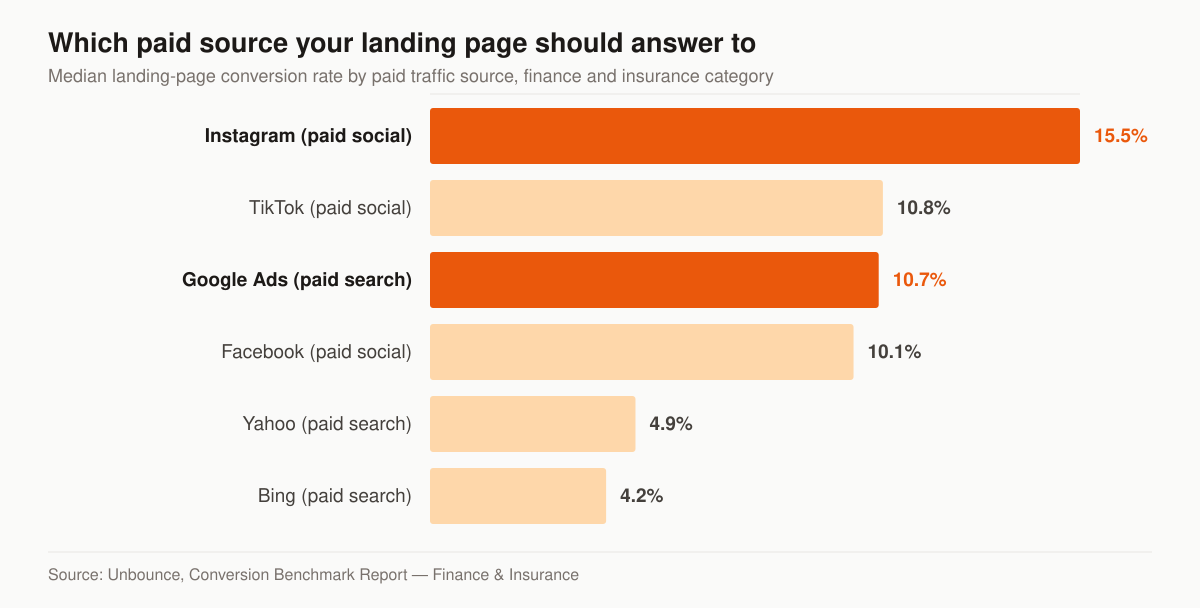
Median landing-page conversion rate by paid traffic source, finance and insurance category. Source: Unbounce, Conversion Benchmark Report — Finance & Insurance, figures as published 6 September 2026.
Read across the whole report rather than off the tallest bar. Unbounce puts paid search at a median 10.1% and paid social at 9.3% for the category, with email at 7.9%. It also reports the insurance subcategory converting at 18.2% against a financial-services median of 8.3%, and mobile at an average 11.5% against 9% on desktop — one of the few categories where phones beat desktops. For an ACA page that means the phone layout is the design and the desktop layout is the adaptation.
The compliance overlay is what makes the social numbers harder than they look. Social ad creative is where “$0 premium” headlines get written, and that exact framing is named in the regulation as prohibited. High-converting social traffic is worth having; it is not worth having on a page whose headline you would not want produced in an audit. If paid search is where you are starting, our insurance PPC service covers the auction side of the same funnel.
What the regulation says you may not put on the page
Most ACA landing-page advice stops at “don’t be misleading.” The rule is more specific than that now. 45 CFR 155.220(j)(3)(ii) requires an agent, broker or web-broker to “refrain from marketing that is misleading, materially inaccurate, coercive, or discriminates based on race, color, national origin, disability, age, or sex” — and then paragraph (j)(3)(iii) supplies worked examples, introduced as “Examples of prohibited misleading marketing practices agents, brokers, and web-brokers may not include in their marketing of FFE plans include, but are not limited to”. The phrase “include, but are not limited to” matters: the list is a floor, not a boundary.
Each item on the list rules out a specific page element, which is why it belongs in the design review and not only in a compliance folder.
| Regulation text, 45 CFR 155.220(j)(3)(iii) | What it rules out on a landing page |
|---|---|
| “Providing cash, monetary rebates, gift cards, travel vouchers, or cash equivalents as an inducement for enrollment or otherwise.” | Gift-card prize draws and “$25 to complete the quote” form bribes |
| “Offering gifts to consumers, unless the gifts are of nominal value, are offered to similarly situated consumers without regard to whether or not the consumers enroll, and are not in the form of cash or cash equivalents.” | Any giveaway conditioned on enrolling |
| “Falsely asserting or suggesting that consumers will always qualify for zero-dollar insurance/zero-dollar premiums.” | “$0 plans” and “free health insurance” headlines |
| “Falsely using identical or facsimiles of government or other official logos and notations.” | Eagle seals, .gov-styled headers, HealthCare.gov lookalike badges |
| “Miscommunicating enrollment timelines and deadlines.” | Evergreen countdown timers that reset on every visit |
| “Misconstruing legislation, regulations, or Executive Orders, including listing fake or incorrect references or citations.” | Invented citations in “new law” ad angles |
| “Utilizing the image or likeness and/or utilize a quote from a notable figure, such as a celebrity or politician, in an advertisement claiming that figure has endorsed you or your agency when that endorsement is not truthful.” | Politician imagery in “new benefit” creative |
The countdown-timer row is the one agents argue about, so be plain about it. A timer counting down to a real, published deadline communicates a timeline. A timer that restarts every time the page loads communicates a false one, and the regulation names miscommunicating enrollment deadlines directly. Use the published date instead of a script.
Two further paragraphs govern the paperwork around all of this. Under (j)(3)(iv) you “must produce any marketing material upon request, within the specified timeframe HHS mandates, in response to monitoring, audit, and enforcement activities”, and (j)(3)(v) makes you “responsible to ensure that all marketing-related materials created, written, released, or otherwise produced by the individual or entity or on their behalf adhere to the requirements” of the marketing paragraphs. “On their behalf” reaches your agency, your media buyer and your page builder. We treat that as a version-control requirement: every published variant of an ACA page is archived with its live dates, so producing it later is a lookup rather than a reconstruction.
CMS-compliant consent capture is the non-negotiable
ACA is a regulated lane. Forms that collect a phone number for outreach should carry clear express written consent for calls and texts, and ACA marketing falls under CMS TPMO rules, including the required third-party marketing disclaimer where applicable. We build the consent checkbox, disclaimer, and a stored submission timestamp into the page itself, so the proof of consent lives with the lead record. Your agency remains the licensed, responsible party — we provide the marketing mechanics, not legal advice. Treat compliance as a trust signal: a clean consent flow is also a cleaner lead.
Two different consents, and one checkbox does not cover both
This is where funnels quietly go wrong. The word “consent” refers to two separate obligations from two separate regulators, and they attach at different points in the funnel.
One consent lets you dial the number; the other lets you touch the application — and a page that conflates them satisfies neither cleanly.
| Contact consent | Enrollment consent | |
|---|---|---|
| Source | 47 CFR 64.1200(f)(9) | 45 CFR 155.220(j)(2)(iii) |
| What it authorizes | Autodialed or prerecorded telemarketing calls and texts to the number given | Assisting with or facilitating enrollment, and applying for advance payments of the premium tax credit |
| Where it belongs | On the landing-page form | At the enrollment step, before you assist |
| Record required | The signed written agreement | Documentation of scope, purpose, duration, date, consumer name, agency name, and a rescission process |
| Retention | Keep it with the lead record | “for a minimum of 10 years” under (j)(2)(iii)(D) |
The enrollment-consent documentation requirement is specific about its contents. Under (j)(2)(iii)(B) the record must include “a description of the scope, purpose, and duration of the consent” provided by the consumer, “the date consent was given, name of the consumer or their authorized representative, and the name of the agent, broker, web-broker, or agency being granted consent, as well as a process through which the consumer or their authorized representative may rescind the consent.” A landing-page checkbox does not carry a duration or a rescission process. Design the funnel so the enrollment consent has its own step rather than trying to make the lead form do both jobs.
The consent block, line by line
The FCC definition tells you what the block has to say. 47 CFR 64.1200(f)(9) defines prior express written consent as “an agreement, in writing, bearing the signature of the person called that clearly authorizes the seller to deliver or cause to be delivered to the person called advertisements or telemarketing messages using an automatic telephone dialing system or an artificial or prerecorded voice, and the telephone number to which the signatory authorizes such advertisements or telemarketing messages to be delivered.”
Paragraph (f)(9)(i) then requires “a clear and conspicuous disclosure” telling the signer two things: (A) “By executing the agreement, such person authorizes the seller to deliver or cause to be delivered to the signatory telemarketing calls using an automatic telephone dialing system or an artificial or prerecorded voice”, and (B) “The person is not required to sign the agreement (directly or indirectly), or agree to enter into such an agreement as a condition of purchasing any property, goods, or services.” That second element is the one that goes missing on rushed pages — the disclosure has to say the visitor does not have to agree in order to get help.
Paragraph (f)(9)(ii) settles the mechanics: the term “signature” “shall include an electronic or digital form of signature, to the extent that such form of signature is recognized as a valid signature under applicable federal law or state contract law.” An unticked box the visitor ticks, stored with the timestamp, the page URL and the exact wording shown, is the artefact you keep.
Revocation belongs in the same build. 47 CFR 64.1200(a)(10) lets a called party revoke “by using any reasonable method”, treats the words “stop,” “quit,” “end,” “revoke,” “opt out,” “cancel,” or “unsubscribe” in reply to a text as reasonable per se, and requires that revocation requests “must be honored within a reasonable time not to exceed ten business days from receipt of such request.” If your follow-up sequence cannot parse those seven words and stop, the funnel has a defect the page cannot fix. That wiring is part of what we build in insurance marketing automation.
What changes for plan years beginning on or after January 1, 2028
Two paragraphs of 45 CFR 155.220 carry a dated switch that changes funnel design, and it is worth building toward now rather than retrofitting later.
For enrollments for plan years beginning on or after January 1, 2028, paragraph (j)(2)(iii)(C) requires that consent documentation “must be collected by having the consumer or the consumer’s authorized representative take an action to execute an HHS-approved and -created consumer consent form”, and states plainly that “A signature that is simply typed on the documentation or a filled-in check box does not properly indicate consent was provided by the consumer or the consumer’s authorized representative.” Paragraph (j)(2)(ii)(A)(2) applies the same standard to the eligibility-review documentation, adding that “A signature that is simply typed on the documentation or a filled-in check box does not clearly indicate the eligibility application information was reviewed and confirmed accurate”.
The practical read for a funnel builder: the lead form keeps doing contact consent, and the enrollment consent moves onto a distinct, recorded action — a written or drawn signature, an email reply from the consumer, or a recorded verbal conversation. Funnels that route the lead into a call or a scheduled appointment already have a natural place to capture that. Funnels designed to enroll someone straight off the form do not.
When a funnel stops being a landing page and becomes a web-broker site
Adding a plan-comparison widget feels like a conversion improvement. It can also move you into a different regulatory category. 45 CFR 155.220(c)(3)(i) opens with the trigger — “When an internet website of a web-broker is used to complete the QHP selection, at a minimum the internet website must:” — and then lists duties an ordinary lead form never incurs. Among them: “Provide consumers the ability to view all QHPs offered through the Exchange”; “Not provide financial incentives, such as rebates or giveaways”; “Maintain audit trails and records in an electronic format for a minimum of ten years and cooperate with any audit under this section”; “Provide consumers with the ability to withdraw from the process and use the Exchange Web site described in § 155.205(b) instead at any time”; prominently display “a standardized disclaimer provided by HHS”, with a link to the Exchange site; and “Not display QHP advertisements or recommendations, or otherwise provide favored or preferred placement in the display of QHPs, based on compensation the agent, broker, or web-broker receives from QHP issuers”.
Read that list before you embed a quoting tool, not after. Skinning an enhanced direct-enrollment platform in your own brand does not move the obligation somewhere else. We keep the marketing funnel and the enrollment platform as separate surfaces on purpose: the page collects a consented request for help, a licensed human takes it from there, and the enrollment happens where the audit trail is already built. The wider layout consequences are covered on our ACA agent website page.
Speed: the three numbers we build the page to hit
ACA traffic arrives on phones, often on a cellular connection, often during the weeks when everyone else is bidding for the same attention. Speed is a conversion lever and an ad-cost lever at once. We build to Google’s published Core Web Vitals thresholds: Largest Contentful Paint within 2.5 seconds of when the page first starts loading, Interaction to Next Paint of 200 milliseconds or less, and Cumulative Layout Shift of 0.1 or less. Google’s guidance is to assess those at “the 75th percentile of page loads, segmented across mobile and desktop devices” — not on an office connection with a warm cache.
Layout shift deserves particular attention on a lead form. A consent checkbox that moves down the screen while a font or a chat widget loads is a checkbox that gets mis-tapped, and a mis-tapped consent box is a lead you cannot legally call. Reserve the space, load the form first, and defer everything that is not the offer or the form.
What the thank-you page has to trigger, and how fast
The thank-you state is half the funnel and gets a tenth of the attention. It has three jobs: tell the visitor exactly when a human will call, fire the conversion event so the ad platform can optimize, and push the record into whatever dials it.
Speed is the reason the third job matters. The 2007 Lead Response Management Study by Dr. James Oldroyd and InsideSales.com, which examined more than 15,000 leads and over 100,000 call attempts across six companies, reported that the odds of contacting a lead at 5 minutes versus 30 minutes drop by 100 times, that the odds fall 5 times between 5 and 10 minutes, and that the odds of qualifying a lead at 5 minutes versus 30 minutes drop 21 times (Lead Response Management Study, 2007). The study is old and it is not ACA-specific; what it establishes is the shape of the decay, not a benchmark for your book. The design conclusion holds either way: a form submission that waits in an inbox is worth less than the same submission routed into a dialer or a booked slot. If your team cannot answer inside the window, appointment setting is the part of the funnel to fix before the page copy.
The funnel calendar changed for 2027, so build earlier
An ACA funnel is a seasonal asset, and the season is being shortened by regulation. 45 CFR 155.410(e)(5) provides that for benefit years beginning on or after January 1, 2027, “The annual open enrollment period for all Exchanges must begin no later than November 1 and must end no later than December 31 of the calendar year preceding the benefit year”, and that “The annual open enrollment period must not exceed 9 weeks in duration.” Paragraph (f)(4) adds that for those benefit years “the Exchange must ensure that coverage is effective January 1, for QHP selections received by the Exchange on or before December 31 of the calendar year preceding the benefit year.”
A shorter window moves the build date, not the launch date.
| Phase | When | What the funnel work is |
|---|---|---|
| Build | Off-season | Page, consent flow, tracking, CRM routing, follow-up sequence |
| Prove | Before the window | Small paid test to confirm the form, the pixel and the handoff all fire |
| Scale | Inside the window | Budget up on the variant that already works; no structural edits |
| Convert the tail | After the window | SEP pages and renewal outreach, not the OEP page left running |
The mistake a compressed window punishes is testing the plumbing with real budget during the weeks that matter. Publish the dates you actually verified — the ACA marketing compliance guide covers what CMS rules change during enrollment windows, and state-based Exchanges set their own dates inside those federal parameters, so a multi-state campaign needs per-state deadline copy rather than one national line.
Special Enrollment Period funnels: the pages that work the rest of the year
Between windows, the audience is not “everyone shopping” — it is people whose life just changed, and they are reachable only inside a running clock. HealthCare.gov states that “Depending on your Special Enrollment Period type, you usually have 60 days before or 60 days following the event to enroll in a plan”, and that “Job-based plans must provide a Special Enrollment Period of at least 30 days” (Special Enrollment Period glossary). Its coverage-outside-open-enrollment page adds that you may qualify if you or anyone in your household “lost qualifying health coverage in the past 60 days OR expects to lose coverage in the next 60 days”, with a longer reach for Medicaid and CHIP: “(If you lost Medicaid or Children’s Health Insurance Program (CHIP) coverage in the past 90 days, you may qualify for a Special Enrollment Period.)”
That produces a different page per trigger — job loss and COBRA ending, a move to a new ZIP code or county, marriage, a birth or adoption — because the qualifying event is the headline and the clock is the reason to act today. One generic “enroll outside Open Enrollment” page asks the visitor to work out whether they qualify. A per-trigger page tells them.
One funnel detail belongs here and appears in almost no landing-page advice. Paragraph (j)(2)(viii) of 45 CFR 155.220 requires an agent submitting SEP-eligibility information to “obtain authorization from the consumer to submit the request for a determination of eligibility for a special enrollment period and make the consumer aware of the specific triggering event and special enrollment period for which the agent, broker, or web-broker will be submitting an eligibility determination request on the consumer’s behalf.” The named triggering event has to survive the whole journey — from ad, to page, to the CRM field, to the conversation. If your form collects “life event: other”, the follow-up call starts by re-asking a question the page already answered.
Fields, length and reading level for an ACA page
Form length is a trade, not a virtue. Every field you add costs completions and buys qualification. On an ACA page the fields that earn their place are the ones a licensed human genuinely cannot proceed without: ZIP code, because rating areas and plan availability are county-level; household size, because it sets the subsidy math; and a phone number you have consent to use. Income can be asked as a band rather than a figure, and it converts better as an outcome (“see what tax credit you’d qualify for”) than as an interrogation.
Copy length has a published band. Unbounce reports that finance pages in the 195-to-715-word range perform best in its data, “around a median conversion rate of 8.3%”, with a suggested ceiling of “35 to 125 difficult words (i.e., words that have three or more syllables)”. The same report groups pages by reading level and puts 5th-to-7th-grade copy at an 18.1% median, against 9.3% for 10th-to-12th-grade and 7.1% for college-level writing — with two outliers worth knowing, 8th-to-9th-grade lowest at 6.5% and professional-level rising again to 14.4%.
For ACA copy that is an instruction rather than a style note. “Premium tax credit” is the accurate term and it is four syllables; “help paying your monthly premium” says the same thing in words a shopper uses. Say what the ad promised, in the words the ad used, and stop. The build standards behind this are the same ones on our global insurance landing page design service.
How to test an ACA landing page without fooling yourself
Seasonal traffic makes testing harder than it looks, because the audience changes underneath you. Two pages compared across different weeks of a window now capped at 9 weeks are not comparing designs; they are comparing weeks. Run variants concurrently with traffic split at the source, decide the metric before the test starts, and keep the one thing you changed to one thing.
Pick the metric that matches the job. A form-submission rate rewards a shorter form even when the extra submissions are unreachable. Booked calls, or consented submissions that a human actually contacted, reward the page that produced business. And when a page gets clicks without leads, read it in a fixed order: does the headline repeat the ad’s promise, does the form load without shifting, does the consent language read as reassurance or as a warning, and does the offer ask for something a shopper would trade a phone number for. The insurance sales funnel service covers the same discipline across the stages after the page.
How this page fits your broader funnel
A single landing page is the quick win. The system around it is where Open Enrollment volume comes from. Sequence it like this:
- Ship the page — one offer, compliant consent, tracking wired.
- Point traffic at it — paid social and search, not your homepage.
- Automate follow-up — speed-to-lead is the difference between a quote and a voicemail.
- Add variants for OEP — separate pages for subsidy-eligible vs. plan-switchers.
To go deeper on each layer, start with our ACA agent marketing hub for the full vertical, and the global insurance landing page design service for the build standards we apply across niches. For seasonal timing and rules, the ACA marketing compliance guide on CMS rules covers what changes during enrollment windows. Between windows, ACA search visibility is what keeps the pages earning without an ad budget behind them.
What an ACA landing page build costs
We publish prices rather than quoting per conversation. A one-time website or landing-page build is $2,500–$8,000 depending on scope. Managed programs run $2,500 per month at the Foundation tier, which covers the optimized site and landing pages plus local SEO, on-page SEO and monthly reporting; $3,500 at Growth, which adds the ongoing SEO and content engine, AI-search visibility and reputation work; and $5,500 at Full-Funnel, which adds managed paid ads, landing-page CRO and marketing automation. Ad spend is billed at cost, straight to the platforms. The full comparison is on the pricing page.
Which tier fits depends on where the funnel is leaking. If you have no compliant page to send traffic to, that is a build. If you have a page and an ad budget but nothing tests or optimizes it, that is the CRO layer at Full-Funnel. If you are not sure which, the audit is free and it exists to answer exactly that question.
Build vs. buy: where this page stops and lead-buying begins
This page is a marketing service — we design the funnel that generates your own leads. We do not sell leads here. If the goal is to buy ACA leads, live transfers, or aged data as a product to fill the pipeline today, that is a separate decision handled by our sister brand: you can buy leads direct from getinsureleads instead. Many agents run both: an owned landing-page funnel for exclusive, lower-cost leads, plus purchased volume during a crunch.
The consent obligations do not transfer with the purchase. Whoever generated the lead, you are the enrolling agent, and the documentation duties in 45 CFR 155.220(j)(2) land on you.
Why our pages convert (the transferable proof)
We did not learn conversion from a course. The same form-friction tests, consent-flow design, and speed-to-lead automation we run for senior-market clients are the levers we pull on an ACA page. The vertical changes; the mechanics do not.
Want it measured before you spend? Three next steps:
- Get a free, numbers-first read of your current funnel with our free marketing audit.
- See how the wider system is built on the ACA agent marketing pillar and the ACA marketing services overview.
- Or tell us what you’re running now and we’ll tell you which part of the funnel is losing the lead.
Guides that go deeper