Who we serve
Medicare Lead Generation for Agents
Medicare lead generation for agents is the system of sourcing seniors actively shopping Medicare Advantage, Supplement, or Part D plans, then routing them to a licensed agent compliantly. It hinges on T65 birthday timing, AEP/SEP enrollment windows, exclusivity, and TPMO disclosure rules.
Free · 15-minute teardown · no pitch deck
- We run our own final-expense book
- No pitch deck — we screen-share real numbers
- TCPA-aware · CMS/AEP-compliant · Meta Special Ad Category
- Core Web Vitals < 2.0s LCP
Medicare lead generation for agents is the system that finds seniors actively shopping plans and hands them to a licensed agent in a compliant way. Done right, it ties every dollar to a cost per enrolled member. Done wrong, it burns budget on aged, over-shared lists that four other agents are already calling.
This page covers the four things that actually move Medicare lead economics: T65 timing, the AEP/SEP calendar, exclusive versus shared sourcing, and TPMO compliance. It then goes past them into the parts agents ask about after the first invoice — what published lead prices actually are, which special enrollment triggers are marketable, what consent a lead has to carry before you may dial it, the referral ceiling written into the regulation, and the charge-back rule that quietly changes your cost per enrolled member.
We run our own senior-market lead operation across live campaigns, so what follows reflects how we think about Medicare specifically, not theory.
One framing note before the tactics. The moment a campaign markets a Medicare Advantage plan it answers to 42 CFR part 422, subpart V, and a Part D campaign answers to the mirrored text at part 423, subpart V. Medicare Supplement is state-regulated insurance and sits outside both. Where this page quotes a regulation, it quotes the current published text.
Time the Medicare lead calendar around the prospect
Medicare is one of the few lines with a fixed enrollment clock. The mistake we correct most often is a book treated as though the whole thing runs on AEP. It does not.
- T65 (turning 65): The Initial Enrollment Period spans seven months around the 65th birthday and rolls every month of the year. T65 lead generation is your year-round engine.
- AEP (Oct 15 – Dec 7): The Annual Enrollment Period for Medicare Advantage and Part D. Demand and ad costs spike. Plan budget and call capacity months ahead.
- SEP (year-round triggers): Special Enrollment Periods open on life events: a move, loss of employer coverage, dual-eligibility, or a plan exiting the market. These are quieter, cheaper acquisition windows.
- Med Supp (no window): Medicare Supplement has no federal enrollment cap, so those leads run continuously.
Mapping campaigns to these windows is the first lever. A book that only fires in Q4 leaves three quarters of T65 volume on the table.
Those dates are not industry convention. They are written into 42 CFR 422.62, and reading the section changes how you plan spend, because each window carries a different population and a different permitted action.
This table pairs each Medicare election window with the paragraph that sets it and the lead work it justifies.
| Window | What the regulation sets | What it justifies in a lead program |
|---|---|---|
| Initial coverage election period | 422.62(a)(1): the period “begins 3 months before the month the individual is first entitled to both Part A and Part B” | The T65 engine, refreshing every month of the year |
| Annual coordinated election period (AEP) | 422.62(a)(2)(iii): for the following calendar year it “is October 15 through December 7” | Concentrated MA and Part D acquisition; capacity booked in advance |
| MA open enrollment period | 422.62(a)(3)(i): an MA enrollee “may make an election once during the first 3 months of the year” | Retention work and switch conversations, inside the OEP marketing limits |
| Special election periods | 422.62(b): 27 numbered circumstances, triggered by events rather than dates | Always-on trigger campaigns fed by event data |
| Age-65 special election period | 422.62(c): a one-time right to leave the first MA plan “at any time during the 12-month period that begins on the effective date of enrollment” | A dated month-11 touch for anyone who chose MA at 65 |
| Medicare Supplement | Outside 42 CFR part 422 entirely; state insurance law governs | Continuous, birthday-anchored acquisition |
The OEP row is the one we flag first in an audit, because a valid election period is not the same thing as permission to market into it. The rules on what you may and may not send during those three months are set out in our guide to Medicare OEP marketing rules.
What counts as a Medicare lead, and what is only data
Two words get used interchangeably in this market and they are not the same asset. Redbird Agents, an FMO that publishes its vendor guide openly, draws the line this way: “a lead is someone who has expressed interest and expecting someone to reach out, and data is simply someone’s contact information.” A T65 birthdate file is data. A returned business reply card is a lead.
The distinction is not pedantry, because the regulation treats the two differently. 42 CFR 422.2264(a)(1) permits an MA organization to “make unsolicited direct contact by conventional mail and other print media (for example, advertisements and direct mail) or email (provided every email contains an opt-out option).” So a purchased birthdate file is a legitimate mail and email audience. The same section then bars unsolicited telephone solicitation, robocalls, text messages and voicemail at (a)(2)(iv), and the examples it names are worth reading closely: calls based on referrals, calls to former enrollees, calls to people who attended a sales event without giving express permission, and “Calls to prospective enrollees to confirm receipt of mailed information.”
Paragraph (a)(3) is the door: “Calls are not considered unsolicited if the beneficiary provides consent or initiates contact with the plan. For example, returning phone calls or calling an individual who has completed a business reply card requesting contact is not considered unsolicited.”
The FCC rules sit alongside that and apply to the call whichever product is on the table. 47 CFR 64.1200(c) bars telephone solicitation to a residential subscriber “before the hour of 8 a.m. or after 9 p.m. (local time at the called party’s location)” or to a residential subscriber registered on the national do-not-call registry. The safe-harbour conditions in (c)(2)(i) include a specific operational detail worth putting in a vendor contract: the caller must employ “a version of the national do-not-call registry obtained from the administrator of the registry no more than 31 days prior to the date any call is made, and maintains records documenting this process.” A list scrubbed once at purchase and worked for three months does not meet that description. Our guide to TCPA compliance when buying insurance leads walks the consent side of the same problem.
What Medicare leads cost, and what the price does not tell you
Ask what Medicare leads cost and you will get a number without a unit attached. The published bands differ by an order of magnitude depending on how the lead was produced.
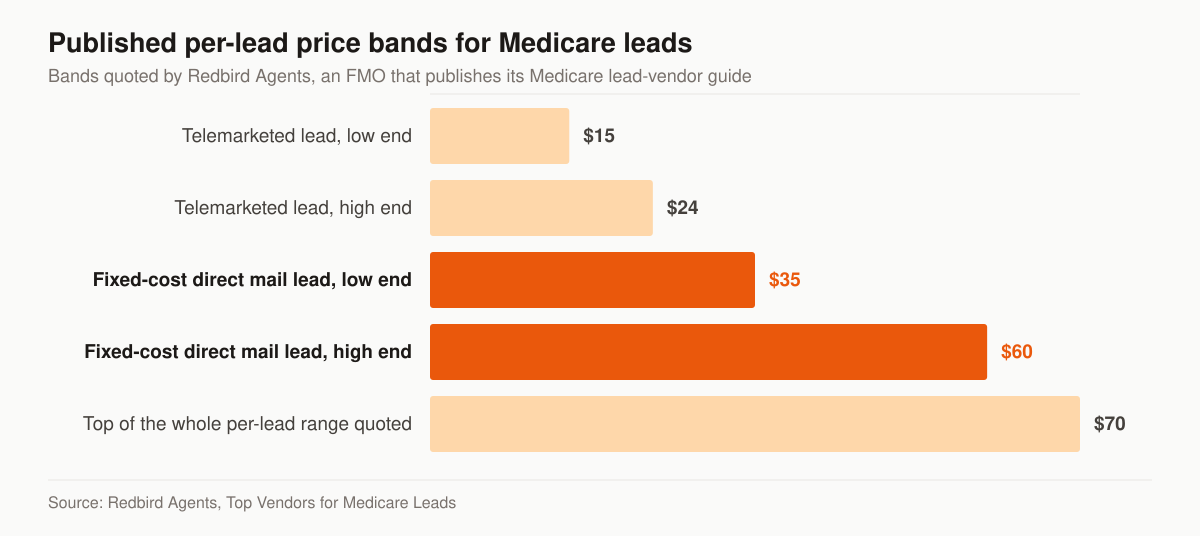
Published per-lead price bands for Medicare leads. Source: Redbird Agents, Top Vendors for Medicare Leads.
This table sets the published bands beside the condition each one comes with, because the condition is usually what decides whether the price is real.
| How the lead is produced | Published band | The condition attached to it |
|---|---|---|
| Fixed-cost direct mail lead | $35–$60 per lead | Redbird notes these are “usually tied to a minimum order of 15-20 leads per week” |
| Direct mail campaign, priced per thousand | $420–$600 per 1,000 mailers | Redbird tells agents to “expect an average annual response rate of 1.5%-3%” on Medicare Supplement direct mail, or 15–30 leads per 1,000 cards |
| Telemarketed lead | $15–$24 per lead | Cheaper, but Redbird’s warning is that these have “a much shorter life span” than a returned mail card |
| Across all types | $1.50–$70 per lead | Redbird’s own answer to the question “How much do Medicare leads cost?” |
Two things follow. First, a per-thousand mail price is not a per-lead price, and a program quoted one way cannot be compared against a program quoted the other way without knowing the response rate the vendor stands behind. Second, cheap and short-lived is a real trade: a telemarketed lead at the bottom of the band is worth less than a mail responder at the top if your team cannot dial it the same day.
Redbird’s own worked arithmetic is the shape we recommend agents copy: “if you have 20 leads that you purchased for $40 per lead and sell policies 5 of them, your total cost was $800 to acquire 5 new customers, making your acquisition cost per customer $160.” That is one line of spreadsheet, and it is the line skipped in favour of arguing about price per lead.
Exclusive vs shared Medicare leads: decide on cost per sale
The exclusive-versus-shared debate gets argued on price per lead. That is the wrong number. Decide on cost per enrolled member.
This table sets the two sourcing models against the five attributes that change how you should staff and pace the follow-up.
| Factor | Exclusive Medicare leads | Shared Medicare leads |
|---|---|---|
| Price per lead | Higher | Lower |
| Competing agents | You only | Typically 3–5 |
| Expected close rate | Higher | Lower (prospect fatigue) |
| Speed-to-lead pressure | Moderate | Extreme (first caller wins) |
| Best fit | Agents with tight follow-up | High-volume dialer teams |
A shared lead at half the price is no bargain if your close rate falls by more than half. We model this the same way for every line. The framework in our exclusive vs shared lead breakdown is written for final expense but the math transfers directly to Medicare.
One caution on the word itself. Exclusivity is a contractual definition, not a property of the data, and vendors define it differently — exclusive to one agent, exclusive within a territory, or exclusive for a stated number of days before resale. Get the definition in writing before it becomes the reason a close rate came in under forecast.
If you want the underlying engine rather than a list to buy, our insurance lead generation service builds owned campaigns where you control exclusivity and consent from the first click.
Special election periods are a lead source, not a footnote
AEP gets the budget and SEPs get an asterisk. That is backwards for anyone trying to smooth revenue across the year, because 42 CFR 422.62(b) lists 27 circumstances in which a beneficiary may change plans outside the annual window, and several of them are events you can know about before the beneficiary calls anyone.
This table pairs the special election periods that are practical to build campaigns around with the window each one runs for.
| Trigger in 42 CFR 422.62(b) | The window the regulation sets | The campaign it defines |
|---|---|---|
| (b)(1) Plan terminated or discontinued in the area | Available on termination, discontinuation, or notice of impending termination | A market page published the week a plan exit is announced |
| (b)(2) Change in permanent residence | Also covers individuals who, “as a result of a change in permanent residence, have new MA plan options available to them” | A movers sequence keyed to new-address data |
| (b)(4) Employer or union coverage ends | “ends 2 months after the month the employer or union coverage of any type ends” | A retirement and late-retirement sequence |
| (b)(8) Medigap trial right | “begins upon enrollment in the MA plan and ends after 12 months of enrollment or when the individual disenrolls from the MA plan, whichever is earlier” | A month-11 educational touch, not a month-13 one |
| (b)(15) Five-star plan | “beginning the December 8th before that contract year through November 30th of that contract year” | A standing offer wherever a 5-star contract is available |
| (b)(18) Declared emergency or major disaster | Starts at the declaration or incident start date, ends 2 full calendar months after the end date identified | A pre-built template you activate, rather than a campaign written under pressure |
| (b)(19) Involuntary loss of creditable drug coverage | “begins when the individual is notified of the loss of creditable coverage and ends 2 calendar months after the later of the loss (or reduction) or the individual’s receipt of the notice” | A notice-triggered follow-up, timed to the letter rather than the calendar |
| (b)(23) Significant provider network change | “begins the month the individual is notified of eligibility for the SEP and extends an additional 2 calendar months thereafter” | A network-termination landing page in affected counties |
Read the table as a list of publishing triggers, not calling triggers. A beneficiary having an election right does not create your permission to phone them; the unsolicited-contact rules in 422.2264 still apply, and the SEP only tells you that a page, a mailer, or an email written for that moment will land on someone who can actually act. Dual-eligible and D-SNP prospects add a further layer of state-level Medicaid rules on top, so a D-SNP campaign has to be scoped to the states and carriers you are actually appointed for.
Referral leads have a price ceiling written into the regulation
Referral programs are cheap to build and easy to design without reading the rule that governs them. 42 CFR 422.2274(f) permits them and caps them: “Payments may be made to individuals for the referral (including a recommendation, provision, or other means of referring beneficiaries) to an agent, broker or other entity for potential enrollment into a plan. The payment may not exceed $100 for a referral into an MA or MA-PD plan and $25 for a referral into a PDP plan.”
Two design consequences. A referral fee is a permitted line item, so a formal program with a written amount is cleaner than an informal gift culture. And the cap is per referral, not per enrollment, so a program that scales referral volume scales cost linearly while your close rate decides whether it pays. Note also that a referral does not convert a cold number into a callable one: 422.2264(a)(2)(iv)(A) names “Calls based on referrals” among the unsolicited contacts that are barred. The referred person still has to reach out or consent.
The consent chain a compliant Medicare lead has to carry
By the time a Medicare Advantage lead reaches an agent it should carry a documented chain of disclosures. The requirements sit in 42 CFR 422.2274(g), and they bind the plan to police them through its contracts with third-party marketing organizations.
- Lead-generation disclosure. A TPMO conducting lead-generating activities must “Disclose to the beneficiary that his or her information will be provided to a licensed agent for future contact” — verbally by telephone, in writing on mail or other paper, and electronically in email, online chat, or other electronic messaging platform.
- Transfer disclosure. It must also “Disclose to the beneficiary that he or she is being transferred to a licensed agent who can enroll him or her into a new plan.”
- Data-sharing consent. Since October 1, 2024, personal beneficiary data collected by a TPMO “may only be shared with another TPMO when prior express written consent is given by the beneficiary,” and that consent must come “through a clear and conspicuous disclosure that lists each entity receiving the data and allows the beneficiary to consent or reject to the sharing of their data with each individual TPMO.” A lead resold down a chain of buyers without per-entity consent does not satisfy that sentence.
- Call recording. All marketing and sales calls, “including the audio portion of calls conducted via web-based technology, must be recorded and retained in their entirety for a minimum period of 6 years,” with the first three years kept in audio format.
- Subcontractor disclosure. The TPMO must disclose to the MA organization “any subcontracted relationships used for marketing, lead generation, and enrollment.”
Sitting on top of all five is the disclaimer itself. 42 CFR 422.2267(e)(41) sets the standardized text for a TPMO that does not sell for every MA organization in the service area: “We do not offer every plan available in your area. Currently we represent [insert number of organizations] organizations which offer [insert number of plans] products in your area. Please contact Medicare.gov or 1-800-MEDICARE to get information on all of your options.” The regulation then sets where it has to appear — verbally “during sales calls prior to the discussion of any benefits”, electronically in email or online chat, “Prominently displayed on TPMO websites”, and in any marketing materials the TPMO develops, uses or distributes.
We provide marketing services, not licensed insurance advice. You are the licensed party; we build the compliant pipe that feeds you. The plain-English walkthrough is in our guide to CMS Medicare marketing rules, and the AEP-specific version is the AEP marketing strategy playbook.
Scope of Appointment is the gate between a lead and an enrollment
A lead is not an appointment and an appointment is not a licence to discuss whatever the prospect raises. 42 CFR 422.2274(b)(3) requires an agent or broker representing an MA organization to “Secure and document a Scope of Appointment prior to a personal marketing appointment.” 422.2264(c)(3)(i) adds the mechanics: the plan, agent or broker “must agree upon and record the Scope of Appointment with the beneficiary(ies)” before the appointment, and “The Scope of Appointment must be in writing for in-person personal marketing appointments.”
Two operational details follow from the same section. The documentation — a Scope of Appointment, a business reply card, or a request to receive additional information — is “valid for 12 months following the date of beneficiary’s signature date or the date of the beneficiary’s initial request for information”, which makes it a data field in your CRM with an expiry, not a piece of paper in a folder. And marketing an additional health-related line of business that was not identified beforehand requires a separate Scope of Appointment, itself valid for 12 months.
The event rules run on the same logic. An educational event “must be advertised as such”, and at one you may distribute materials, answer beneficiary-initiated questions, hand out business cards, and “Make available and receive beneficiary contact information, including Business Reply Cards and Scope of Appointment forms” — but you may not conduct sales presentations or accept applications. That single paragraph is why seminars work as a lead-generation channel rather than a closing channel, and we build them that way in Medicare seminar marketing. The deeper walkthrough is our post on Scope of Appointment and TPMO compliance.
Charge-backs: the line that changes cost per enrolled member
Cost per enrolled member assumes the commission stays paid. For Medicare Advantage it does not always. 42 CFR 422.2274(d)(5)(ii)(A) requires compensation recovery when “A beneficiary makes any plan change (regardless of the parent organization) within the first three months of enrollment (known as rapid disenrollment)”, and where that applies, “the entire compensation must be recovered.” Not a pro-rated slice — the whole thing.
The regulation carves out the situations where a fast move is not the agent’s doing, including an October 1, November 1 or December 1 effective date followed by an AEP change to January 1, a move into or out of an institution, a gain or loss of employer coverage, plan termination, becoming dually eligible, death, or a move out of the service area. Read the list once and it reframes lead quality: a lead source that produces enrollments which churn inside 90 days for none of those reasons is not a cheap lead source, it is a negative-margin one.
The renewal side matters for the same calculation. For contract years beginning with 2025, “for each enrollment in a renewal year, MA organizations may pay compensation at 50 percent of FMV.” So the economics of a Medicare lead are a two-year question, and persistency is the multiplier. That is the argument for building client retention into a Medicare program rather than treating it as a separate project.
How to vet a Medicare lead vendor against the regulation
Vendor comparison tends to happen on price and volume. The questions that predict trouble are the ones the regulation already answers for you.
This table turns five requirements into the question to put to a vendor before the first order.
| The requirement | The question to ask | What a vague answer means |
|---|---|---|
| 422.2274(g)(2)(ii) — 6-year call recording, first 3 years in audio | Where are your call recordings stored, and for how long? | The retention obligation lands somewhere; find out whether it lands on you |
| 422.2274(g)(4) — per-entity written consent to share data | Which entities are named in the consent language the consumer saw? | The lead may have been sold down a chain the consumer never agreed to |
| 422.2274(g)(3)(i) — disclosure that data goes to a licensed agent | Show me the exact disclosure wording and where it appears | If they cannot produce it, it probably is not being said |
| 47 CFR 64.1200(c)(2)(i)(D) — registry version under 31 days old | How often is the calling list re-scrubbed against the national registry? | “At purchase” is not the same as within 31 days of the call |
| 422.2267(e)(41) — TPMO disclaimer placement | Is the disclaimer on the landing page the ad points to? | A missing website disclaimer is visible from outside; assume a regulator can see it too |
Ask for the landing page, not a description of it. Everything in the right-hand column above can be checked in an afternoon, and a vendor who cannot answer four of the five is selling you a compliance liability with a lead attached.
Speed and cadence: what happens after the lead arrives
Sourcing decides what you pay. Follow-up decides what you keep. The measurement we design shift patterns against is the InsideSales.com and MIT Lead Response Management Study, which timed first dials across six companies.
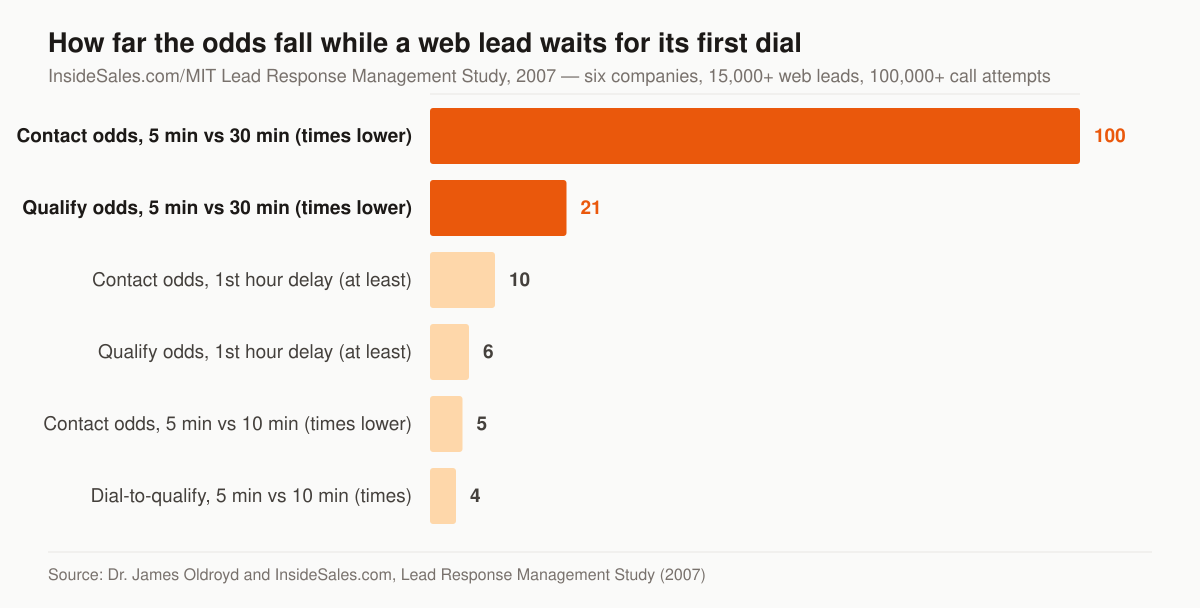
How far the odds fall while a web lead waits for its first dial. Source: Dr. James Oldroyd and InsideSales.com, Lead Response Management Study (2007).
Those figures come from web leads across six companies rather than from Medicare specifically, so treat them as a direction rather than a Medicare benchmark. The direction is unambiguous, and it interacts with everything above: a shared lead is a race, an exclusive lead is a relationship, and a telemarketed lead with a short life span is the one most damaged by a queue. The cadence we build against is set out in our insurance lead follow-up cadence guide, and the calling operation itself is what our appointment setting service exists to run.
Compliant Medicare lead generation under TPMO and TCPA
Compliance is not a tax on Medicare marketing. It is a trust signal, and for Medicare Advantage and Part D it is non-negotiable.
Three rules shape how leads can be generated:
- CMS TPMO rules. Third-Party Marketing Organization requirements mandate the standardized TPMO disclaimer when an agent represents fewer than all plans in a service area, ban misleading claims, and require clear consent at data capture. See our plain-English guide to CMS Medicare marketing rules and the broader AEP marketing strategy playbook.
- TCPA. Calling and texting Medicare prospects requires documented consent. The FCC one-to-one consent rule was vacated in January 2025, but TCPA itself still governs how you contact a lead.
- Meta Special Ad Category. Insurance-adjacent housing/credit limits do not apply to Medicare directly, but age-targeting on Meta is constrained, which shapes how T65 audiences are built.
We provide marketing services, not licensed insurance advice. You are the licensed party; we build the compliant pipe that feeds you.
Inbound and outbound: the channels you rent versus the ones you own
Every Medicare lead reaches you through a channel you rent or a channel you own, and the difference shows up in year two rather than month one. A purchased lead is inventory: the cost repeats every month at whatever the market charges that season, and it charges the most during AEP, when every agent in the country wants the same impression. An owned channel — a site that ranks, a list you built, a seminar audience that returns — has a build cost and then a maintenance cost.
The practical answer is rarely one or the other. Buying fills capacity now; building lowers blended cost per enrolled member later. Where we usually start is with the assets that keep working after the campaign stops: a Medicare agent website that converts the traffic already arriving, then paid acquisition on top of it through Medicare Facebook ads once there is somewhere worth sending the click. The product-specific plays sit in Medicare Supplement lead generation and the turning-65 system.
Our published retainers start at $2,500 a month for Foundation, $3,500 for Growth and $5,500 for Full-Funnel, with one-time website builds from $2,500 to $8,000; the tier breakdown is on the pricing page. Set that against the lead bands above before deciding which side of the buy-versus-build line your next dollar belongs on.
What “best Medicare leads for agents” actually means
There is no universal best Medicare lead. The best lead is the one that fits your follow-up capacity, your plan portfolio, and your enrollment window. A solo agent who calls within five minutes wins on exclusive T65. A six-seat dialer room may profit on shared SEP volume.
Four questions settle it faster than any vendor comparison. How many dials can you make in the first hour after a lead lands? Which products are you appointed for, and does the lead type match them? Which election window is the prospect actually inside? And what did your last hundred leads cost per enrolled member, after charge-backs?
Start by auditing your current cost per enrolled member, then work backward. The free marketing audit does exactly that: we pull your numbers, map them against the AEP/SEP calendar, and show where the leaks are. If you would rather open with a conversation about your market and your appointments, get in touch.
For a worked example of these lead-economics levers applied to one agency, read our Medicare agency case study. And for the full senior-market picture, including websites and content that pre-qualify before the call, see our Medicare marketing overview.