Final Expense Mailer Templates: Four Free, Editable Downloads
Below are four free final expense mailer templates — a letter with tear-off reply card, a 6×9 postcard, a turning-65 letter, and a thank-you/referral card — each downloadable as editable HTML and print-ready PDF. Every template bakes in the disclosure structure that NAIC advertising model regulations and state senior-marketing rules expect, with merge fields you customize before carrier sign-off.
Most pages ranking for “final expense mailer templates” show you a locked preview and a checkout button. This one gives you the actual files. Below are four final expense mailer templates — the classic letter with a tear-off reply card, a 6×9 postcard, a turning-65 letter, and a post-sale thank-you/referral card — each as editable HTML you can open in any browser and a print-ready PDF. Download them, replace the bracketed merge fields, get carrier sign-off, and mail.
They are deliberately plain. In this market, plain is what survives compliance review and still gets read. The strategy layer — where mail fits next to Facebook, transfers, and SEO — lives on our final expense marketing program page; this post is the toolbox.
Which final expense mailer templates are in the free pack?
| Template | Size / format | Built for | Response path |
|---|---|---|---|
| Letter with tear-off reply card | 8.5×11 letter | Cold, age- and income-filtered lists; the classic mail-back lead | Postage-paid reply card or call |
| 6×9 postcard | Postcard, front + back | Lower-cost volume drops and second touches | Phone call |
| Turning-65 / senior letter | 8.5×11 letter | T65 birthday lists and retirement-timing prospects | Phone call |
| Thank-you / referral card | 5.5×8.5 card | Existing clients right after policy delivery | Hand-back or mail-back referral card |
1. Letter with tear-off reply card
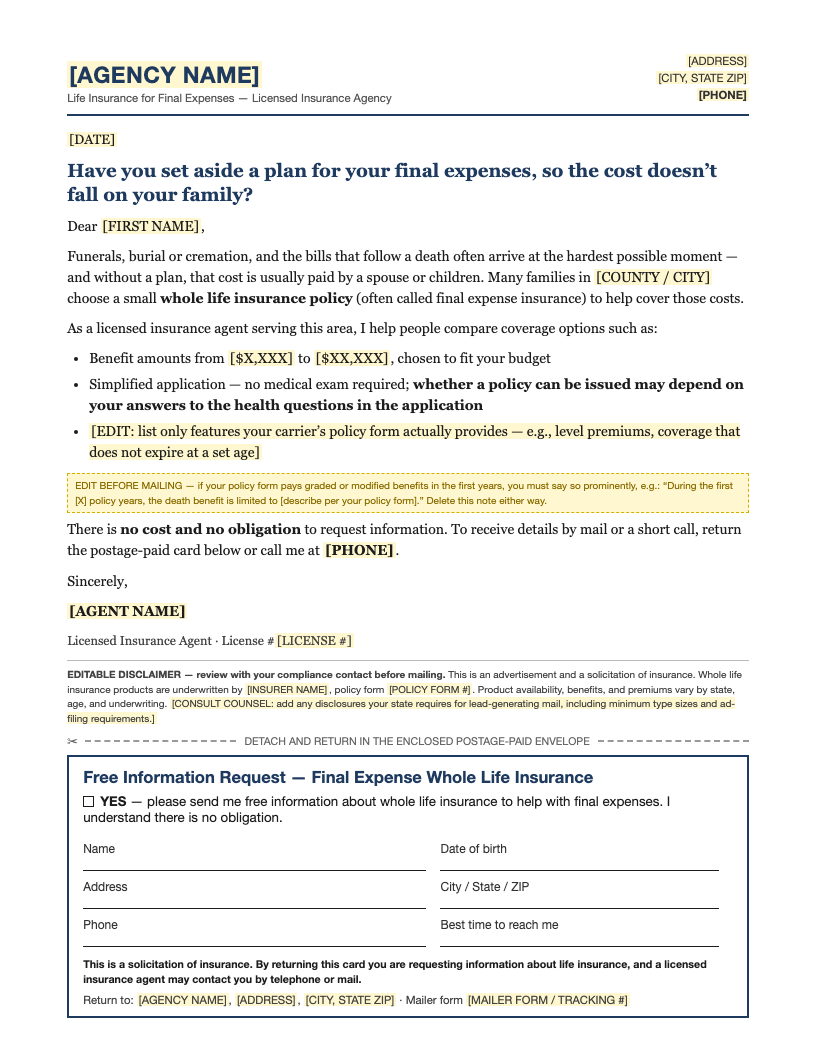
The workhorse. A one-page letter that opens on the family-cost question, frames the product honestly as small whole life insurance for final expenses, and ends in a detachable, postage-paid reply card. The card is the lead: it captures name, date of birth, address, phone, and preferred call time, above a consent line stating that a licensed agent may contact the respondent by telephone or mail. Use it on cold lists when you want a durable, written response record.
Download the reply card — editable HTML · Download the reply card — print-ready PDF
2. 6×9 postcard (front + back)
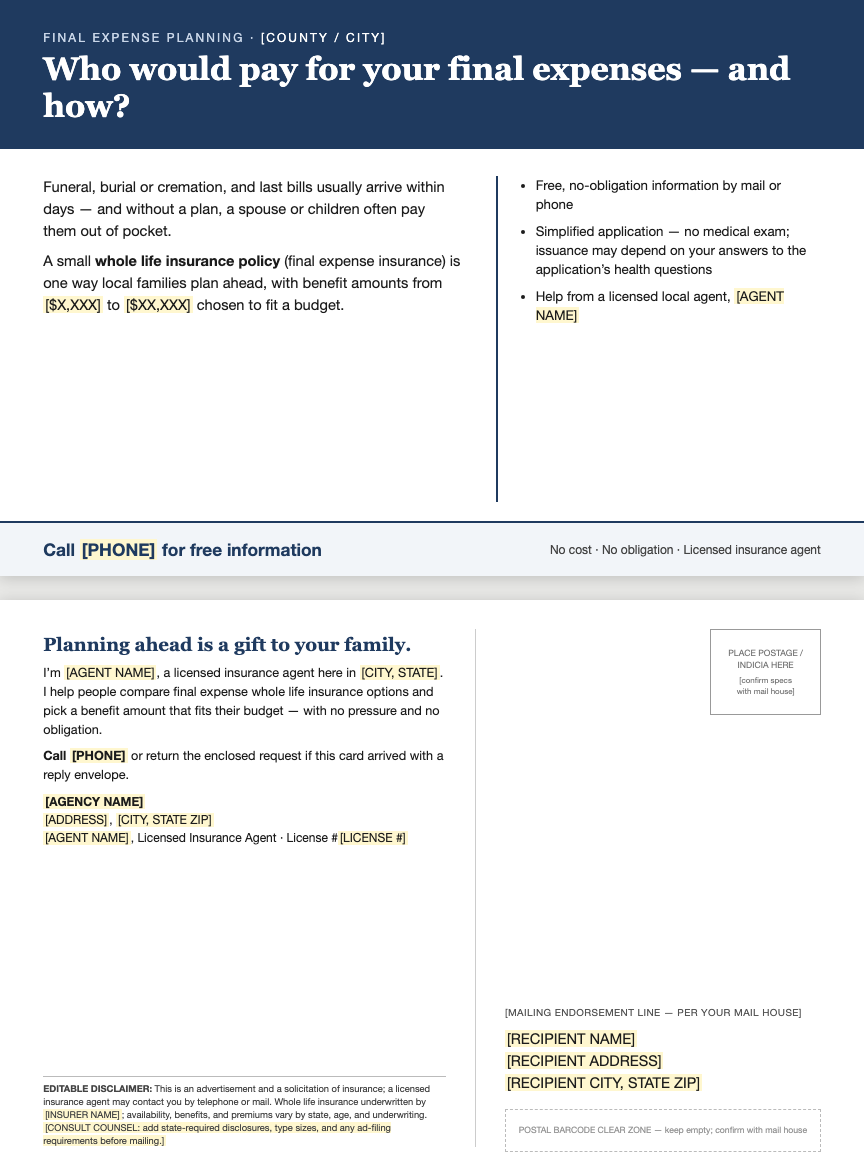
The volume piece. The front poses the question — who would pay for your final expenses, and how — with three scannable benefit lines and a phone number; the back introduces the local licensed agent by name and repeats the call-to-action. No reply card, so the response path is a phone call. Use it for cheaper, higher-frequency drops and as the second or third touch on a list you have already lettered. It includes an indicia/barcode zone to confirm with your mail house.
Download the 6x9 postcard — editable HTML · Download the 6x9 postcard — print-ready PDF
3. Turning-65 / senior letter
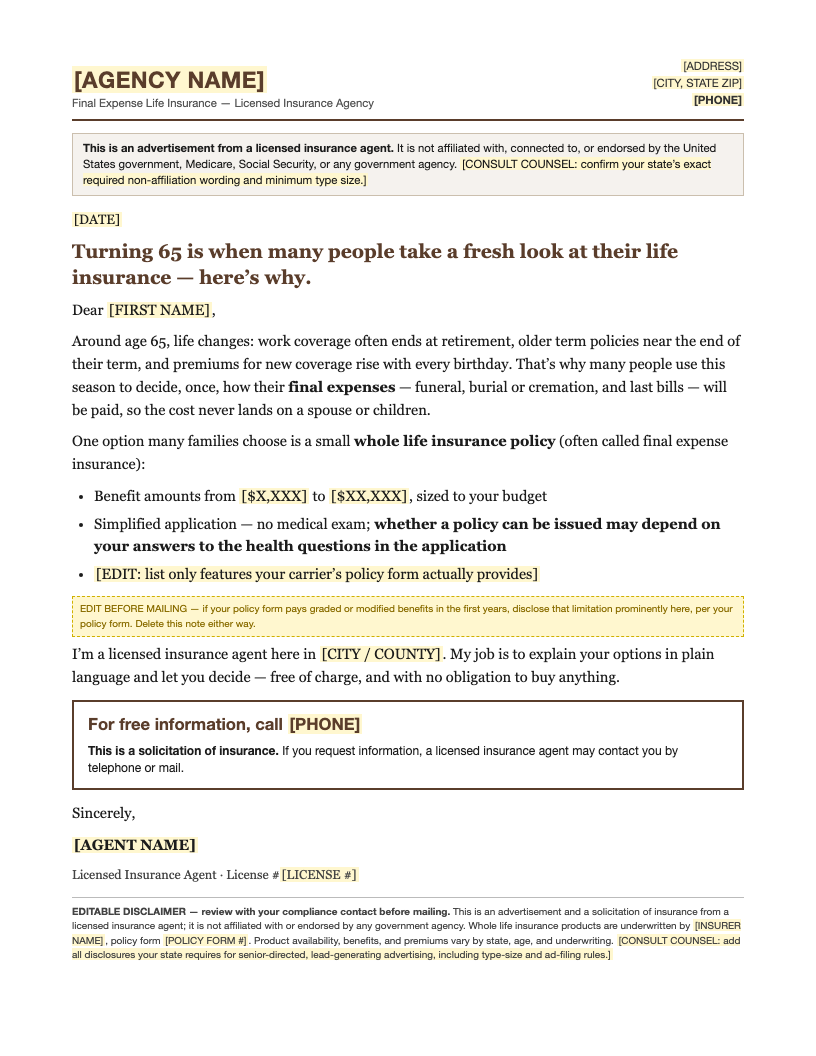
The life-event piece, built for T65 birthday lists. Its hook is timing, not fear: around 65, work coverage ends at retirement, older term policies run out, and new coverage gets pricier with every birthday — so this is the season to settle how final expenses will be paid. Because senior-directed mail is where regulators look hardest, this template rides a prominent non-affiliation banner at the very top: it is an advertisement from a licensed agent, not connected with or endorsed by the government, Medicare, or Social Security.
Download the T65 letter — editable HTML · Download the T65 letter — print-ready PDF
4. Thank-you / referral card
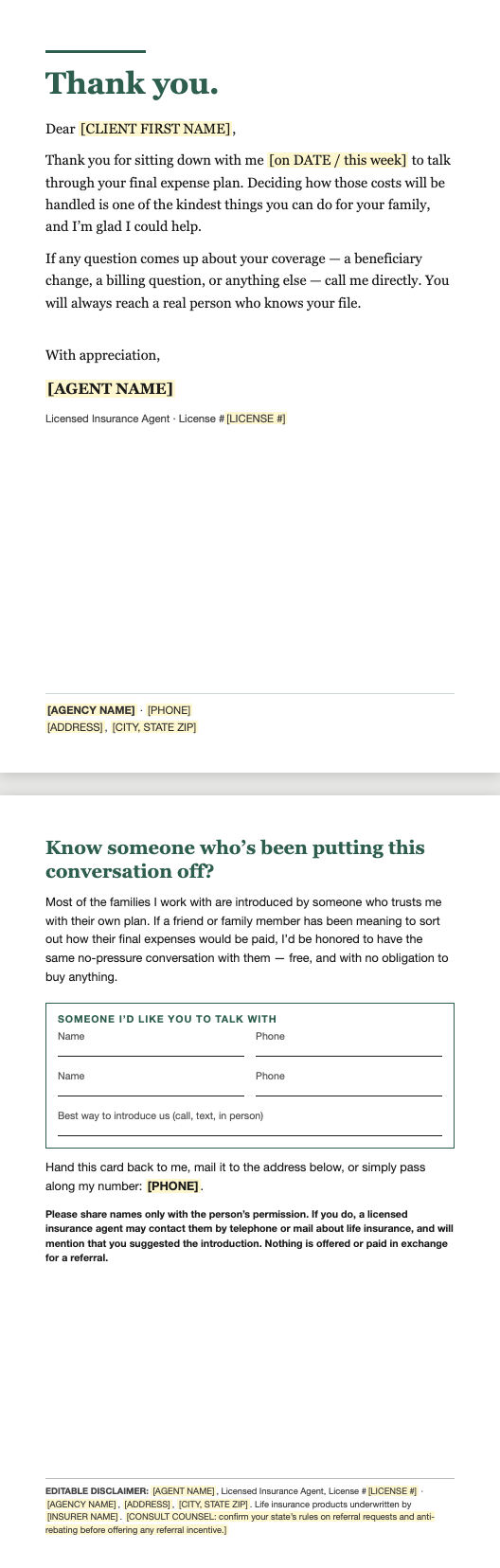
The cheapest lead source in the pack. A 5.5×8.5 card that thanks a new client after policy delivery, restates the service promise (“you will always reach a real person who knows your file”), then makes a soft referral ask: two name-and-phone lines plus a “best way to introduce us” field. It offers nothing in exchange for the referral — by design, since referral incentives collide with anti-rebating rules in many states — and asks the client to share names only with the person’s permission.
Download the follow-up referral card — editable HTML · Download the follow-up referral card — print-ready PDF
What does a compliant final expense mailer include?
Every template in the pack is built around the same four load-bearing parts. (The final expense marketing pillar covers the anatomy in the context of the whole channel mix; here is the short version as it applies to these files.) The hooks carry off paper as well: the same angles run as posts, emails, and videos in our content ideas for final expense agents list.
An honest headline. A plain benefit question aimed at the family’s cost, a local age-band frame, or a life-event hook. Never a fake government notice, a “benefit waiting to be claimed,” or manufactured urgency.
A short body that names the product. Each template says “whole life insurance” out loud, states that no medical exam is required and, right beside it, that issuance may depend on the answers to the application’s health questions — a pairing the NAIC’s life-advertising model regulation explicitly requires. No premium quotes on paper: a printed number you can’t honor burns the lead.
A response device. The reply card, the phone number, or the referral lines. On the reply card, every field earns its place, and the consent sentence is the part that makes the lead legally workable.
Identification and disclaimers. Each piece identifies itself as an insurance advertisement and solicitation, names the agent and agency with license number, carries an editable insurer/policy-form line, and flags — in visible EDIT/CONSULT COUNSEL notes — the graded-benefit disclosure and state-specific wording you must resolve before printing.
Which headline and reply-card formulas power each template?
The four templates run four distinct copy formulas. Steal the pattern, not just the words:
- Family-cost question (reply-card letter): “Have you set aside a plan for your final expenses, so the cost doesn’t fall on your family?” The reader’s spouse and kids are the subject; the product enters only after the problem is real. The reply card then asks for exactly six things — name, date of birth, address, city/state/ZIP, phone, preferred call time — plus the consent line.
- Direct question + local agent (postcard): “Who would pay for your final expenses — and how?” One honest product sentence, three scannable bullets, then a named local agent and phone number. Postcards win by being readable in three seconds on the way to the recycling bin.
- Life-event timing (T65 letter): “Turning 65 is when many people take a fresh look at their life insurance — here’s why.” The urgency is real (retiring coverage, expiring terms, age-rated premiums), so nothing has to be invented — and the non-affiliation banner sits above all of it.
- Gratitude before the ask (referral card): Thank-you first, service promise second, referral request last, permission-based and unrewarded.
The anti-patterns are just as important: no eagle seals or “official business” envelope games, no “you have been individually selected” (prohibited when the piece goes to everyone on a mailing list), no enrollment deadlines that don’t exist, and no “low cost” framing on guaranteed-issue products — a restriction worth reading in full if you write that product, since marketing guaranteed issue final expense narrows what you can promise further. For the same principles applied across paid and organic formats, see our annotated insurance advertising examples.
How do you build the mailing list for a final expense drop?
The templates address a person; the list decides whether that person can buy. Basics that hold across the pack:
- Age band. Final expense lists typically run seniors in a set band (the letter and postcard templates frame “age 50–80” as an editable field). The T65 letter wants a birthday list pulled a few months ahead of each prospect’s 65th.
- Income filter. The classic FE filter is modest, fixed income — this buyer is protecting family from burial costs, not doing estate planning. Match the filter to the product you actually intend to write.
- Geography. Mail the counties you are licensed in and can service; the templates surface [COUNTY / CITY] merge fields because local specificity lifts response and matches the license disclosure on the piece.
- Hygiene and suppression. Run the list through your mail house’s address hygiene, and suppress current clients, recent responders, and any names you are already working from other sources — including aged final expense leads you may have bought, so the same senior isn’t dialed and mailed by you in the same week.
- Move Update, if you want commercial prices. DMM 602.5.1 puts every address in a mailing at commercial First-Class Mail presorted or automation prices, or at USPS Marketing Mail prices, under the Move Update standard: each address must be updated within 95 days before the mailing date using an approved method such as NCOALink or Address Change Service. A list bought in January and mailed in June is out of compliance on its face, and the discount is what you lose.
- Keep the card. A returned reply card is your consent artifact. Image and archive every one — some states require you to disclose at first contact that the person’s name came from a lead card, and the card itself is the record that supports the call.
Budget-wise, mail is paid per piece regardless of response, so judge it the way we judge every channel: cost per issued policy, not cost per thousand pieces. The what to budget for agency marketing walks that math.
What does it cost to mail one of these templates?
Postage is the floor under every direct mail budget, and it moves with the class you mail and how well the list is presorted. These are the published per-piece prices in USPS Notice 123, the price list effective July 12, 2026. Whatever your mail house quotes sits on top of these numbers, not instead of them.
| What you are mailing | Mail class and preparation | Price per piece |
|---|---|---|
| Postcard dropped one at a time | First-Class Mail, retail single-piece postcard | $0.65 |
| Reply-card letter dropped one at a time | First-Class Mail, retail single-piece letter, stamped, 1 oz. | $0.82 |
| Postcard in a presorted commercial drop | First-Class Mail, automation 5-digit postcard | $0.453 |
| Letter in a presorted commercial drop | First-Class Mail, automation 5-digit letter, 1 oz. | $0.621 |
| Letter at advertising-mail prices | USPS Marketing Mail, automation 5-digit letter | $0.395 |
| Letter to every address on a carrier route | USPS Marketing Mail, carrier route saturation letter | $0.255 |
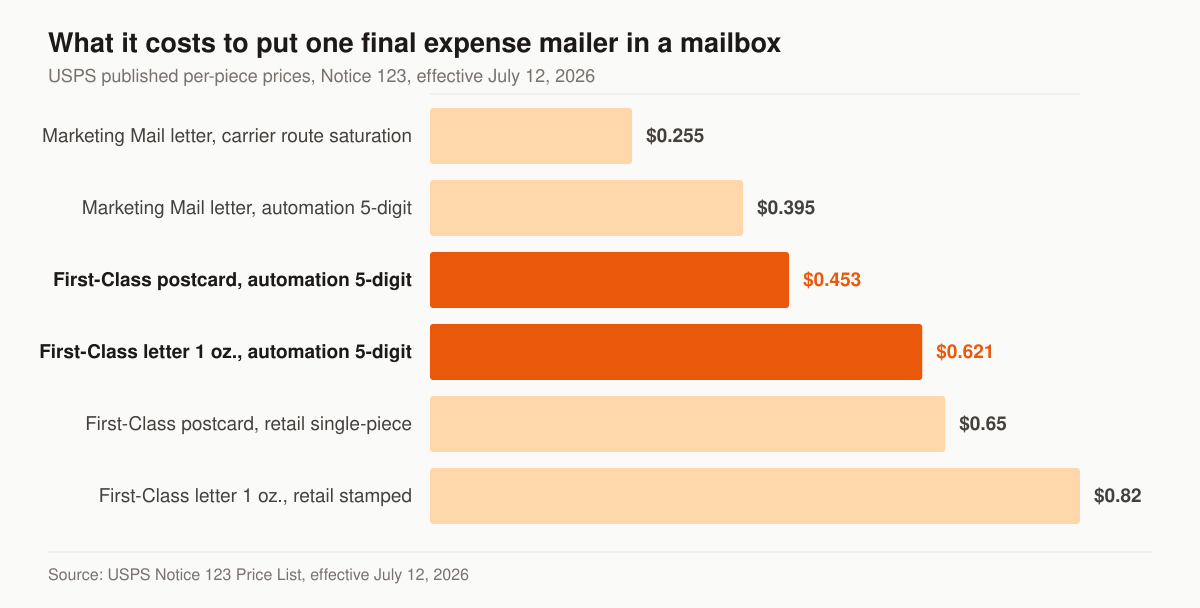
Per-piece prices from the USPS Notice 123 price list effective July 12, 2026. The two highlighted rows are the classes these templates are designed for.
Read the bottom row carefully before it tempts you. Carrier route saturation carries the lowest price in the table because it goes to every address on a route — there is no age band and no income filter, which is the opposite of what a final expense list is for. The saturation price buys reach, not the buyer you built the age and income filters to find.
Three costs sit outside the per-piece table and surprise agents who try to run a drop themselves. Notice 123 sets the annual mailing fee at $390.00 per office of mailing for First-Class Mail Presort and another $390.00 for USPS Marketing Mail, and the permit imprint application fee at $390.00. And a nonmachinable envelope does not stay at the automation price: in the commercial First-Class letter table, a nonautomation nonmachinable letter of one ounce is priced at $0.844 at 5-digit, $0.979 at 3-digit/SCF and $1.128 at mixed, against $0.621 for the automation 5-digit letter in the table above, so read the DMM 101.1.2 nonmachinable characteristics before you approve an unusual envelope. We treat those fees as the reason to start at a mail house that already holds the permits, and to bring a permit in-house only once the mail volume is steady enough to be worth the paperwork.
For an all-in comparison, two vendors publish their numbers on their own live pages. Print Label and Mail lists full-service direct mail starting at $813 — described as including custom postcard design, printing, a neighborhood list, labeling, mail prep and postage — with postcard printing alone starting at $138 and targeted mailing lists starting at $80. My Insurance Postcards prints and mails its final expense postcards starting at 56 cents per piece, postage included. Those are the numbers to hold your own quote against, and the reason the templates on this page are free: the design was never the expensive part of a drop. Where mail lands against paid and organic channels is the whole point of the cost per issued policy math, and if you would rather have the whole channel mix run for you, our published monthly pricing is the starting point.
Will these template sizes mail at card prices?
Card prices are a dimensional test, not a design preference — DMM 201.1.2.1 decides it, and a piece that trims past the maximum stops being a card. Here is where each template in the pack falls.
| Template | Size as built | Governing standard | Where it lands |
|---|---|---|---|
| 6×9 postcard | 6 in. high × 9 in. long | Postcards claimed at card prices may be no more than 6 in. high, 9 in. long, or 0.016 in. thick (DMM 201.1.2.1) | Sits exactly on the maximum on both dimensions; aspect ratio 1.5 is inside the required 1.3-to-2.5 band |
| Thank-you / referral card | 5.5 in. high × 8.5 in. long | Same card standard, plus the 3-1/2 in. by 5 in. minimum | Inside every limit, with room to spare |
| Letter with tear-off reply card | 8.5×11 sheet, folded into an envelope | Machinable letter-size mail is no more than 11-1/2 in. long, 6-1/8 in. high, or 1/4 in. thick, within the same 1.3-to-2.5 aspect ratio (DMM 201.1.1.1) | Mails as a letter, never as a card |
| Turning-65 / senior letter | 8.5×11 sheet, folded into an envelope | Same machinable-letter standard | Mails as a letter |
Two traps live inside that table. The first is thickness: DMM 201.1.2.1 requires cards more than 4-1/4 inches high or 6 inches long to be at least 0.009 inch thick, and a postcard that misses that minimum is a nonmachinable letter, not a card. Print Label and Mail lists 14pt card stock for its final expense postcards; ask your printer for the caliper in inches, because 0.009 is the figure the Postal Service actually checks. The second is the size upgrade a printer will happily sell you. The same vendor offers a 6×11 jumbo postcard, and 11 inches is past the 9-inch card maximum — that piece prices as a letter, and the whole per-piece line in your budget changes with it.
How does the postage-paid reply card actually work?
A postage-paid reply card is not free postage; it is a permit plus a charge on every card that comes back. Business Reply Mail bills you only for returns, which is the right shape for a lead program, but the fee structure has more rows in it than the phrase “postage paid” suggests. All of these are from Notice 123.
| Reply-mail option | Annual permit fee | Annual account maintenance | Quarterly fee | Charge per returned card |
|---|---|---|---|---|
| BRM, Basic | $390.00 | none | — | $0.65 + $1.31 |
| BRM, High Volume | $390.00 | $1,130.00 | — | $0.65 + $0.164 |
| QBRM, Basic | $0.00 | $1,130.00 | none | $0.624 + $0.058 |
| QBRM, High Volume | $0.00 | $1,130.00 | $3,850.00 | $0.624 + $0.036 |
| QBRM, IMbA | $0.00 | $0.00 | $0.00 | $0.624 + $0.023 |
Run those rows against the number of cards you expect back, not the number you mail — the fixed fees are annual and the per-piece charge is not. Basic BRM is the row with no annual maintenance fee and the highest charge per returned card; the qualified rows trade fixed fees for a far smaller per-piece charge, and the IMbA row carries no fixed fee at all in this list. Which row you can actually claim depends on volume and on how the reply piece is prepared, so settle it with your mail house before the artwork is final rather than after, because the reply-card layout has to match whatever you qualify for.
You can also skip reply mail entirely. That is a legitimate design choice, and it is why the 6×9 postcard template in the pack has no reply card at all: its response path is a phone call, which costs the respondent nothing and costs you nothing until the phone rings. Mail is one route into the pipeline among several — the rest are compared in how to generate final expense leads. The trade is what you get back — a call gives you a conversation, a returned card gives you a written consent artifact with a date on it, and those are worth different things.
What advertising rules govern final expense mailers?
Three primary sources shaped these templates. Read them yourself — they are short — and treat this as marketing guidance, not legal advice; your carrier and compliance counsel make the final call.
- NAIC Model 570 — Advertisements of Life Insurance and Annuities Model Regulation. The core rulebook for FE mail, since final expense is life insurance. Ads must be truthful and not misleading, judged on the overall impression created (§4A). “No medical exam” claims must sit in juxtaposition with an equally prominent disclosure that issuance may depend on the application’s health questions (§5C) — the templates pair these sentences on purpose. Graded or modified benefits must be prominently disclosed (§5G), and guaranteed-issue policies can’t be marketed as “inexpensive” or “low cost” (§5H). No words, symbols, or physical materials similar to a governmental program or agency (§6C). And every ad — regardless of who created it — is the insurer’s responsibility too: carriers must run prior-approval systems and keep specimen files of every ad for five years after last use (§3B, §9A), which is why carrier sign-off is structural, not a courtesy.
- NAIC Model 40 — Advertisements of Accident and Sickness Insurance Model Regulation. The health-side advertising regulation — directly in scope the moment a senior mailer touches health or Medicare-adjacent products, and the source of the lead-card standards many state rules mirror. It defines a lead-generating device as any communication to the public intended to compile a list of names for insurance solicitation (§3I), requires mail ads and lead-generating devices to disclose that an agent may contact the applicant (§5B(30)), bans “individually selected” claims on list mail (§5B(31)) and anything implying connection with a government agency such as the Social Security Administration (§5B(21)), and prohibits cold lead advertising — marketing that hides, rather than conspicuously discloses, that its purpose is insurance solicitation and that an agent or insurer will make contact (§8B(3)).
- California Insurance Code §787. The template for state senior-advertising statutes. Advertising directed at persons 65 or older must disclose that an agent may contact the applicant, and an agent who gets a name from a lead-generating device must disclose that fact in the initial contact. It also bars names and symbols so similar to those of governmental agencies, charities, veterans or senior organizations that they could mislead — and requires event ads to append “and insurance sales presentation” to words like “seminar” in identical type.
States adopt these models with local changes, add type-size minimums, and sometimes require ad filing. That is what the [CONSULT COUNSEL] notes inside each template are for — they mark exactly where state-specific wording goes.
Can you call someone who mails back a reply card?
Insurance advertising rules govern what goes on the paper. A different regulator governs what happens after the card comes back, and this is where a compliant mailer turns into a non-compliant phone call.
A returned reply card is an inquiry, and federal telemarketing rules treat an inquiry as a short, expiring window rather than open-ended permission. The chain runs through three paragraphs of one rule, 47 CFR 64.1200:
- The ban. Paragraph (c)(2) prohibits initiating any telephone solicitation to “A residential telephone subscriber who has registered his or her telephone number on the national do-not-call registry of persons who do not wish to receive telephone solicitations that is maintained by the Federal Government.”
- The carve-out. Paragraph (f)(15) defines telephone solicitation and then says the term “does not include a call or message” falling into three listed classes, the second of which is “To any person with whom the caller has an established business relationship”.
- The clock. Paragraph (f)(5) defines that relationship, for telephone solicitations, as one formed by voluntary two-way communication “on the basis of the subscriber’s purchase or transaction with the entity within the eighteen (18) months immediately preceding the date of the telephone call or on the basis of the subscriber’s inquiry or application regarding products or services offered by the entity within the three months immediately preceding the date of the call, which relationship has not been previously terminated by either party.”
Three months, running from the inquiry, and belonging to the entity the respondent inquired of — the same rule adds at (f)(5)(ii) that a subscriber’s established business relationship with a particular business entity “does not extend to affiliated entities unless the subscriber would reasonably expect them to be included given the nature and type of goods or services offered by the affiliate and the identity of the affiliate.” So a card mailed back to your agency does not automatically license the upline, the FMO, or a downline agent to dial it; the rule turns on whether the respondent would reasonably expect that affiliate to be included.
Four conditions survive the carve-out, and none of them are optional:
- Hours. Paragraph (c)(1) bars a telephone solicitation to any residential telephone subscriber “before the hour of 8 a.m. or after 9 p.m. (local time at the called party’s location)”.
- Your own list. Paragraph (d) requires anyone making telemarketing calls to a residential subscriber to have instituted procedures for maintaining a list of people who ask not to be called, including a written policy available on demand and trained personnel. And (f)(5)(i) is explicit that a seller-specific do-not-call request ends the established business relationship even if the person keeps doing business with you.
- Dialers and recordings are a separate question. Paragraph (a)(2) requires prior express written consent for any call that “includes or introduces an advertisement or constitutes telemarketing, using an automatic telephone dialing system or an artificial or prerecorded voice” placed to the numbers described in (a)(1)(i) through (iii) — a list that includes any number assigned to a cellular telephone service. The paragraph’s own exits are a tax-exempt nonprofit caller and a HIPAA health-care message, neither of which is available to a licensed agent selling life insurance. An established business relationship does not substitute for that consent, and nothing on a handwritten reply card tells you whether the number is a landline or a mobile.
- State law sits on top. The federal rule is a floor, not a ceiling. California Insurance Code §787, cited in the section above, already requires an agent who obtains a name from a lead-generating device to disclose that fact in the initial contact — one state, one extra duty, and yours may add others. Confirm your own state’s do-not-call and lead-card rules before the first dial, and read our insurance marketing compliance overview for the broader picture.
The practical consequence is a scheduling one. If the exemption you are relying on expires three months after the card is postmarked, a stack of unworked cards is not a pipeline — it is an expiring asset. That is the same argument the follow-up cadence makes on conversion grounds, arriving from a completely different direction. If dialing is the part that keeps slipping, the phone-first version of this problem is worked through in how to sell final expense over the phone.
How do you take a template from download to mailbox?
- Download both files. The HTML opens in any browser for preview and edits in any text editor; the PDF is the print-ready reference layout.
- Replace every bracketed merge field. [AGENCY NAME], [AGENT NAME], [LICENSE #], [PHONE], [ADDRESS], [COUNTY / CITY], [INSURER NAME], [POLICY FORM #], and the benefit-amount ranges. No brackets may survive to print.
- Resolve every EDIT and CONSULT COUNSEL note. The big two: if your policy form pays graded or modified benefits in the first years, disclose that limitation prominently; and confirm your state’s required wording, type sizes, and any ad-filing rules.
- Get carrier advertising approval. Submit the finished piece through your carrier’s ad-approval process and keep the approved specimen — their obligation under the model regulation, and your paper trail.
- Order and scrub the list. Apply the age, income, and geography filters; run hygiene and suppression; for the postcard, confirm indicia and barcode clear-zone specs with your mail house before printing.
- Build the reply path before the drop. Decide who images the cards, who dials, and how fast. A reply card answered days later is a wasted stamp — wire responses into the same follow-up cadence you run on digital leads.
The bottom line
Direct mail is the intent channel of final expense: slower and paid per piece, but the senior who mails back a card or dials a postcard number is telling you something a form-fill rarely does. These four templates cover the full arc — cold list, volume touch, T65 timing, and the post-sale referral loop — and every one of them is free, editable, and built around the disclosure structure regulators actually check.
Mail is still only one input. If you want the demand side built and run for you — mail-adjacent lead flow, exclusive and live-transfer leads, and the routing that answers them in minutes — that’s our insurance lead generation service, and the full engine lives in the final-expense program. Want a second set of eyes on a piece you’re about to print, or on the list behind it? Start with a free marketing audit.
- Guaranteed Issue Final Expense Marketing: How Agents Actually Sell It
How to run guaranteed issue final expense marketing that profits: who to target, compliant ad angles, and how to message the graded death benefit.
- How to Evaluate the Best Final Expense Carriers for Agents
How to evaluate the best final expense carriers for agents: underwriting niches, issue ages, graded wording, ratings and a scoring framework.
- Final Expense Sales Tips That Actually Move Placed Policies
Final expense sales tips from a working book: lead routing, speed-to-dial, scripting, and the close mechanics that turn contacts into issued policies.
- Free Final Expense Leads for Agents: What They Really Cost
An operator's honest breakdown of free final expense leads: where they come from, what they really cost you in time, and how to build cheap leads instead.