Who we serve
Home Insurance Agency SEO Services That Win the Local Map Pack
Home insurance agency SEO services are built around local search, because homeowners hunting coverage search '[city] home insurance agent' and click the map pack first. The work that moves rankings is concrete: an optimized Google Business Profile, a location page for every town you write in, schema markup, and a steady flow of reviews.
Free · 15-minute teardown · no pitch deck
- We run our own final-expense book
- No pitch deck — we screen-share real numbers
- TCPA-aware · CMS/AEP-compliant · Meta Special Ad Category
- Core Web Vitals < 2.0s LCP
Homeowners don’t research insurance the way they research a final-expense policy. They have a property, a renewal date, or a closing deadline, and they search with local intent: “home insurance agent near me,” “[city] homeowners insurance quote,” “best home insurance in [state].” That behavior is why home insurance agency SEO services have to be local-SEO led, not blog-led. The map pack sits above the organic results, and three listings take most of the clicks. If you’re not in it, you’re competing for scraps.
We’re direct about our credential here. Our authority comes from a senior-market lead operation — final expense — and home insurance is a different buyer, so we don’t pretend the books transfer. What transfers is the mechanism: the same conversion systems and ad discipline that work for our senior-market clients, applied to a vertical where proximity and reviews decide rankings. The measurement habit is the asset, not a fake lineage claim.
Why home insurance SEO lives or dies on local search
Google’s local algorithm ranks on three things: proximity, relevance, and prominence. You can’t move proximity, but you control the other two. Relevance comes from a complete Google Business Profile and on-page signals that match what searchers type. Prominence comes from reviews, citations, and links. We score all three before quoting a program, because an agency that has worked on none of them is competing on distance alone, and distance is the one input nobody can edit.
The weighting is no longer guesswork. Whitespark’s 2026 Local Search Ranking Factors survey asked 47 local search practitioners to score 187 factors. On the local pack list, the primary Google Business Profile category comes first with a score of 227, ahead of proximity of the address to the searcher at 225 and keywords in the business title at 223. Two of those top three are profile fields rather than campaigns, which is the argument for finishing the profile before commissioning a single blog post. One of the two, the business title, is also a trap; the section below unpacks it.
The table below is the same set of levers sorted by how long each takes to show up, because that ordering is what decides which one you fund in month one.
| SEO lever | Time to impact | Effort | Primary payoff |
|---|---|---|---|
| Google Business Profile optimization | 30–60 days | Low | Map-pack visibility |
| Review velocity (steady, not bulk) | 30–90 days | Ongoing | Map rank + click-through |
| Location pages (one per town) | 4–8 months | Medium | Organic + local relevance |
| NAP / citation consistency | 60–120 days | Low–medium | Trust signals, dedupe |
| Coverage-question content | 4–8 months | Medium | Top-of-funnel capture |
We sequence the fast levers first so leads start moving while the slower equity compounds.
Who is searching, and what that changes about the pages you write
An SEO plan aimed at homeowners is aimed at a defined slice of the population, and the Census Bureau publishes its exact shape. In the second quarter of 2026 the U.S. homeownership rate was 65.0%, covering 86,985,000 owner-occupied units out of 133,811,000 occupied housing units. The rate rises steeply with the age of the householder.
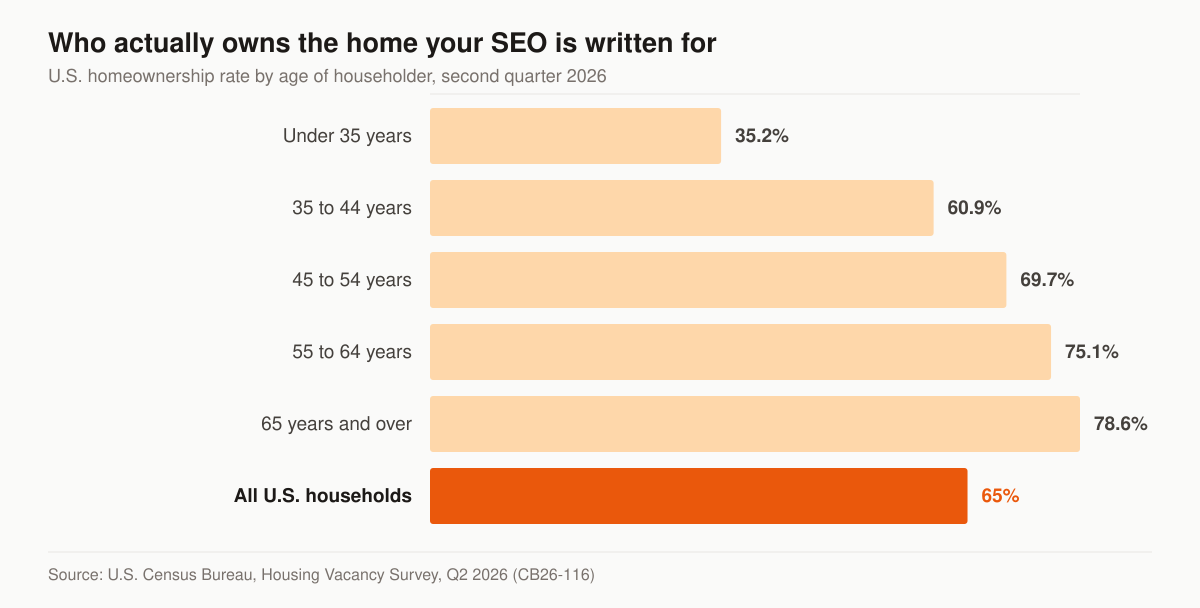
U.S. homeownership rate by age of householder, second quarter 2026. Source: U.S. Census Bureau, Quarterly Residential Vacancies and Homeownership, release CB26-116, 28 July 2026.
Three things follow for the page itself. The first is that the homeowner population is weighted toward older householders: 78.6% of those aged 65 and over own, against 35.2% of those under 35. Body text at a comfortable size, phone numbers that are tappable, and a quote form that does not require a desktop are not accessibility garnish on a homeowners page, they are the audience.
The second is a sizing rule for location pages. The addressable market of a city page is its owner-occupied households, not its population, and at a 65.0% national rate the two numbers are far apart. A town of 8,000 people is not a town of 8,000 prospects, which is how a service-area list balloons into forty pages that each deserve a fraction of an hour.
The third is a cross-sell prompt. The under-35 group renting at scale is the renters insurance audience, and renters is the line that turns into a homeowners policy at the first closing. If you write both, they are separate pages with separate intent, not one page hedging between them.
The query map: which home insurance searches an agent can actually win
Carriers and comparison sites own the head terms. What an agency can win is the query with something attached to it — a city, a peril, a constraint, or a deadline — because that is where national scale stops helping and local knowledge starts.
The table below maps the five query shapes worth building for, with the job each page has to do before it can convert.
| Query shape | Example search | What the page has to do |
|---|---|---|
| Renewal shopper | “why did my home insurance go up in [state]” | Explain the drivers honestly, then offer a re-shop |
| Purchase deadline | “home insurance binder before closing” | Show turnaround time and a same-day quote path |
| Availability | “home insurance after non-renewal,” “roof over 20 years” | Say which carriers you can actually place, and where |
| Local buying intent | “[city] homeowners insurance quote,” “agent near me” | Rank in the map pack and answer the phone |
| Coverage question | “how much dwelling coverage do I need” | Answer it fully, then route to a quote |
The first three of those shapes are trigger queries — someone searching them has a reason and a date. The home insurance agent marketing pillar covers the triggers themselves, including the force-placed insurance notice schedule and the flood gap, and the home insurance agent marketing playbook sequences which page gets built first. For pulling the query list before anything is written, our guide to insurance SEO keywords covers the mechanics.
The build order we actually use
For a homeowners insurance SEO engagement, the work runs in this order:
- Claim and optimize the Google Business Profile — correct category, service areas, photos, and weekly posts. This is where we spend the first hour of a local program, because the primary category is the highest-scoring factor on the survey’s local pack list.
- Fix NAP consistency across every directory so Google stops seeing two “versions” of your agency.
- Build real location pages — one per town you write in, each with local risk factors (wind, flood, wildfire zones), carrier availability, and a quote path. No swapped-city templates; Google filters those, and the section below quotes the policy that says so.
- Add LocalBusiness and FAQ schema so AI search and rich results can read the page cleanly.
- Install a review request system that asks every closed client at the right moment.
This is the same disciplined structure behind our home insurance agent marketing program, and it ladders up to our broader insurance SEO methodology for agencies that want the full technical and content build, not just local.
Is your Business Profile even eligible?
Before optimizing a profile, check that the profile is allowed to exist in the shape you have built it. Google’s guidelines for representing your business on Google settle four questions that come up on every insurance engagement.
- An agent is an individual practitioner. Google’s wording: “An individual practitioner is a public-facing professional, typically with their own customer base. Doctors, dentists, lawyers, financial planners, and insurance or real estate agents are all individual practitioners.” That is what makes a producer eligible for a profile of their own.
- A downline producer inside a corporate sales structure is not. The same section states: “Sales associates or lead generation agents for corporations aren’t individual practitioners and aren’t eligible for a Business Profile.” It also closes the stacking loophole: “A practitioner shouldn’t have multiple Business Profiles to cover all of their specializations.” One agent, one profile, even if you write home, auto, and umbrella.
- A solo producer under a carrier brand shares one profile. Google prescribes the format: “Create a single Business Profile, named using the following format: [brand/company]: [practitioner name],” and gives “Allstate: Joe Miller” as the acceptable example.
- Working from home means the address comes down. “If you’re a service-area business, you should hide your business address from customers.” On reach, Google’s default expectation is that the boundaries of the service area “shouldn’t extend farther than about 2 hours of driving time from where your business is based,” and it attaches an explicit exception: “For some businesses, larger service areas may be appropriate.” An agency that lists half a state should be able to say why it is one of those businesses, rather than setting the radius by appointment ambition.
Two more rules decide whether the profile survives its own optimization. On the business name, Google states: “Including unnecessary information in your business name isn’t permitted, and could result in the suspension of your Business Profile” — and its list of banned additions includes marketing taglines, store codes, and location information. Stuffing “Home Insurance” into an agency name scores well on the survey and risks the listing that carries the ranking; we have written up what that recovery looks like in our guide to a suspended Google Business Profile.
On categories, the guidance is a filter rather than a keyword slot. Google says to “Use as few categories as possible to describe your overall core business from the provided list.” It also says to “Choose categories that are as specific as possible, but representative of your main business.” And it gives the test as a sentence to complete:
Select categories that complete the statement: “This business IS a” rather than “this business HAS a.”
An agency that writes home insurance is an insurance agency that has a homeowners line, which is a different answer from the one category-stuffing produces. The profile and citation work is run as its own service on our insurance local SEO page.
Location pages that rank, and the two spam policies that end city-page sprees
The instinct after a keyword export is to spin up a page for every town in the county. Google names that pattern twice in its spam policies, and one of the examples describes it precisely.
Doorway abuse “is when sites or pages are created to rank for specific, similar search queries. They lead users to intermediate pages that aren’t as useful as the final destination.” Among the illustrative examples: “Having multiple domain names or pages targeted at specific regions or cities that funnel users to one page.” Scaled content abuse “is when many pages are generated for the primary purpose of manipulating search rankings and not helping users,” a practice the policy describes as “typically focused on creating large amounts of unoriginal content that provides little to no value to users, no matter how it’s created.” That last clause closes the loophole an AI writing tool appears to open.
A home insurance city page clears both policies when it carries something only that city has. In this line, that list is unusually concrete:
- Which carriers you can currently bind in that county, and which have stopped writing there.
- The wind or hail deductible practice that applies locally, stated as a percentage of dwelling coverage rather than a flat number.
- Whether the residual market — a FAIR plan, a beach and windstorm plan, or a state-run insurer — is a realistic placement, and what it does and does not cover.
- Roof age and roof material rules that decide eligibility before price does.
- Flood zone status and the separate policy it implies, including the waiting period that makes it a months-early conversation.
- A named producer who writes business in that town, with a phone number that reaches them.
If a page differs from its neighbour by the city name and nothing else, it is the pattern Google just described. We would rather ship six real town pages than forty templates, and six are cheaper to keep accurate when a carrier changes appetite mid-year.
What the survey says a local organic page needs
The local pack is one surface. Localized organic — the blue links under it — is scored separately in the same Whitespark survey, and the top of that list is an argument for site structure rather than for volume.
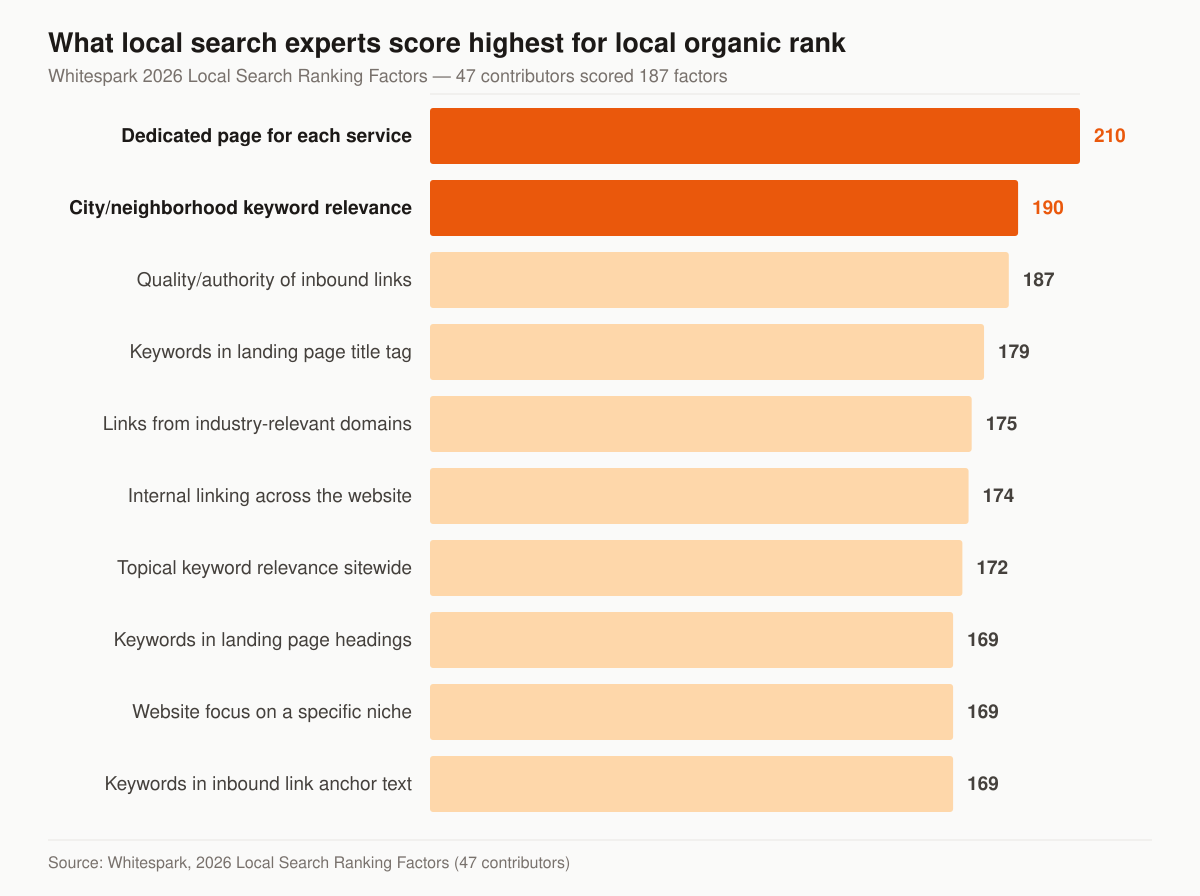
Top ten local organic ranking factors by expert score. Source: Whitespark, 2026 Local Search Ranking Factors, a survey of 47 contributors, read September 2026.
A dedicated page for each service scores 210, ahead of city or neighborhood keyword relevance at 190 and inbound link authority at 187. Read the first two together and the instruction is a grid: a page for each thing you sell, and a page for each place you sell it, with the intersection built where the volume justifies it. Internal linking across the site scores 174 and topical relevance across the site scores 172, which is the case for a small, tightly interlinked agency site over a sprawling blog. The website’s degree of focus on a specific niche scores 169 — a signal a single-line agency site carries by default.
The link rows are the honest constraint. Two of the top five factors are inbound links, and links to an agency site are slow, manual work: local sponsorships, the chamber, the realtor and lender partners already sending you closings, a state association listing. That is the half of the program nobody can promise a date on, and any proposal that does is selling something else. Our write-up on how to rank an insurance agency website covers what actually earns those links.
The technical floor a quote widget puts at risk
Speed is where insurance sites lose ground quietly, and the thresholds are published rather than argued.
The table below is the passing bar for each Core Web Vital, which is the standard a third-party rate quoter has to fit inside.
| Core Web Vital | What it measures | Threshold for “good” |
|---|---|---|
| Largest Contentful Paint (LCP) | Loading performance | Within 2.5 seconds |
| Interaction to Next Paint (INP) | Responsiveness to a tap or click | 200 milliseconds or less |
| Cumulative Layout Shift (CLS) | Visual stability while loading | 0.1 or less |
Those come from web.dev’s Core Web Vitals guide, which also sets the measurement rule that catches people out: “a good threshold to measure is the 75th percentile of page loads, segmented across mobile and desktop devices.” A page that feels fine on your own laptop can still fail, because the bar is set at the 75th percentile: a quarter of loads are allowed to be worse than the value that passes, and they are the loads on older phones over cell data.
On a home insurance site the candidates are specific: a carrier comparative rater embedded in an iframe, a chat widget loaded on every page, and a hero image sized for a desktop that a phone downloads in full. Each one is a decision with a cost attached, not a free add-on. Our home insurance agent website design work treats the quote widget as a line item in the performance budget, and the broader build standards live on the insurance web design service.
Schema markup: what still earns a rich result, and what does not
Structured data is worth adding, and the reason changed in 2023. On 8 August 2023 Google announced it was reducing FAQ rich results, writing that “Going forward, FAQ (from FAQPage structured data) rich results will only be shown for well-known, authoritative government and health websites. For all other sites, this rich result will no longer be shown regularly.” The same post limited How-To rich results, which “will only be shown for desktop users, and not for users on mobile devices.”
That does not make schema pointless on an agency site. Google’s own note in the same post: “While you can drop this structured data from your site, there’s no need to proactively remove it. Structured data that’s not being used does not cause problems for Search, but also has no visible effects in Google Search.” The reason to keep FAQ markup on a home insurance page now is that it hands a machine a clean question-and-answer pair, which is the shape an answer engine can lift. The reason to stop budgeting for it is that Google said the accordion in the blue links is not coming back for a commercial site.
Here is where markup effort belongs on a home insurance agency site, and what each type is actually doing.
| Schema type | What it should describe | What to expect from it |
|---|---|---|
| InsuranceAgency or LocalBusiness | Office address, hours, service area, phone | Feeds the entity behind your map-pack presence |
| Service | The homeowners line specifically, not “insurance” | Clarifies the page subject for crawlers and answer engines |
| Person, on the author | The licensed producer behind the page | Supports a byline a content mill cannot copy |
| FAQPage | Question-and-answer pairs from real quote calls | No rich result for a commercial site; still parseable |
| BreadcrumbList | The page’s place in the site hierarchy | Breadcrumb display in results |
The signals that subtract, and why they outrank what you add
The same survey scores negative factors separately, and the top of that list is administrative rather than editorial. A profile marked permanently closed scores 217. An incorrect primary category scores 214. The presence of other profiles in the same category at the same address — the filter — scores 188. Low numerical Google ratings score 168, a business marked temporarily closed 166, an incorrectly-placed map marker 164, and no hours of operation on the profile 141. Absence of crawlable NAP on the website scores 121, and an address that is a PO box, mail store, or virtual office scores 106.
Three of those have an insurance-specific shape. A producer moves office and leaves the old pin live. An independent agency shares a suite with two other agencies carrying the same category, which is the filter in its natural habitat. And a producer who leaves a carrier can leave a branded duplicate profile behind, competing with the new one at the same address.
The practical read is that a local SEO program has a subtraction phase before it has an addition phase. Checking that list costs an afternoon and requires no new content at all, which is why an audit comes before a proposal here rather than after it.
Reviews decide the click after the ranking
Ranking and being chosen are two different problems, and Whitespark scores them separately. On the conversion list, high numerical Google ratings score 213, positive sentiment in review text 179, quantity of native Google reviews with text 173, recency of reviews 165, and the presence of owner responses to most reviews 136. Those are conversion scores rather than ranking scores: the survey asks separately what makes a searcher choose a listing once they can see it.
For a home insurance agency, two moments in the policy lifecycle put a homeowner in a position to write something specific: the day the policy binds ahead of a closing, and the week after a claim was handled well. A quarterly blast to the whole book catches neither. Build the ask into the bind checklist and it runs itself.
Two constraints on that habit. The FTC’s rule at 16 CFR 465.4 states that it is “an unfair or deceptive act or practice and a violation of this part for a business to provide compensation or other incentives in exchange for, or conditioned expressly or by implication on, the writing or creation of consumer reviews expressing a particular sentiment, whether positive or negative, regarding the product, service, or business that is the subject of the review.” Read the condition rather than the headline: what the section reaches is buying the sentiment, not asking for the review. Our reputation management service covers the rule section by section, and the survey above scores review gating as a negative factor in its own right. Ask everyone, incentivise nobody, and route no one around the honest answer. The operating cadence is in our guide to getting more Google reviews for insurance agents.
AI search is the same page aimed at a second surface
New in the 2026 edition of the survey is a score for visibility in AI search responses, and the ranking it produces is not the same as the local pack list. Presence of the business on expert-curated “best of” and similar lists scores 179. A dedicated page for each service scores 170. Prominence on key industry-relevant domains scores 167, and the quality and authority of unstructured citations — newspaper articles, blog posts, government sites, industry associations — scores 160. Geographic keyword relevance scores 153, and a scannable content structure across the site scores 137.
The pattern is that off-site mentions carry more weight on this surface than profile settings do. For a home insurance agency, that means the local “best insurance agents in [city]” roundups, the chamber and association directories, and the local news quote about storm season are doing work an on-page change cannot replicate. It also means the page itself has to be liftable: a direct answer near the top, headings phrased as the question a homeowner asks, tables a parser can read, and named sources with links.
The genuinely different part is measurement, because a citation inside a chat window produces no Search Console row. Our AI search and GEO service tracks it as its own surface, and the page-level mechanics are in our guide to getting cited by Perplexity and AI Overviews.
Where SEO stops and lead-buying starts
SEO compounds, but it isn’t instant. While rankings mature, some agencies want intent now. That’s a different product — we sell marketing systems, not leads. If your goal is to buy homeowner prospects or live transfers directly, you can buy leads direct from getinsureleads rather than waiting on organic. On this site, we build the engine that lowers your cost-per-lead over time; the proof we lean on is our own book — live campaigns we actually run — applied as method, not as a home-insurance result.
A note on timing that follows from the tables above. Location and coverage pages take months to mature, so they get built ahead of renewal season rather than during it. A page published in the week you need it has not been indexed, linked or aged long enough to catch anything, which is when agencies end up buying the traffic instead.
What home insurance SEO costs, and what the gap buys
Published price data on SEO exists and it is wide. Ahrefs surveyed 439 SEO providers and reports local SEO averaging $1,557 per month, with agencies typically charging $1,819 and freelancers around $1,150. Across all SEO work, agencies average $3,209 per month, the $501–$1,000 band is the most popular monthly retainer at 20.4% of respondents, and 68.8% of respondents charge $2,000 per month or less. On one-time projects the same survey puts freelancers at an average of $2,348.63, consultants at $8,685.53 and agencies at $9,507.84.
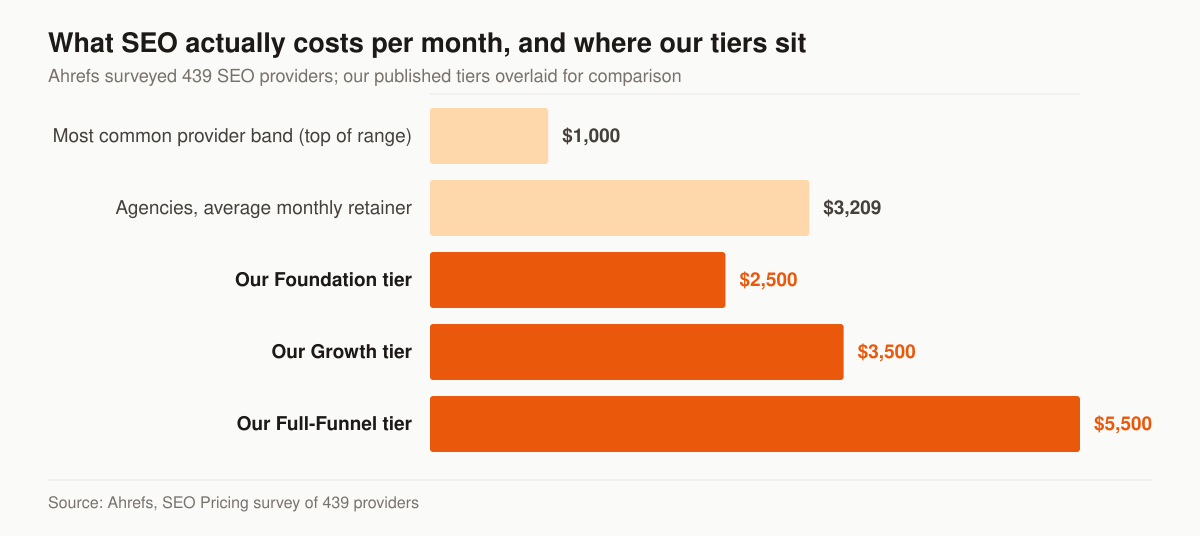
Monthly SEO retainers from the Ahrefs survey of 439 providers, with our published tiers overlaid. Source: Ahrefs, SEO Pricing.
Our prices are published rather than quoted. Foundation is $2,500 per month and covers the optimized website or landing pages, local SEO and Google Business Profile, on-page SEO and monthly reporting. Growth is $3,500 and adds the ongoing SEO and content engine, AI-search visibility, and reputation and reviews. Full-Funnel is $5,500 and adds managed paid ads on Google and Meta, landing-page CRO, and marketing automation. A one-time website or landing-page build runs $2,500–$8,000. Ad spend sits outside the retainer, billed at cost straight to the platforms. The full breakdown is on the pricing page.
Set against the $1,557 local SEO average, our Foundation tier is above the market rate, and the difference is worth naming rather than hiding. A local-SEO-only retainer buys profile management and citations. Foundation includes the site those citations point at, which is the asset the Core Web Vitals and conversion work above lands on. For an agency that already has a site worth keeping and needs only the profile and review layer, a cheaper local specialist is a rational choice, and we will tell you so on the audit call.
For a home insurance agency the tier follows the constraint. No site worth ranking: Foundation. A sound site nobody finds: Growth. Organic handled and volume is the limit: Full-Funnel, which is also where the PPC layer gets scoped to the counties you actually hold appointments in.
What to measure, and when to expect it
Rankings alone mislead in a market this local, because a term with tiny volume can sit at position one and send nothing.
The table below is the reporting sequence we hold a home insurance program to, and what is genuinely too early to judge at each stage.
| Month | What should be moving | What is too early to judge |
|---|---|---|
| 1–2 | Profile complete and categorised, NAP fixed, Core Web Vitals at the 75th percentile | Rankings, traffic, leads |
| 3–4 | Map-pack appearance for the office city, first review velocity, impressions in Search Console | Revenue attribution |
| 5–6 | Calls and direction requests from the profile, quote-form starts, first town-page rankings | Head-term rankings |
| 7–12 | Quote requests per month, quote-to-bind rate by source, cost per bound policy from organic | Whether to expand into new towns |
Two rows deserve a note. Impressions arriving before clicks is the normal order; rising impressions with flat clicks can point at ranking for the wrong half of the query set rather than at SEO failing. And cost per bound policy is the figure that decides whether to continue, because a homeowners lead in a county where you cannot place the risk costs more than an expensive one you can bind.
Where home insurance SEO programs stall
Each row below is a process failure rather than an algorithm problem, and each has a fix that does not require publishing more content.
| Where it stalls | What it looks like | The fix |
|---|---|---|
| Carrier-supplied microsite | The agency’s pages sit on a shared carrier domain as one of many near-identical templates | Own the domain, own the pages, make the content specific to the agency |
| One page for the whole book | Home, auto, umbrella and commercial share a single services page | A page per line, each with its own intent and call to action |
| Service-area list instead of pages | A comma-separated list of thirty towns in the footer | Six real town pages carrying carrier appetite and local peril detail |
| Profile left at defaults | Category generic, hours blank, service area unset, no photos | The eligibility and category pass described above |
| Reviews asked for in bulk | A quarterly blast to the whole book, then silence | An ask built into the bind checklist, running weekly |
| Rate quoter bolted on last | A third-party embed pushes LCP past 2.5 seconds | Budget the widget into the page; load it on interaction |
| Content with no query behind it | Posts written to a length target | A query list from search data, one page per intent |
That last row is the one worth arguing with a vendor about. Google’s guidance on helpful, reliable, people-first content lists, among the warning signs of search-engine-first writing, “Are you writing to a particular word count because you’ve heard or read that Google has a preferred word count? (No, we don’t.)” Depth is a count of questions answered.
How home insurance SEO fits the rest of the book
Homeowners is one line in a book, and the SEO does not have to be single-line either. The P&C insurance agency marketing pillar covers running home and auto as one book, including the account-rounding logic that makes a single ranked page pay twice, and the auto insurance agent marketing page covers the other half of the bundle. Where the same household is worth two policies, the internal linking between those pages is doing conversion work as well as ranking work.
What you get and what to do next
You get a local-first SEO program — profile, pages, schema, reviews — measured against leads, not vanity rankings. If you want a numbers-based read on where you’re losing local visibility today, start with a free marketing audit. Want to see how the conversion discipline plays out across a full book before you commit? Compare it against our final-expense marketing operation, where the systems we apply to your home insurance pages were proven first, then read the home insurance marketing playbook for the full vertical context. Prefer to talk it through first? Get in touch.
The shortest path to home insurance leads online is owning the map pack in the towns you write. That’s local SEO, done by people who count cost-per-lead.