Who we serve
Medicare Supplement Leads for Agents: Marketing Medigap Year-Round
Medicare supplement leads for agents are seniors shopping Medigap coverage — predictable out-of-pocket costs and any-provider freedom — rather than bundled Medicare Advantage. Medigap marketing runs year-round, not AEP-locked, and turns on medical underwriting, the six-month open enrollment window, and state birthday rules. That calendar difference is the whole opportunity.
Free · 15-minute teardown · no pitch deck
- We run our own final-expense book
- No pitch deck — we screen-share real numbers
- TCPA-aware · CMS/AEP-compliant · Meta Special Ad Category
- Core Web Vitals < 2.0s LCP
Medicare Supplement is the calmer half of the Medicare book, and it is the easy half to underwork. Medigap does not answer to the CMS Medicare Advantage marketing rulebook, it does not spike and collapse around AEP, and its buyer is often the more loyal one. The catch is that Medigap runs on a different clock — medical underwriting, a one-time open-enrollment window, and a handful of state rules — and marketing that ignores that clock wastes spend on prospects who cannot buy.
This page covers how to generate Medicare supplement leads that actually convert: the Medigap-versus-Advantage buyer split, how large the Medigap base already is in your state, the enrollment and underwriting windows that decide who is sellable, the guaranteed-issue events worth a campaign, birthday and anniversary rules, Plan G and Plan N positioning against published premiums, the rating method that changes your copy, which rulebook actually governs Medigap advertising and outbound calls, and the local SEO that lowers your blended cost per lead.
Medigap vs Medicare Advantage: two buyers, one age band
The expensive mistake in senior-market marketing is running one message at two products that sell opposite promises. Both reach the 65-plus prospect. They value different things, sit under different rulebooks, and buy on different calendars.
This table sets the two products side by side on the dimensions that change a marketing decision.
| Dimension | Medicare Supplement (Medigap) | Medicare Advantage (MA) |
|---|---|---|
| The promise | Predictable out-of-pocket costs, any Medicare provider, no networks | Bundled benefits, low or $0 premium, network-based |
| Rulebook | State DOI + carrier advertising rules | Full CMS/TPMO marketing rules, Oct 1 benefit-marketing limit |
| Seasonality | Year-round; anchored to the Medigap open-enrollment window | AEP/OEP driven; competitive and spiky |
| Underwriting | Medically underwritten outside guaranteed-issue windows | Guaranteed acceptance in-window |
| Buyer mindset | Wants freedom and predictability, will pay the premium | Cost-sensitive, tolerates networks |
| Lead timing | Steady, tied to Part B enrollment and birthdays | Concentrated in the loud window |
| Drug coverage | Not included — Medigap policies sold after 2005 do not include prescription drug coverage, so a Part D plan sits alongside | Usually bundled as MA-PD |
| Who can hold one | Original Medicare only; you cannot pair Medigap with an MA plan | Replaces Original Medicare while enrolled |
The pillar page frames this split at a strategic level in Medicare Advantage vs Medigap marketing. This spoke is the tactical build for the Medigap side.
Two facts from the CMS and NAIC guide Choosing a Medigap Policy set the boundary a campaign has to respect. First, “You can only buy Medigap if you have Original Medicare” — generally meaning Part A and Part B before a policy can be sold. Second, an MA enrollee planning to return to Original Medicare can apply before their MA coverage ends, and the insurer “can sell it to you as long as you’re leaving the Medicare Advantage Plan.” A Medigap ad served to a happy MA enrollee is not just a wasted impression; it is an offer they are not eligible to accept.
How big is the Medigap base where you sell?
Medigap is not a niche within the senior market — in 2022, 12.5 million people, four in ten (42%) of everyone in traditional Medicare, held a Medigap policy, per KFF’s key facts on Medigap enrollment and premiums. The territory question is where those people are, because the share ranges from 9% to 67% between states.
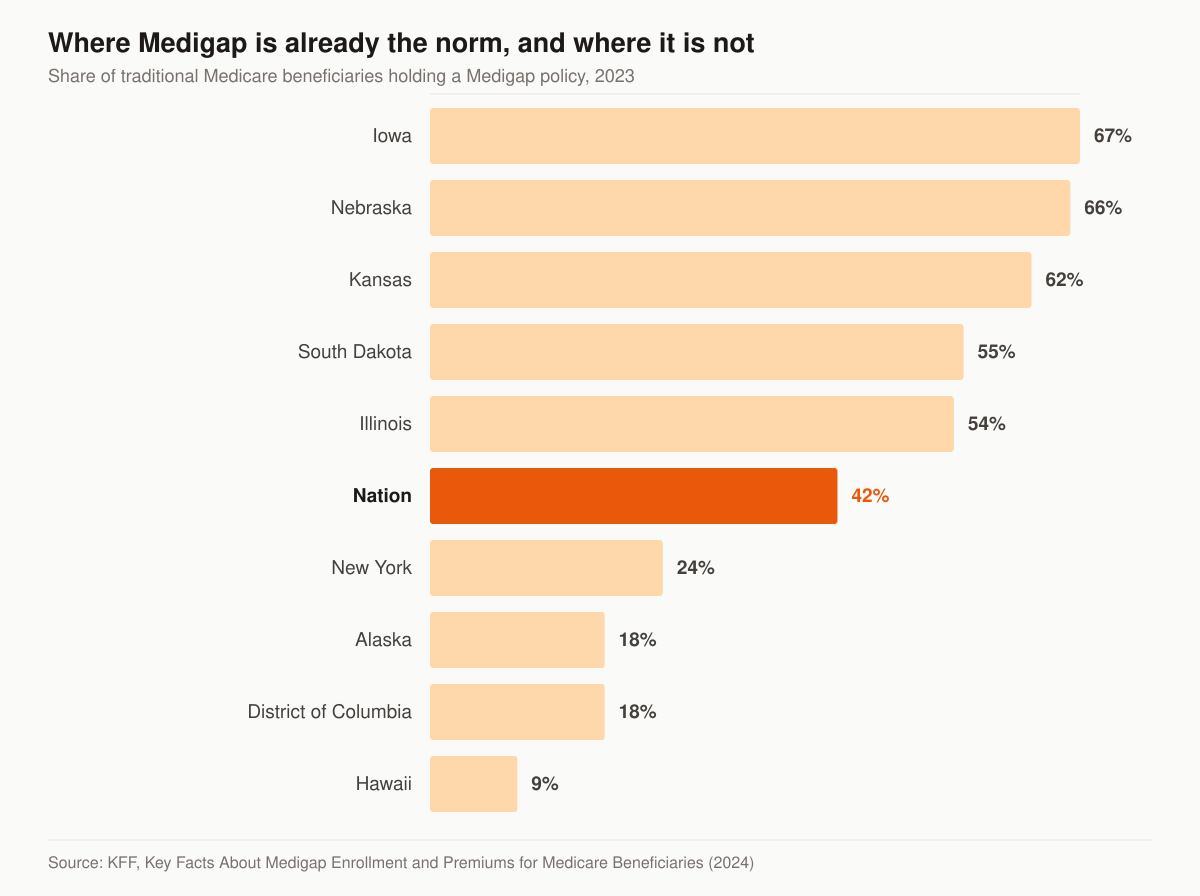
Share of traditional Medicare beneficiaries holding a Medigap policy, 2023. Source: KFF, Key Facts About Medigap Enrollment and Premiums for Medicare Beneficiaries (2024).
KFF’s 2023 state table puts the range from 9% in Hawaii to 67% in Iowa, and notes that the high-enrollment states cluster in the Midwest and plains, where fewer beneficiaries are enrolled in Medicare Advantage. Read that as two different marketing jobs. In Iowa, Nebraska (66%) or Kansas (62%), Medigap is the default and you are competing on carrier, price and service, so comparison content and rate-shopping pages do the work. In Hawaii, Alaska (18%) or New York (24%), the job upstream is explaining why a supplement exists at all, which is education-first content and a longer nurture.
The switching side of the market is larger still, and mostly locked. KFF’s companion brief finds that “Nine out of ten (90%) Medicare Advantage enrollees ages 65 and older, or 22.4 million people, do not have guaranteed issue protections to purchase Medigap beyond the initial Medicare Advantage trial period, as of 2022.” That single sentence explains why a “switch from Advantage to Medigap” campaign aimed at a general MA audience underperforms: nine in ten of the people it reaches would have to pass underwriting first.
The windows that decide who can actually buy
Medigap lead quality is not just about intent — it is about eligibility, because underwriting can decline a willing buyer. Three timing rules govern the whole game:
- The Medigap Open Enrollment Period. Federal law gives a beneficiary one guaranteed-issue window: a one-time, six-month period that starts the month they are 65 or older and enrolled in Medicare Part B. The CMS and NAIC guide states it plainly: “Your 6-month Medigap Open Enrollment Period starts the first month you have Medicare Part B and you’re 65 or older. This is a one-time enrollment period; it doesn’t repeat every year.” Inside it, carriers cannot deny coverage or charge more for health history. It is the one window where intent and eligibility line up, which is where we point spend.
- Medical underwriting after the window. Once those six months close, most states let carriers medically underwrite and decline applicants with pre-existing conditions — per KFF’s analysis of Medigap guaranteed-issue rules. So a lead’s health status, not just their interest, shapes whether they convert.
- State exceptions and birthday rules. A group of states softens underwriting, and four of them remove it entirely for 65-plus applicants. Where those rules exist, they are recurring, marketable events competitors ignore.
One clock sits underneath all three and rarely makes it into agent marketing: for qualifying events that carry guaranteed-issue rights, KFF notes that people ages 65 and older “generally have 63 days to apply for a Medigap policy.” Sixty-three days is a campaign window, not a season. It is too short for a quarterly newsletter to catch, which is why we run these as trigger-based email and direct-mail sequences, and it is the reason a Medigap funnel needs event data — a plan termination, a retiree-coverage cancellation, a move — rather than only an age filter.
The practical upshot: build your Medigap funnel around Part B enrollment dates and, where they exist, birthday and guaranteed-issue windows — the same aging-in discipline behind our turning-65 (T65) marketing system, pointed at the supplement product instead of Advantage.
The guaranteed-issue events worth building a campaign around
Guaranteed issue is where Medigap marketing gets genuinely operational, because each trigger is a knowable, datable event rather than a mood. KFF’s Table 1 maps federal rights against the situations where none exist; the marketing translation is below.
This table pairs each federal guaranteed-issue trigger with the audience it defines and the asset that should be waiting for them.
| Trigger under federal law | Who it describes | What the campaign is |
|---|---|---|
| First six months of enrolling in Part B at 65 or older | Aging-in and late Part B enrollees | The turning-65 sequence, timed to the Part B start month |
| Employer cancels retiree coverage | Retirees whose group plan was dropped | A “your retiree plan ended” landing page and a 63-day reminder cadence |
| MA plan withdraws from the area, is terminated, or the member moves out of its service area | Displaced MA enrollees | A market-specific page published when a plan exit is announced |
| Trial right: dropped Medigap to try MA for the first time, within the first year | First-time MA switchers inside 12 months | An anniversary reminder before the trial right expires |
| Trial right: joined MA when first eligible at 65, switching to Original Medicare within the first year | New enrollees who chose MA at 65 and reconsidered | A month-11 educational touch, not a month-13 one |
| Medigap insurer goes bankrupt, coverage ends through no fault of the beneficiary, or the insurer commits fraud | Orphaned policyholders | A replacement-guidance page and a phone path |
| No federal right: voluntarily dropping Medigap, or switching Medigap plans after year one | Everyone else | Underwriting-first expectations, set before the application |
Note what is not on the list. A beneficiary who simply wants a cheaper Medigap policy has no federal right to switch, and KFF’s table records one exception to that: a beneficiary may suspend Medigap for up to two years if they become eligible for Medicaid, with no new medical underwriting or waiting periods for pre-existing conditions when they restart it. Sell “we will shop your Medigap rate” to a general list and every responder outside a state switching rule meets underwriting first.
Birthday rules, anniversary rules and the states where switching is marketable
State law is where the switching market reopens, and it reaches further than a California-and-Oregon shortlist. In KFF’s 2024 review, nine states operate birthday rules — California, Idaho, Illinois, Kentucky, Louisiana, Maryland, Nevada, Oklahoma and Oregon. Each requires Medigap insurers to let a current policyholder switch, once a year around their birthday, to a different Medigap policy “with equal or lesser benefits from either the same or different insurance carrier, depending on the state.” The window runs between 30 and 63 days depending on the state, and the allowance does not let someone who has no Medigap buy one for the first time.
Three more state mechanics matter to a campaign calendar:
- Missouri requires insurers to let current policyholders switch to an equivalent policy from a different insurer within 30 days before or after the annual anniversary date of their policy — an anniversary rule rather than a birthday rule, which means your trigger field is the policy date, not the date of birth.
- Maine requires insurers to let current policyholders move to a policy with equal or less generous benefits at any time during the year, provided there is less than a 90-day gap in coverage.
- Washington does the same, except that Plan A policyholders are limited to switching to another Plan A, while those on Plans B through N can switch to any other Plan B through N.
Above all of those sit the four states — Connecticut, Maine, Massachusetts and New York — that require either continuous or annual guaranteed issue for all beneficiaries ages 65 and older regardless of medical history. In Connecticut, Massachusetts and New York, insurers must issue at any time during the year; Maine’s guarantee is a one-month annual period and only for Plan A. Minnesota has enacted legislation instituting annual guaranteed-issue protections for individuals ages 65 to 70, which KFF’s brief records as slated rather than in force at the time of its review — confirm the effective date with the state Department of Insurance before you market it. If you are licensed in Connecticut, Massachusetts or New York, “you can change your Medigap plan without medical questions” is a factual, year-round headline that carries a real offer behind it.
What Medigap buyers actually hold, and what is closed to new ones
Marketing a plan letter your prospect cannot buy is spend with nowhere to land. The Medicare Access and CHIP Reauthorization Act of 2015 prohibited insurers from issuing new policies covering the full Part B deductible, which made Plans C and F unavailable to beneficiaries who turned 65 on or after January 1, 2020.
This table shows the plan mix among Medigap policyholders in 2023, which is what search demand is anchored to — not what a new prospect can buy.
| Plan letter | Share of Medigap policyholders, 2023 | Available to someone newly eligible? |
|---|---|---|
| Plan G | 38.82% | Yes |
| Plan F | 35.96% | No — closed to those newly eligible on or after Jan 1, 2020 |
| Plan N | 10.04% | Yes |
| Plan O (waiver states) | 6.05% | Used by carriers in waiver states including Massachusetts, Minnesota and Wisconsin |
| Plan C | 2.58% | No — closed on the same date as Plan F |
| Plans E, H, I and J | 2.40% | No — withdrawn from new applicants as of 2010 |
| Plan P (pre-standard) | 1.06% | No — policies issued before the Omnibus Reconciliation Act of 1990 |
| Plan B | 1.04% | Yes |
| Plan D | 0.79% | Yes |
| Plan A | 0.58% | Yes |
| Plan K | 0.43% | Yes |
| Plan L | 0.20% | Yes |
| Plan M | 0.03% | Yes |
Figures are KFF’s analysis of NAIC data via Mark Farrah Associates, across Medigap enrollment of 13,564,595 in 2023. The commercial read: Plan F still held 35.96% of policyholders in 2023, so search volume and brand recall for it are real, but nobody who turned 65 on or after January 1, 2020 can buy one. Write Plan F content as replacement and comparison content aimed at existing holders, and write Plan G and Plan N content as acquisition content for the aging-in cohort.
Positioning Plan G and Plan N without steering
Among the plans still open to a newly eligible prospect, Plan G and Plan N are the two largest by enrollment — 38.82% and 10.04% of 2023 policyholders — so your content should educate on that tradeoff rather than push one plan.
- Plan G covers nearly everything except the Part B deductible. It suits buyers who want the fewest surprises and will pay a higher premium for it.
- Plan N carries a lower premium in exchange for modest copays and possible excess charges. It fits budget-minded, relatively healthy prospects. KFF describes it as similar to Plan G, “except that there are Part B copayments for some office visits and some emergency room visits, and it does not cover Part B excess charges.”
- The honest frame: show the premium-versus-exposure tradeoff side by side and route to a licensed conversation. Steering a healthy prospect into the wrong plan is how you earn a complaint instead of a renewal.
Then there is the number that upends the usual script.
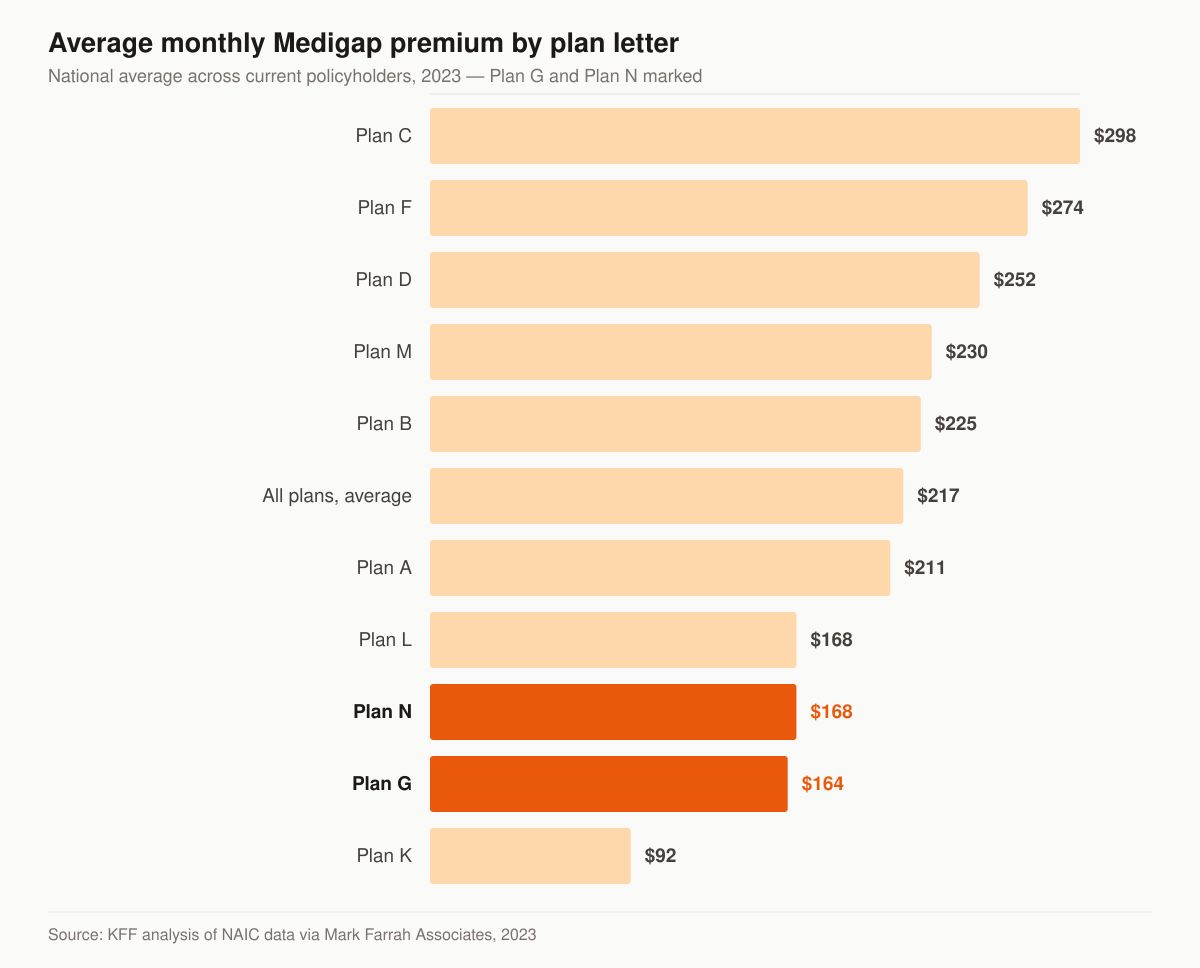
Average monthly Medigap premium by plan letter among current policyholders, 2023. Source: KFF analysis of NAIC data via Mark Farrah Associates.
Across current policyholders in 2023, the national average monthly premium for Plan G was $164 and for Plan N was $168, against $217 for all Medigap plans combined. Read that carefully before repeating it in an ad: it is an average across everyone holding each plan, not a like-for-like quote for one 65-year-old in one ZIP code, and the two cohorts differ in age and issue year. What it does support is a content position — the assumption that Plan N is automatically the cheaper choice is not what the national averages show, and a page that says so, then routes to a real quote, is answering the question the shopper actually arrived with.
Two more premium anchors are worth knowing because prospects arrive holding them. KFF puts the average full-year premium among current Medigap policyholders at $2,604 in 2023, and reports Plan G averages ranging from around $140 in D.C., Hawaii and New Mexico to $236 in New York. And for the high-deductible option on Plans F or G, the CMS and NAIC guide sets the 2026 figure: the beneficiary “must pay the first $2,950 (in 2026) of deductibles, copayments, and coinsurance for covered services not paid by Medicare before the Medigap policy pays anything,” plus a separate $250 annual deductible for foreign travel emergency care.
Why your state’s rating method changes the copy
Two prospects with the same plan letter can face completely different premium trajectories, and the reason is in the pricing method rather than the plan. The CMS and NAIC guide lists three, and says each policy can be priced in one of them:
- Community-rated (also called no-age-rated). “Generally the same premium is charged to everyone, regardless of age or gender.” Premiums can rise with inflation and other factors, but not because of the buyer’s age.
- Issue-age-rated (also called entry-age-rated). “The premium is based on the age you are when you buy the Medigap policy.” Buying younger locks in a lower base that does not climb with age.
- Attained-age-rated. “The premium is based on your current age, so your premium goes up as you get older.” The guide’s own warning is the useful line for content: these “may be the least expensive at first, but they can eventually become the most expensive.”
KFF’s state premium table records which rating types each state permits — Arkansas, Connecticut, Idaho, Maine, Massachusetts, Minnesota, New York, Vermont and Washington are listed as community, Florida as issue-age, Arizona, Georgia and Missouri as issue-age or community rating, and the rest as any rating. That matches the brief’s narrative: “Currently, nine states (AR, CT, ID, MA, ME, MN, NY, VT, and WA) require premiums to be community rated among policyholders ages 65 and older”, four states permit issue-age but prohibit attained-age rating, and “the majority of states (37 states and D.C.) allow any rating system.” If you sell in an attained-age state, “what will this cost me at 78?” is a question your content can answer with the guide’s own three-way framing. If you sell in a community-rated state, the buy-early argument is weaker and the comparison shifts to carrier service and rate-increase history. Same product, different page.
Underwriting, pre-existing conditions and the expectations content has to set
Applications that get declined poison a Medigap funnel, so the content that qualifies is worth as much as the content that attracts. Three mechanics from the CMS and NAIC guide belong on any Medigap education page:
- The waiting period. Even where a policy is issued, the guide warns that “In some cases, the Medigap insurance company can refuse to cover your out-of-pocket costs for these pre-existing health problems for up to 6 months.” Original Medicare still covers the condition for Medicare-covered services during that time; the beneficiary is exposed to the coinsurance or copayment.
- The look-back. Coverage for a pre-existing condition “can only be excluded if the condition was treated or diagnosed within 6 months before your Medigap policy coverage starts.”
- Creditable coverage cancels the wait. With at least six months of continuous prior creditable coverage, the insurer cannot impose the waiting period at all — and prior coverage only counts if the break was no more than 63 days.
There is also a free-look provision that belongs in every replacement conversation: on switching, “You have 30 days to decide if you want to keep the new Medigap policy,” during which both premiums are payable for the overlapping month. An agent who explains that before the application arrives is naming the protection the free-look period exists to give.
The lead-generation consequence is straightforward. A Medigap form that asks nothing about timing or coverage history hands the agent a list they cannot triage. Ask when the prospect started Part B, whether they hold Medigap today, and whether any qualifying event has happened in the last 63 days, and the same volume of raw responses becomes a routable pipeline. That qualification layer is part of how we build insurance lead generation rather than a bolt-on.
Which rulebook actually governs Medigap marketing
Subpart V of 42 CFR part 422 governs Medicare Advantage marketing and does not reach standalone Medicare Supplement. The federal floor for Medigap comes instead from the Social Security Act as amended by OBRA-90 — which, per KFF, established the six-month open enrollment period, standardized benefits into ten plans, required guaranteed plan renewability with few exceptions and minimum medical loss ratios, and limited the exclusion period for pre-existing conditions to six months — and by MACRA in 2015. Above that floor sits the NAIC model regulation as each state adopts it, enforced by the state Department of Insurance, plus the carrier’s own advertising guidelines.
This table maps each Medigap marketing activity to the body of rules that actually governs it.
| Marketing activity | Governing rulebook | Practical consequence |
|---|---|---|
| Print, direct mail and web advertising of Medigap | State Department of Insurance under the NAIC model regulation, plus carrier advertising guidelines | Filing and approval requirements are set state by state, not by CMS |
| What may be claimed about the product | Federal Medigap standards plus the CMS and NAIC guide’s list of illegal practices | No claim that Medigap is part of Medicare or any federal program |
| Outbound calls and texts | FCC rules at 47 CFR 64.1200 | National and internal do-not-call obligations, consent standards, calling hours |
| Marketing MA or MA-PD alongside Medigap | 42 CFR part 422 subpart V (and part 423 for Part D) | The MA rules attach to the MA half of the conversation |
| Anything an appointed agent publishes | The carrier’s compliance team | The carrier signs off; the marketing agency does not |
The CMS and NAIC guide is unusually direct about agent conduct, and its list reads as a compliance checklist for your own creative. It states that it is illegal if someone tries to pressure a beneficiary to buy a Medigap policy or lie to get them to switch; to sell a Medigap policy knowing the person already has one, unless they state in writing that they plan to cancel the existing policy; to sell one knowing the person has Medicaid, except in limited situations; to sell one knowing the person is in a Medicare Advantage Plan, unless they are switching back to Original Medicare; to claim that “A Medigap policy is part of the Medicare program or any other federal program”; to “Suggest the Medigap policy has been approved or recommended by the federal government, or misuse the names, letters, or symbols” of HHS, SSA or CMS; to sell an MA plan when the person has said they want to stay in Original Medicare and buy Medigap; or to “Ask you questions about your family history or make you take a genetic test.”
Read that list as creative direction. Government-styled envelopes, eagle-and-flag imagery, “official Medicare enrollment center” headlines and family-history questions on a lead form are all named there. The step-by-step version of the neighbouring MA rules is in our guide to CMS Medicare marketing rules for agents — worth reading precisely so you can tell which half of your book each rule belongs to.
Calling, texting and emailing Medigap prospects
Because the CMS prohibition on unsolicited contact is written about Medicare Advantage, Medigap agents sometimes conclude the phone is open. It is not; it is governed by a different section. 47 CFR 64.1200 sets the rules, and each paragraph carries its own scope.
- Calling hours and the registry. Paragraph (c) provides that no person or entity shall initiate any telephone solicitation to a residential telephone subscriber “before the hour of 8 a.m. or after 9 p.m. (local time at the called party’s location)”, or to a residential subscriber “who has registered his or her telephone number on the national do-not-call registry”. The safe-harbour conditions in (c)(2)(i) require written compliance procedures, trained personnel, a recorded list of numbers not to contact, and a version of the registry obtained “no more than 31 days prior to the date any call is made”.
- Your own do-not-call list. Paragraph (d) requires anyone making telemarketing calls to a residential subscriber to institute procedures for maintaining a list of people who ask not to be called, including a written policy available on demand and trained personnel. A request must be honoured within a reasonable time, and that “period may not exceed ten (10) business days from the receipt of such request.”
- Autodialed and prerecorded telemarketing. Paragraph (a)(2) bars telemarketing calls placed with an automatic telephone dialing system or an artificial or prerecorded voice to the numbers listed in (a)(1)(i) through (iii) — which include any number assigned to a cellular telephone service — other than with the prior express written consent of the called party. The paragraph’s other exceptions cover calls by or on behalf of a tax-exempt nonprofit organization and “health care” messages under the HIPAA Privacy Rule, neither of which describes agency telemarketing.
- What consent has to look like. Paragraph (f)(9) defines prior express written consent as “an agreement, in writing, bearing the signature of the person called that clearly authorizes the seller to deliver or cause to be delivered to the person called advertisements or telemarketing messages using an automatic telephone dialing system or an artificial or prerecorded voice, and the telephone number to which the signatory authorizes such advertisements or telemarketing messages to be delivered.” The disclosure must also tell the signer that they are “not required to sign the agreement (directly or indirectly), or agree to enter into such an agreement as a condition of purchasing any property, goods, or services.”
- Revocation. Paragraph (a)(10) treats “stop,” “quit,” “end,” “revoke,” “opt out,” “cancel,” or “unsubscribe” in reply to a text as a reasonable means per se of revoking consent, and requires every revocation to be honoured “within a reasonable time not to exceed ten business days from receipt of such request.”
The design conclusion for a Medigap funnel is the same one we reach on the MA side for different reasons: build the consent artifact into the form rather than bolting it on. A landing page whose consent language matches (f)(9), records the exact wording shown, timestamps it and stores the source URL turns a lead file into something an agent can dial without guessing. The build discipline for those pages is our insurance landing pages service, and the nurture that runs on the email channel instead of the phone is insurance email automation.
Nothing here is legal advice, and we are not the licensed party. We build the marketing; the licensed agent and the carrier’s compliance team own what is said to a beneficiary.
Local SEO for “medigap plans [state]”
Medigap is standardized by letter but priced and regulated by state, which makes it ideal for local, compounding SEO. The searches that convert pair the product with a place — “medigap plans [state],” “Medicare Supplement rates [city],” “Plan G quotes [state].” Those are comparison-stage queries, not idle browsing.
The state-by-state variation documented above is what gives a Medigap state page something real to carry: whether the state has a birthday rule and how many days it runs, which rating methods are permitted there, the state’s Medigap penetration, and the average premium band for the plan letters sold locally. That is a page built from public data rather than a template with the city name swapped, which is the difference between a page with something to say and a set of near-duplicates.
A dedicated, educational page per state or metro you serve builds topical authority and lowers your blended cost per Medigap lead over time, instead of renting attention at peak prices every season. The build discipline lives in our insurance SEO service, the map-pack side is insurance local SEO, and the Medigap prospect who finds you organically arrives pre-educated and cheaper to close.
Three Medigap audiences sitting in the enrollment data
Three audiences show up clearly in the published enrollment data.
Under-65 beneficiaries with disabilities. Federal law does not require insurers to sell Medigap to the more than 7 million Medicare beneficiaries under age 65, and only 7% of under-65 traditional Medicare beneficiaries had a Medigap policy in 2022, against 46% of those 65 and older. But 36 states require insurers to offer at least one Medigap policy to under-65 beneficiaries with disabilities during an initial open enrollment period, and 25 of those require all plan types. In those states there is a real audience with a documented coverage gap, and the compliance posture — explain the rule, do not overpromise — is the same one this whole page runs on.
People who will turn 65 while holding under-65 Medicare. When an under-65 beneficiary reaches 65, federal law entitles them to the same six-month open enrollment period as anyone else, regardless of whether they had Medigap before. That is a datable trigger sitting in an agent’s existing book.
Retiree-coverage losers and displaced MA members. These are the guaranteed-issue events in the table above, and they arrive as news — an employer dropping retiree benefits, a carrier exiting a county. An agent whose site already ranks for the county name is the one who captures that search. This is where a Medigap page and a seminar programme reinforce each other: the news creates the demand, the room converts it.
For the wider senior-market view across products, our senior market insurance marketing page sets Medigap alongside final expense and annuities.
Turn Medigap intent into owned leads
Buying a shared Medigap list means calling prospects other agents are dialing at the same time. A marketing system instead builds an owned stream of Medigap opt-ins you control from the first click — exclusivity, consent, and health-expectation framing baked in. That engine is our insurance lead generation service, and Medigap is one of its steadiest year-round inputs because it never goes dark between enrollment seasons. If you want the channel-by-channel comparison first, our Medicare leads page sets direct mail, paid social, search and seminars side by side.
What a done-for-you Medigap program includes, and what it costs
This is the commercial side of the page — what we build and run when an agency hands Medigap marketing over:
- A Medigap-specific site section, with a state page for every market you are licensed in, carrying that state’s birthday or guaranteed-issue rule, permitted rating methods and plan availability rather than a templated paragraph.
- Trigger-based sequences for the events above: Part B start month, retiree-coverage loss, MA trial-right anniversary, plan exits — each timed inside the 63-day window rather than sent monthly.
- A qualifying form that captures Part B start, current coverage and any qualifying event, plus consent wording written against 47 CFR 64.1200(f)(9) and stored with a timestamp and source URL.
- Comparison content on Plan G against Plan N and on Plan F replacement, written from published premium data and routed to a licensed conversation rather than a plan recommendation.
- Reporting down the whole ladder — impressions, form starts, qualified leads by guaranteed-issue status, applications, issued policies. Reporting only the first and last of those hides which step is costing you.
Pricing is published rather than quoted: Foundation at $2,500 per month, Growth at $3,500, and Full-Funnel at $5,500, with a one-time website or landing-page build of $2,500 to $8,000. Foundation covers the site or landing pages, local SEO and Google Business Profile, on-page SEO and monthly reporting; Growth adds the ongoing SEO and content engine, AI-search visibility, and reputation and reviews; Full-Funnel adds managed paid ads, landing-page CRO and marketing automation. Ad spend and mail costs are billed at cost to the platforms and vendors rather than marked up. The full breakdown, including what sits outside the monthly fee, is on the pricing page.
What to measure on a Medigap funnel
Medigap economics are slower and steadier than Medicare Advantage, so the reporting has to be too. Four numbers tell you whether the programme is working:
- Cost per qualified lead, split by guaranteed-issue status. A lead inside a guaranteed-issue window and a lead facing underwriting are different products at different prices, and blending them hides which campaign is actually paying.
- Underwriting decline rate by source. If one channel produces double the declines, the targeting is wrong, not the closer.
- Time from first touch to issued policy. Medigap sales frequently span an aging-in gap of months, which means an attribution window sized for a fast MA cycle will credit the wrong channel.
- Persistency. A Medigap book is a renewal book. A source that closes fast and lapses in month seven costs more than a slower one that stays.
Those are the same measurement habits we apply across the Medicare marketing cluster, and they are why we report on cost per lead and cost per sale rather than impressions.
Start with the math
If you want a numerate read on your current Medigap funnel — where underwriting is killing conversion, which states carry a birthday-rule opportunity, what a set of local pages would return — grab a free marketing audit and we will map it against your book, or contact us if you would rather talk it through first. The agents who win Medicare Supplement are the ones marketing it all twelve months, not the twelve weeks everyone else fights over.