Who we serve
ACA Insurance Agent SEO Services That Win Open-Enrollment Traffic
ACA insurance agent SEO services rank your site for the searches that drive enrollments, from 'ACA agent near me' to '[state] marketplace subsidy help' and 'cheap health insurance [city]', so you own organic traffic instead of renting it. It pairs enrollment-intent keyword targeting, per-area location pages, and content timed to the OEP demand spike.
Free · 15-minute teardown · no pitch deck
- We run our own final-expense book
- No pitch deck — we screen-share real numbers
- TCPA-aware · CMS/AEP-compliant · Meta Special Ad Category
- Core Web Vitals < 2.0s LCP
An ACA book can be run entirely on paid clicks for the enrollment window and then go quiet, which works right up until the auction gets expensive. SEO flips that math. ACA insurance agent SEO services put your site in front of people already searching “marketplace subsidy help” or “ACA agent near me” — intent you don’t have to pay per click for, every time, forever. The trade-off is honest: rankings take months, not days. But once a page ranks, the lead it produces costs you nothing beyond the content that earned the spot.
We’re not an agency guessing at this. We run a final-expense lead operation — real ad spend, real close data, live campaigns, not theory. ACA isn’t final expense, so we don’t claim shared lineage. What carries over is the discipline: the same conversion systems and ad-tested copy that work for our senior-market clients, applied to organic search.
Why ACA SEO beats renting traffic
Paid search during Open Enrollment is a crowded auction. Carriers, aggregators and national brokers bid alongside you, and the moment you stop paying, you vanish. Organic rankings don’t reset when your budget does.
- Owned, not rented — a ranked page keeps pulling enrollments OEP after OEP at no incremental cost.
- Compounds over time — the content is a fixed cost paid once; the next lead it produces does not add to it.
- Captures every intent — subsidy questions, plan comparisons, “near me” local searches, Special Enrollment Period triggers like job loss.
- Builds before the rush — the work happens in the off-season so you rank when the window opens.
If you’d rather buy enrollments as a finished product instead of building the asset, that’s a different model — you can buy ACA leads direct from getinsureleads. SEO is the build path: slower to start, cheaper at scale.
What an ACA SEO build actually covers
Health insurance agent SEO is three layers working together — technical foundation, location coverage, and intent-matched content.
The table below maps each layer to the outcome it is responsible for, so you can see which one your site is missing.
| SEO Layer | What We Build | Why It Matters for ACA |
|---|---|---|
| Local SEO | Google Business Profile, location pages per county/metro | “ACA agent near me” and city searches drive the highest-intent calls |
| Intent content | Subsidy guides, plan-comparison pages, SEP triggers | Captures questions enrollees search before they pick an agent |
| Technical SEO | Schema markup, fast load, clean indexation | Pages rank and earn rich results; AI-search engines cite structured answers |
| Seasonal timing | Publish June–Sept, rank by November | OEP demand is compressed; rankings must be banked ahead |
Each location page targets one service area with genuinely local signals — not a template with the city swapped. Each content page answers one search the way an enrollee phrases it, which is also how AI search engines and Overviews pull citations. That structure is what gets you quoted when someone asks ChatGPT “best ACA agent in [city].”
The ACA keyword map: match intent, not volume
The mistake is chasing “health insurance” as a bare query. It is contested by carriers, HealthCare.gov itself and national web-brokers, and an agency domain has no realistic path into it. The win is the terms a licensed agent can rank for and close.
The table below sorts ACA search intent into the three bands we build against, in the order they pay.
| Intent band | How the enrollee phrases it | What the page has to do |
|---|---|---|
| Ready to enroll | “health insurance agent [city]”, “ACA agent near me”, “Obamacare broker [county]” | Prove you are local, licensed and reachable; book the call |
| Eligibility and money | “marketplace subsidy [state]”, “health insurance for self-employed”, “what if I underestimate my income” | Answer the question fully, then offer to run the numbers with them |
| Trigger events | “lost job health insurance”, “COBRA ending options”, “turning 26 health insurance” | Catch a running 60-day clock and route to an appointment today |
Two of those bands are year-round demand and one is not, which is why the calendar section below matters as much as the keyword list. For the mechanics of pulling and grading a list like this before anything gets written, our guide to insurance SEO keywords covers the process, and how to rank an insurance agency website covers turning the list into ranked pages.
One caution the keyword tool will not give you. Google’s own guidance on creating helpful, reliable, people-first content lists this among the warning signs of search-engine-first writing: “Are you writing to a particular word count because you’ve heard or read that Google has a preferred word count? (No, we don’t.)” A subsidy page earns its ranking by answering more of the enrollee’s real questions than the page above it, not by running longer.
When the demand arrives, and when the work has to be finished
ACA search demand is shaped by a federal calendar, which is a gift: you know the date the traffic arrives, so you know the date the page has to be indexed.
HealthCare.gov publishes the consumer-facing sequence on its dates and deadlines page: November 1 is “Open Enrollment starts — first day you can enroll in, renew, or change health plans through the Marketplace for the coming year”; December 15 is the “Last day to enroll in or change plans for coverage to start January 1”; January 15 is “Open Enrollment ends — last day to enroll in or change Marketplace health plans for the year.”
That window is also moving. When CMS issued the 2025 Marketplace Integrity and Affordability Final Rule, it stated that “Each OEP must start no later than November 1 and end no later than December 31,” that “the OEP may not exceed 9 calendar weeks,” and that “For Exchanges on the Federal platform, the OEP will run from November 1 through December 15 preceding the coverage year, beginning with the OEP for plan year 2027.” A shorter window does not change what you write. It changes when the writing has to be done, and it raises the value of a page that is already ranking when the auction spikes.
The table below is the publishing calendar we work backward from, and the SEO job each phase owns.
| Phase | Months | The SEO job |
|---|---|---|
| Build | Jun–Aug | Ship the site and county pages, fix Core Web Vitals, claim and categorise the Business Profile |
| Index and earn | Sep–Oct | Get pages crawled and ranking, publish subsidy and plan-comparison content, build internal links |
| Harvest | Nov–Dec | Do not rewrite; monitor, add FAQ answers to live queries, keep speed-to-lead tight |
| SEP and cleanup | Jan–May | Trigger-event content, review acquisition, prune pages that ranked for nothing |
There is a compliance edge on that calendar most SEO plans miss. Because deadlines shift between plan years, a hardcoded date in a title tag, a meta description or an evergreen blog post ages into a false statement — and 45 CFR 155.220(j)(3)(iii)(E) names “Miscommunicating enrollment timelines and deadlines” as a prohibited misleading marketing practice. Put the season’s dates in one template variable and render every surface from it. Our field notes on how ACA agents fill their pipeline during OEP cover the in-season mechanics, and the Q4 open enrollment playbook lists the campaigns worth running once the pages are live.
Local search is where an agent can beat a national brand
An agency domain will not outrank a carrier on authority. It can win on proximity, profile completeness and page-per-service structure, which is exactly what the practitioner survey data says drives local organic results.
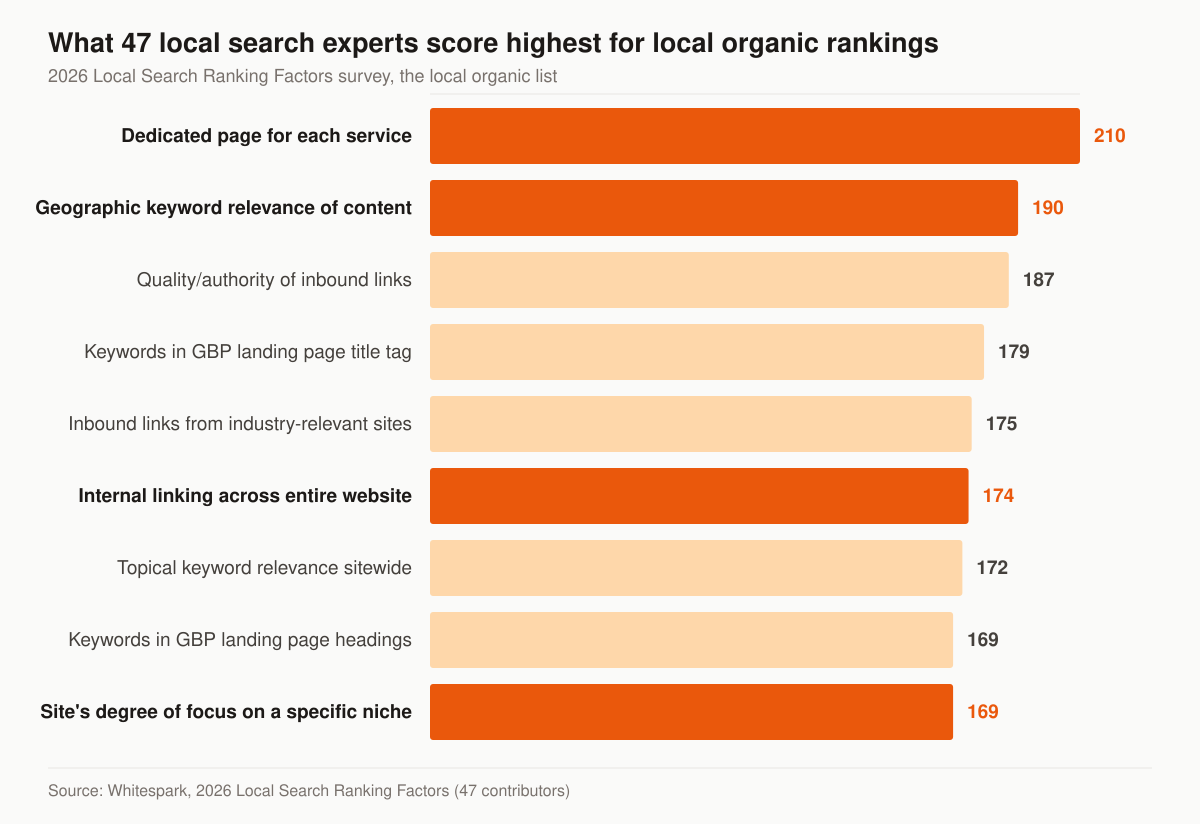
Source: Whitespark, 2026 Local Search Ranking Factors, a survey in which 47 local search experts weighed and scored 187 factors, published November 6, 2025. Read September 2026.
Read the first and last bars together. A dedicated page for each service scores 210 and the site’s degree of focus on a specific niche scores 169, which is the empirical case for an ACA agent building a page per product line and per county rather than one “health insurance” page listing everything. The same survey’s AI search visibility list keeps the pattern: a dedicated page for each service scores 170 there too.
Four rules from Google’s guidelines for representing your business decide whether your profile survives long enough to rank at all:
- Insurance agents are named as eligible. Google’s wording: “An individual practitioner is a public-facing professional, typically with their own customer base. Doctors, dentists, lawyers, financial planners, and insurance or real estate agents are all individual practitioners.”
- Producers inside a corporate sales structure are not automatically eligible. “Sales associates or lead generation agents for corporations aren’t individual practitioners and aren’t eligible for a Business Profile.” Nor can you stack listings by line of business: “A practitioner shouldn’t have multiple Business Profiles to cover all of their specializations.”
- Under a carrier brand, the format is prescribed. “Create a single Business Profile, named using the following format: [brand/company]: [practitioner name].” The example Google gives is “Allstate: Joe Miller”.
- Stuffing the name is a suspension risk. “Including unnecessary information in your business name isn’t permitted, and could result in the suspension of your Business Profile.” If you work from home, “you should hide your business address from customers,” and the service area “shouldn’t extend farther than about 2 hours of driving time from where your business is based.”
A profile that ranks until it is suspended is not a ranking. We have written up what recovery looks like in our guide to a suspended Google Business Profile, and our insurance local SEO service runs the profile and the review request cadence as one workflow, because a correctly categorised profile with no reviews stalls in the same place every time.
Special Enrollment Period content is the other half of the year
Between the close of Open Enrollment and the following November, HealthCare.gov enrolls people who qualify for a Special Enrollment Period. Its dates page puts it plainly: after the January deadline, “you can enroll in or change plans only if you qualify for a Special Enrollment Period.”
That is a different kind of search. A trigger-event query is written by someone with a clock already running, which makes it the highest-urgency traffic an ACA site gets and the least seasonal. It is also the band where the answer depends on which event happened and when, which is the kind of question a licensed producer answers better than a plan brochure.
Build one page per trigger rather than one “special enrollment” page listing them. Job loss, COBRA ending, a move to a new county, aging off a parent’s plan, marriage, birth and losing Medicaid are separate searches with separate anxieties, and the survey data above is explicit that a dedicated page per service outscores a combined one. Each page should state the qualifying event, the window, the documents the enrollee will be asked for, and a way to start today. Our ACA landing pages build handles the conversion half of those pages; the SEO half is making sure each trigger has a page to convert on.
The technical work Google publishes thresholds for
Fast is not a standard. The Core Web Vitals thresholds are, and they are the part of ACA SEO that quote widgets and carrier iframes routinely break.
The table below is the pass mark, taken from Google’s published guidance rather than a vendor’s dashboard.
| Core Web Vital | What it measures | Threshold for “good” |
|---|---|---|
| Largest Contentful Paint (LCP) | How long the main content takes to paint | Within 2.5 seconds |
| Interaction to Next Paint (INP) | How fast the page responds to a tap or click | 200 milliseconds or less |
| Cumulative Layout Shift (CLS) | How much the layout jumps while loading | 0.1 or less |
Those come from web.dev’s Core Web Vitals guide, which also sets the measurement rule that catches people out: “a good threshold to measure is the 75th percentile of page loads, segmented across mobile and desktop devices.” An average that looks acceptable can still fail, because a quarter of visitors are having a worse experience than the average describes.
On an ACA site the usual offenders are a subsidy calculator, an embedded quoting engine and a chat widget, each loading its own script. Treat every embed as a line in a performance budget with a named owner, and load what you can on interaction rather than on page load. Our ACA agent website build treats the quoting embed as a budgeted decision, not a free add-on.
Schema markup: what still earns a rich result, and what does not
Structured data is worth adding, but the reason changed in 2023. On August 8, 2023 Google reduced FAQ rich results, writing that “Going forward, FAQ (from FAQPage structured data) rich results will only be shown for well-known, authoritative government and health websites. For all other sites, this rich result will no longer be shown regularly.” The same post limited How-To rich results, which “will only be shown for desktop users, and not for users on mobile devices.”
Note who kept the FAQ rich result: government and health sites. For an ACA agent that is a pointed detail, because HealthCare.gov is on the other side of that line and you are not. Google added in the same post that “While you can drop this structured data from your site, there’s no need to proactively remove it. Structured data that’s not being used does not cause problems for Search, but also has no visible effects in Google Search.”
The table below is where the markup effort belongs on an ACA agent site, and what each type is actually worth now.
| Schema type | What it describes | What to expect from it |
|---|---|---|
| InsuranceAgency or LocalBusiness | The office, hours and service area | Feeds the entity behind your local pack presence |
| Person, on the author | The licensed producer behind the page | Supports the byline Google’s guidance asks for |
| Service | The specific line the page sells, per page | Clarifies the page’s subject for crawlers and answer engines |
| FAQPage | Machine-readable question-and-answer pairs | No rich result for a commercial site; still parseable |
| BreadcrumbList | Position in the site hierarchy | Breadcrumb display in results |
Compliance is a ranking signal too
ACA marketing lives under CMS rules, and the section that governs agents and brokers in the Federally-facilitated Exchanges is 45 CFR 155.220. Three of its clauses are SEO instructions in everything but name.
The first is a design and title-tag constraint. Under (j)(2)(i) you must “refrain from conduct that is misleading (including by having a direct enrollment website that HHS determines could mislead a consumer into believing they are visiting HealthCare.gov)”. A page title that reads like the federal Marketplace, or a header lifted from it, is the exact confusion that clause describes.
The second is the example list at (j)(3)(iii), which opens: “Examples of prohibited misleading marketing practices agents, brokers, and web-brokers may not include in their marketing of FFE plans include, but are not limited to:” — illustrative, not exhaustive.
The table below takes the named prohibitions that land on an SEO deliverable, quoted from the regulation, and shows what each one rules out on a page.
| Prohibition, quoted from 45 CFR 155.220(j)(3)(iii) | What it rules out in SEO work |
|---|---|
| “Falsely asserting or suggesting that consumers will always qualify for zero-dollar insurance/zero-dollar premiums.” | “$0 health plans” as a title tag, H1 or meta description with no eligibility framing |
| “Falsely using identical or facsimiles of government or other official logos and notations.” | Government-styled favicons, seals and page chrome; official-looking site names |
| “Miscommunicating enrollment timelines and deadlines.” | Hardcoded deadline dates in evergreen posts, titles and schema that outlive the plan year |
| “Misconstruing legislation, regulations, or Executive Orders, including listing fake or incorrect references or citations.” | AI-drafted explainers that cite a CFR section which does not say what the page claims |
The third clause decides who carries the risk when you hire anyone. Under (j)(3)(v) you are “responsible to ensure that all marketing-related materials created, written, released, or otherwise produced by the individual or entity or on their behalf adhere to the requirements of paragraphs (j)(3)(ii) and(iii) of this section” — and (j)(3)(iv) requires you to “produce any marketing material upon request, within the specified timeframe HHS mandates”. On their behalf covers your SEO vendor. Ask for version-controlled page copy you can retrieve by date, and treat a partner who cannot produce a dated archive as an exposure rather than a bargain.
None of this is a tax on rankings. Accuracy, citations and clear disclosure are the same signals Google describes for the category. Its helpful-content guidance says its systems “give even more weight to content that aligns with strong E-E-A-T for topics that could significantly impact the health, financial stability, or safety of people,” and that “Of these aspects, trust is most important.” Our plain-English breakdown of the CMS marketing rules for ACA agents covers the rest of the rule set. We provide marketing services, not legal advice; you are the licensed party and your compliance counsel signs the copy off.
One trust signal costs you nothing and a content mill cannot copy it: your FFM registration. HealthCare.gov’s agent and broker quick start states that “Before selling health insurance plans through the federal Health Insurance Marketplace® (FFM) on HealthCare.gov, you need to register, sign agreements, and complete required training.” You did that. Google’s guidance asks, in its own self-assessment questions, “Do pages carry a byline, where one might be expected?” and says “We strongly encourage adding accurate authorship information, such as bylines to content where readers might expect it.” Put the licensed producer’s name on the page and link it to a real bio.
Answer engines read the same page
Some of your prospects will ask a chatbot before they open a search box, and the work that earns a citation there is not a separate program. An answer engine reads the same HTML, prefers the same clean structure, and quotes pages that state a claim plainly and attribute it. The levers are the ones already on this page: a direct answer near the top, headings phrased as the question a person asks, tables a parser can read, named sources with links, and an author with a licence.
The Whitespark survey’s AI search visibility list ranks presence on expert-curated “best of” and similar lists highest at 179, then a dedicated page for each service at 170 and prominence on key industry-relevant domains at 167 — off-site surfaces and page structure, in that order. That is a useful correction to the idea that AI visibility is a schema trick.
What is genuinely different is measurement, because a citation inside a chat window produces no Search Console row. Our AI search and GEO service tracks it as its own surface, and our guide to getting cited by Perplexity and AI Overviews covers the page-level mechanics.
What ACA SEO costs, and what the spend should return
Published price data for SEO exists and it is wide. Ahrefs surveyed 439 SEO providers and reports the $501–$1,000 per month band as the most popular monthly retainer at 20.4% of respondents, while agencies average $3,209 per month. On one-time projects the same survey puts freelancers at an average of $2,348.63, consultants at $8,685.53 and agencies at $9,507.84.
Our prices are published rather than quoted: Foundation at $2,500 per month, Growth at $3,500, Full-Funnel at $5,500, plus a one-time website build of $2,500–$8,000. Ad spend sits outside the retainer and is billed at cost straight to the platforms.
The table below matches each tier to the ACA constraint it removes, so you can pick against your season rather than a feature list.
| Tier | Monthly | The ACA agent it fits |
|---|---|---|
| Foundation | $2,500 | No site worth ranking, or a site that cannot be found locally |
| Growth | $3,500 | A sound site with no content engine, building owned pipeline before the next OEP |
| Full-Funnel | $5,500 | Organic handled; paid volume through the season and SEP audiences after it |
Full detail, including what each tier excludes, is on the pricing page. If you would rather buy the pipeline than build it, our ACA marketing services overview prices the wider retainer, and buying leads is the other motion entirely.
What to measure, and when to expect it
Rankings alone will mislead you here, because an ACA term can sit at position one in a small county and send nothing. Watch the funnel in the order it fills.
The table below is the review sequence we run, and the thing it is too early to judge at each stage.
| Month | What should be moving | Too early to judge |
|---|---|---|
| 1–2 | Pages indexed, Core Web Vitals at the 75th percentile, Business Profile complete and categorised | Rankings, traffic, leads |
| 3–4 | Impressions in Search Console, first long-tail positions, local pack appearance for the home county | Revenue attribution |
| 5–6 | Clicks on enrollment-intent terms, form starts, calls from the profile | Head-term rankings |
| 7–12 | Appointments per month, applications from organic, cost per effectuated enrollment | Whether to expand into new counties |
The last row is the one that decides the program. Commission follows the effectuated, paid policy, and CMS is explicit that its own enrollment reporting stops short of that: its 2026 Open Enrollment national snapshot states that “To have their coverage effectuated, consumers generally need to pay their first month’s health plan premium, if applicable. This release does not report the number of effectuated enrollments.” A dashboard that stops at form fills is measuring the wrong end of the same problem.
Where ACA SEO programs stall
Each row below is a process failure rather than an algorithm problem, and none of the fixes require more content.
| Where it stalls | What it looks like | The fix |
|---|---|---|
| Carrier or FMO microsite | The agent’s pages sit on a shared domain as one of many near-identical templates | Own the domain, own the pages, make the content specific to you |
| One page for everything | ACA, Medicare, dental and life share a single thin services page | A page per line and per county, each with its own intent and call to action |
| Seasonal publishing | Content ships in October and gets indexed in December | Publish in the off-season; treat November as harvest, not build |
| Deadline copy hardcoded | Last year’s dates sit in title tags and evergreen posts | One template variable for the season’s dates, rendered everywhere |
| Quoting embed bolted on last | A third-party script pushes LCP past 2.5 seconds | Budget the embed; load it on interaction |
| No named producer | Plan and subsidy copy with no licensed human behind it | A byline with the licence and NPN, linked to a bio page |
| County pages by find-and-replace | Twenty pages differing only in the city name | Service radius, state Exchange platform, local carrier availability, a real producer |
How this fits your wider marketing
SEO is one engine. It runs best alongside the rest of your funnel. This page sits under our ACA agent marketing hub, and the SEO discipline here mirrors our core insurance SEO service — same playbook, tuned for marketplace and subsidy intent. The content engine behind the cluster is our insurance content marketing service.
A typical ACA build pairs SEO with conversion-built landing pages so the organic traffic you earn actually converts, and an agent website structured for both search engines and enrollees. If you also work the 65+ market, our Medicare marketing playbook pairs naturally with the ACA season, since the two calendars overlap in Q4.
Start with the numbers
We don’t start with rankings — we start with what an enrollment is worth to you and how long the math takes to turn positive. To find out whether ACA SEO pays for your book, start with a free marketing audit: we’ll show you which searches you’re missing, what your competitors rank for, and a realistic timeline. Prefer to talk it through first? Get in touch. The proof we lean on comes from a real lead operation, not a pitch deck.