Who we serve
Marketing for Health Insurance Agents
Marketing for health insurance agents is the tracked system that puts ACA and individual-market agents in front of buyers searching right now: a fast website, search and AI-search visibility, compliant paid ads, and content that ranks. Every dollar is measured to a cost-per-lead and a close rate, not to impressions.
Free · 15-minute teardown · no pitch deck
- We run our own final-expense book
- No pitch deck — we screen-share real numbers
- TCPA-aware · CMS/AEP-compliant · Meta Special Ad Category
- Core Web Vitals < 2.0s LCP
Most marketing for health insurance agents fails the same way: spend goes out, a vague pile of “leads” comes back, and nobody can tell you the cost per enrolled client. We run marketing the way an operator runs a book — every channel tied to a cost-per-lead and a close rate, so you can see exactly which dollar produced which application.
We are not a generalist agency that discovered insurance last quarter. We run our own senior-market lead operation across live campaigns. That is our money on the line, and the conversion systems we built to make it work are the same ones we point at your campaigns. We do not claim ACA lineage we do not have — we claim transferable discipline.
Three in four Marketplace enrollments already run through an agent
The case for spending money on marketing in this line is not a hunch about how people buy. CMS publishes the number.
In its Health Insurance Exchanges 2026 Open Enrollment Report, CMS reports that 23.1 million consumers selected or were automatically re-enrolled in an Exchange plan during the 2026 Open Enrollment Period — 15.8 million through the HealthCare.gov platform and 7.4 million through State-based Exchanges. Of the 10.8 million active HealthCare.gov plan selections, 76% were agent or broker assisted.
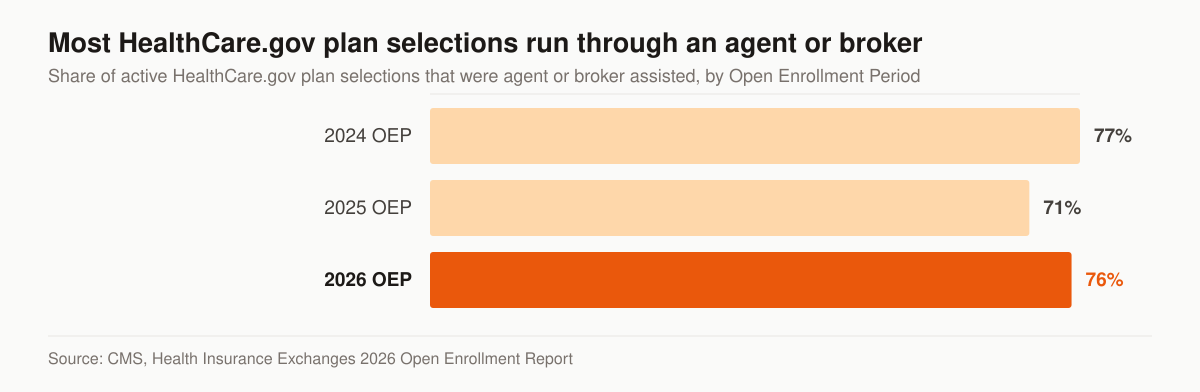
Source: CMS, Health Insurance Exchanges 2026 Open Enrollment Report, figures for the 2024, 2025 and 2026 Open Enrollment Periods. Read September 2026.
Read the dip in the middle bar before you read the trend. CMS attributes the 2025 decline to “system updates that prevented agents and brokers from changing a consumer’s enrollment without the consumer’s engagement prior to the 2025 OEP”, updates that “followed an increase in consumer complaints about unauthorized changes to FFM enrollments.” The share recovered afterwards. The marketing lesson sits inside that sentence: the enrollments that survive an integrity crackdown are the ones where a consumer knowingly picked a producer. Being chosen is worth more than being inserted.
CMS states one caveat in the same section, and it is worth carrying into any pitch built on this figure: “These data do not reflect the channel through which the application was submitted (for example, through the Marketplace Call Center or a direct enrollment partner), only whether the application involved the assistance of an agent or broker.”
The segment mix in the same report tells you where the demand sits. New consumers selecting Exchange coverage declined 13% to 3.6 million, compared with 4.1 million in the 2025 OEP. Actively returning consumers — people who came back and chose again — rose 15%, to 10.7 million from 9.4 million. Automatic re-enrollees fell 19%, to 8.8 million from 10.8 million. The pool of buyers who take a deliberate action each year is larger than the pool of first-timers, which makes renewal-season outreach to your existing book a channel with its own budget line rather than an afterthought.
The services a health insurance agent actually needs
Health insurance marketing is not one tactic. It is a sequence where each piece feeds the next. A converting site makes ads cheaper. Ranking content makes ad spend optional over time. Skip a step and the others leak.
The table below maps each service to the job it does for a health agent and the point at which it starts paying.
| Service | What it does for a health agent | When it pays off |
|---|---|---|
| Agent website & landing pages | Turns clicks into booked calls | Immediately — it gates every other channel |
| SEO | Ranks you for “ACA agent near me” and plan questions | 3–6 months, compounds |
| Paid ads (PPC / social) | Buys demand during enrollment windows | Same week, if the site converts |
| AI-search / GEO | Gets you cited in ChatGPT and AI Overviews | Emerging, low competition now |
| Content marketing | Earns trust and organic traffic year-round | Long-term moat |
Start with the funnel target, not the channel. If your site cannot turn a visitor into a phone call, more traffic just makes the leak bigger.
Build the foundation before you buy clicks
The order matters. Here is the sequence we run for new health-agency clients:
- Fix the conversion surface first — a fast, mobile agent website and high-intent landing pages so no paid click is wasted.
- Stand up tracking — every form, call, and ad mapped to a cost-per-lead, because un-tracked spend is just a donation.
- Capture intent that already exists — search engine optimization for insurance agents plus AI-search and GEO positioning so buyers find you without paying per click.
- Buy demand for the windows — compliant paid search and paid social campaigns timed to open enrollment and OEP.
- Compound it — content that ranks and earns trust so your cost per acquisition drops every quarter.
You can see the full menu on our insurance marketing services overview, or read how this maps to your line on the ACA agent marketing pillar.
What health insurance agent marketing costs
Where a price is quoted rather than published, the number depends on what the salesperson thinks you will pay. Ours is published. Foundation is $2,500 per month, Growth is $3,500 and Full-Funnel is $5,500, plus a one-time website build of $2,500 to $8,000. Programs run month to month with no long lock-in.
The table below shows what each tier contains and the health agency it is built for, so you can pick against your weakest link rather than a feature list.
| Tier | Monthly | What it includes | The health agent it fits |
|---|---|---|---|
| Foundation | $2,500 | Optimized website and landing pages, local SEO and Google Business Profile, on-page SEO, monthly reporting | No site worth ranking, or a site nobody can find locally |
| Growth | $3,500 | Everything in Foundation, plus an ongoing SEO and content engine, AI-search visibility, reputation and reviews | A sound site with no content engine, building owned pipeline before the next OEP |
| Full-Funnel | $5,500 | Everything in Growth, plus managed Google and Meta ads, landing-page CRO, marketing automation and CRM, full-funnel reporting | Organic handled; buying paid volume through the season and working SEP audiences after it |
Two things sit outside the fee, and any agency that blurs them is doing you a disservice. Ad spend is a pass-through paid directly to Google or Meta and never marked up by us. Your tool stack — rank tracking, email, CRM, call tracking — is billed to you directly, so you keep the logins when the relationship ends. The complete breakdown, including what is excluded at each tier, is on the pricing page.
The retainer is only half the decision. The other half is what share of commission revenue you can defend spending, which is a different calculation for a marketplace book with per-member-per-month renewals than for a single-commission product. Our insurance agency marketing budget guide works through the percentage-of-revenue ceiling and the cost-per-sale floor, and explains why published benchmarks in this category disagree so widely: they are measuring different denominators.
The enrollment calendar decides when the money goes out
Most industries guess at demand seasonality. Health insurance agents are handed a federal calendar, which means the media plan can be built backwards from a published date.
HealthCare.gov’s dates and deadlines page sets the consumer-facing sequence: November 1 is when “Open Enrollment starts — first day you can enroll in, renew, or change health plans through the Marketplace for the coming year”; December 15 is the “Last day to enroll in or change plans for coverage to start January 1”; and January 15 is when “Open Enrollment ends — last day to enroll in or change Marketplace health plans for the year”. After that date, the same page says, “you can enroll in or change plans only if you qualify for a Special Enrollment Period”, and coverage between January 16 and October 31 runs through those SEPs.
That window is contracting. In the 2025 Marketplace Integrity and Affordability Final Rule, CMS stated that “Each OEP must start no later than November 1 and end no later than December 31, and the OEP may not exceed 9 calendar weeks”, and that “For Exchanges on the Federal platform, the OEP will run from November 1 through December 15 preceding the coverage year, beginning with the OEP for plan year 2027.” A shorter window compresses the same demand into fewer days, which raises the cost of arriving late and raises the value of anything already ranking when the auction opens.
The table below is how we pace a year of budget against that calendar, and what each phase is not for.
| Phase | Months | Where the budget goes | What not to start here |
|---|---|---|---|
| Build | June–August | Site and landing-page work, tracking, county pages, review requests | Paid volume — you would be buying clicks into an unfinished funnel |
| Warm | September–October | Retargeting audiences, ad account history, content indexed and internally linked | New page ideas that cannot rank before November |
| Harvest | November–December | Paid search and paid social at full weight, speed-to-lead on every inbound | Rewrites, redesigns, or a platform migration |
| SEP and renewal | January–May | Trigger-event pages, outreach to your own book, review acquisition | Cutting spend to zero and losing the ad account’s learning |
The SEP half of the year runs on triggers instead of a calendar, which is why it is easy to leave out of a media plan built around November. A job loss, a move, a marriage or aging off a parent’s plan all start a clock the person did not schedule, and the search behind them is written with urgency rather than curiosity. Our ACA landing pages build treats each trigger as its own page and its own conversion path, and the in-season campaign list is in our open enrollment marketing ideas playbook.
Compliance is a feature, not a footnote
Health insurance marketing lives under CMS rules, and the first job is matching the rule to the line. ACA Marketplace marketing is governed by 45 CFR 155.220. The CMS third-party marketing organization disclaimer is a Medicare Advantage requirement that lives in 42 CFR part 422, with the parallel Part D requirements in part 423 — it binds your Medicare lines and does not reach a pure Marketplace campaign. Agents who run both need the Medicare pieces walled off rather than pasted across everything, which is what our health insurance agent website build maps out page by page.
The registration itself is a marketing asset that usually sits unused. HealthCare.gov’s agent and broker quick start states that “Before selling health insurance plans through the federal Health Insurance Marketplace® (FFM) on HealthCare.gov, you need to register, sign agreements, and complete required training.” A content mill cannot replicate that sentence about itself. Putting the licensed producer’s name, licence and registration status on the page is a trust signal that costs nothing and cannot be copied.
The marketing practices the ACA rule names by name
Compliance advice in this category usually stops at “don’t be misleading.” The regulation is more specific than that, and reading the list is faster than paraphrasing it.
The standard of conduct at 45 CFR 155.220(j)(2)(i) requires a registered agent, broker or web-broker to provide correct information “without omission of material fact” and to “refrain from conduct that is misleading (including by having a direct enrollment website that HHS determines could mislead a consumer into believing they are visiting HealthCare.gov), coercive, or discriminates based on race, color, national origin, disability, age, or sex”.
The marketing paragraph then gives examples. It opens: “Examples of prohibited misleading marketing practices agents, brokers, and web-brokers may not include in their marketing of FFE plans include, but are not limited to:” — illustrative, not a closed list.
The table below takes the named prohibitions that land hardest on a marketing campaign, quoted from the regulation, and states what each one rules out in practice.
| Prohibition, quoted from 45 CFR 155.220(j)(3)(iii) | What it rules out in a campaign |
|---|---|
| “Providing cash, monetary rebates, gift cards, travel vouchers, or cash equivalents as an inducement for enrollment or otherwise.” | Referral bounties, gift-card giveaways for a quote request, cash-back offers in ad creative |
| “Offering gifts to consumers, unless the gifts are of nominal value, are offered to similarly situated consumers without regard to whether or not the consumers enroll, and are not in the form of cash or cash equivalents.” | A prize draw restricted to people who enrolled; a giveaway whose value is not nominal |
| “Falsely asserting or suggesting that consumers will always qualify for zero-dollar insurance/zero-dollar premiums.” | “$0 plans” as an ad headline, H1 or meta description with no eligibility framing |
| “Utilizing the image or likeness and/or utilize a quote from a notable figure, such as a celebrity or politician, in an advertisement claiming that figure has endorsed you or your agency when that endorsement is not truthful.” | Implied endorsements, borrowed public figures, AI-generated spokespeople |
The zero-dollar line is worth pairing with the actual distribution, because the honest version of that claim still converts. In the 2026 OEP, CMS reports a nationwide average monthly premium of $619 before the advance premium tax credit and $178 after it, that 29% of HealthCare.gov consumers selected plans with a $0 monthly premium after APTC, and that 54% had premiums of $50 or less after APTC. An ad that reads “29% of HealthCare.gov consumers selected a plan with a $0 monthly premium after subsidies — let’s see what you qualify for” states the figure CMS published and stays inside the rule, which the prohibited version does not.
Two more clauses decide who carries the risk when you hire anyone. Under (j)(3)(v) the registered agent or broker is “responsible to ensure that all marketing-related materials created, written, released, or otherwise produced by the individual or entity or on their behalf” meet those requirements, and (j)(3)(iv) requires them to “produce any marketing material upon request, within the specified timeframe HHS mandates”. On their behalf covers your marketing vendor. Ask for dated, version-controlled copies of every page and ad you have run, and treat a partner who cannot produce that archive as an exposure rather than a saving. The rest of the rule set is broken down in our guide to ACA marketing compliance and CMS rules for agents. We provide marketing services, not legal advice; your compliance counsel or carrier signs off on your specific campaign.
Reviews, referrals and giveaways have a second rulebook
Reviews are a trust signal a local health agency can build without a budget line, and they are also where a well-meaning agent walks into a federal rule that has nothing to do with CMS. The FTC’s Rule on the Use of Consumer Reviews and Testimonials, 16 CFR part 465, has been in force since October 2024.
Four of its sections describe things agents are routinely advised to do by marketing vendors.
- Fake or misrepresented reviews. Section 465.2 makes it an unfair or deceptive act for a business to write, create or sell a review or testimonial that materially misrepresents that the reviewer “exists”, that they “used or otherwise had experience with the product, service, or business”, or their actual experience with it — and the same applies to disseminating one the business “knew or should have known” was misrepresented.
- Incentives tied to sentiment. Section 465.4 prohibits providing “compensation or other incentives in exchange for, or conditioned expressly or by implication on, the writing or creation of consumer reviews expressing a particular sentiment, whether positive or negative”. A gift card conditioned on a positive review sits squarely inside it.
- Staff and family reviews. Section 465.5(a) requires a “clear and conspicuous disclosure” of an officer’s or manager’s material relationship to the business, “unless, in the case of a consumer testimonial, the relationship is otherwise clear to the audience.” Paragraph (c) reaches reviews solicited from employees, agents and their immediate relatives, but only where the solicitation actually produces an undisclosed review and the officer or manager encouraged the omission, gave no instruction to disclose, or knew of the undisclosed review and “failed to take remedial steps.” The definition of clear and conspicuous in 465.1(c)(4) is strict for a web page: the disclosure “must be unavoidable”, and “is not clear and conspicuous if a consumer must take any action, such as clicking on a hyperlink or hovering over an icon, to see it.”
- Suppressing the bad ones. Section 465.7(a) covers using “an unfounded or groundless legal threat, a physical threat, intimidation, or a public false accusation” to stop a review being written or to get one removed; the false-accusation prong reaches an accusation “made with the knowledge that the accusation was false or made with reckless disregard as to its truth or falsity”. Paragraph (b) covers misrepresenting that a displayed set of reviews represents most or all of those submitted while reviews are suppressed for their rating or negative sentiment — with an express carve-out where the withholding criteria “are applied equally to all reviews submitted without regard to sentiment”, which is what a published, sentiment-blind moderation policy gives you.
The rule leaves an obvious safe path, and it is the one that works anyway. Section 465.2(d)(1) carves out reviews “that resulted from a business making generalized solicitations to purchasers to post reviews or testimonials about their experiences”. Ask every client the same way, at the same point in the relationship, with no incentive attached and no filter on who gets asked. That request cadence is part of our insurance local SEO service, and the mechanics of building it into a renewal workflow are in our guide to getting more Google reviews for insurance agents.
One related line for anyone buying social proof by the thousand: section 465.8(b) makes it a violation to purchase or procure fake indicators of social media influence — followers, likes, views — that the buyer knew or should have known to be fake and that materially misrepresent the buyer’s influence or importance for a commercial purpose. The knowledge element is not a loophole for a vendor who promises real followers and delivers bots; it is the reason to keep the invoice and the pitch.
A note on buying leads vs. generating them
We do one thing on this site: build marketing systems that generate leads you own. We do not sell leads here. If you specifically want to buy ACA leads, live transfers, or appointments as a product, that is a different transaction — you can buy leads direct from getinsureleads instead. Keeping the two clean means you always know whether a result came from a system you own or a list you rented.
Owning the channel changes what happens when spend stops. A rented list resets to zero every month; a ranking page and a converting site keep producing after the invoice ends. That is the whole argument for health insurance agent marketing services over a permanent lead bill. The two also behave differently under the consent rules that govern calling and texting whatever arrives — a distinction our TCPA compliance guide for agents buying leads covers in detail, and one reason a lead you generated with your own consent language is worth more than a lead you did not.
In-house, an FMO’s marketing, or an outside shop
There are three ways a health agency gets marketing done, and agents usually compare them on price alone. Price is the least informative column.
The table below compares them on the things that decide whether the marketing still exists in two years.
| Carrier or FMO material | In-house hire | Outside marketing shop | |
|---|---|---|---|
| Cost to you | Included in your contract | Salary, benefits, tools, your management time | A published monthly fee |
| Who owns the domain and pages | The hierarchy, usually on a shared platform | You | You |
| Differentiation | Shared with every producer in the hierarchy | Whatever the hire can build | Whatever the scope covers |
| Compliance review | Pre-approved by the carrier | Yours to run | Yours to run, with the vendor producing the archive |
| Continuity risk | Ends when you switch uplines | Ends when the person leaves | Ends at the end of a month |
| Best use | Compliance-safe collateral and plan material | A book large enough to keep one person busy year-round | Getting a tracked funnel running without a hire |
Free carrier material is worth taking. It stops being a marketing plan the moment you notice that every other producer in the hierarchy received the same page. Anything that makes you findable ahead of the agent in the next county has to be yours: your domain, your pages, your reviews, your tracked funnel. If a full-time hire is on the table, our in-house versus agency breakdown prices the loaded cost of the role against a retainer.
What we measure, and when it is fair to judge it
Marketing reports in this category tend to lead with impressions, which is the number that moves first and matters least. We report in the order the funnel actually fills.
The table below is the review sequence we run, and what it is too early to judge at each stage.
| Month | What should be moving | Too early to judge |
|---|---|---|
| 1–2 | Pages live and indexed, tracking firing on every form and call, Business Profile complete | Rankings, traffic, leads |
| 3–4 | Impressions and first long-tail positions, paid cost-per-lead stabilising, form starts | Revenue attribution |
| 5–6 | Booked appointments per month, cost per booked call, close rate by source | Head-term rankings |
| 7–12 | Applications per month, cost per submitted application, retention into the next plan year | Whether to expand into new counties |
The last row carries a measurement trap specific to this line. Commission follows the policy that gets paid for, and CMS is explicit that its own headline enrollment reporting stops short of that: the Marketplace 2026 Open Enrollment national snapshot states that “To have their coverage effectuated, consumers generally need to pay their first month’s health plan premium, if applicable. This release does not report the number of effectuated enrollments.” Your dashboard has the same gap unless you close it deliberately. A funnel that ends at “application submitted” is measuring the wrong end of the problem, so the effectuation status has to come back from your AOR reporting and land next to the cost that produced it.
Where health insurance marketing money leaks
Each row below is a process failure rather than a channel failure, and none of the fixes involve buying more traffic.
| Where it leaks | What it looks like | The fix |
|---|---|---|
| Ads before conversion | Paid traffic pointed at a slow homepage with a contact form | Build the landing page and the tracking first, then buy clicks |
| Untracked phone calls | The best channel is invisible because calls are not attributed | Call tracking on every source, ringing the same number the ads show |
| Season-only spend | Ads switch on November 1 and off January 16 | Keep a floor through SEP months so the account keeps its learning |
| No renewal outreach | The book is contacted once a year, by the carrier | Own the renewal conversation; the returning consumer is the larger segment |
| Shared hierarchy site | Your pages are one template among hundreds on an upline domain | Your own domain and pages, with a named producer on them |
| Slow follow-up | Leads sit in an inbox until the end of the day | Route to a phone immediately; the SEP clock is running for the person who filled the form |
| Undated marketing archive | Nobody can produce what an ad said last October | Version-controlled copy, retrievable by date, as 155.220(j)(3)(iv) contemplates |
Questions to ask any marketing vendor before you sign
The answers are more diagnostic than the pitch deck.
- Who owns the domain, the pages and the ad accounts if we stop? The right answer is you, on your own billing, with your own logins.
- What is the reporting metric? If it is impressions or “engagement” rather than cost per lead and cost per booked call, the program cannot be judged.
- Can you produce every ad and page we ran, by date? Under 45 CFR 155.220(j)(3)(v) that obligation lands on you, not on the vendor, so the archive has to exist.
- Which rule are you writing to? A vendor who applies the Medicare TPMO disclaimer to a Marketplace-only campaign, or who has never heard of 155.220, will over-disclose in one place and under-disclose in another.
- What happens in February? A plan that has nothing to say between the close of OEP and the following November has not accounted for the SEP half of the year.
- Is ad spend marked up? Ours is not; it is paid straight to the platforms. Ask for the platform invoice.
If a vendor cannot answer those six in a first call, the sixth month will not go better than the first.
Where to start with ACA marketing services
The quickest way to know what to fix is to look at the numbers. Get a free marketing audit and we will show you where your current funnel leaks — load time, conversion rate, wasted ad spend, missing search visibility — before you commit a dollar of budget. If you would rather talk it through first, get in touch. For the organic half of the plan in detail, our ACA insurance agent SEO services page covers the keyword bands, the local build and the publishing calendar; if you also work the 65+ market, the Medicare marketing playbook pairs with the ACA season because the two calendars collide in Q4. If you want proof the approach holds, the same systems run our own final-expense lead operation.
Marketing for health insurance agents is not magic. It is a tracked funnel, run by people who actually generate insurance leads, applied to your line with the compliance rails on. That is the whole offer.