Insurance Marketing Organizations: Who the Largest IMOs and FMOs Are, and Who Owns Them
An insurance marketing organization (IMO) is a wholesale distributor that contracts independent agents with carriers, is paid by those carriers on what the agents sell, and supplies contracting, training, tools and marketing support. FMO is the Medicare-side name for the same model. The biggest today are acquisition-built groups such as Integrity, AmeriLife and Simplicity Group.
An insurance marketing organization (IMO) is the wholesaler between insurance carriers and independent agents: it holds the carrier contracts, contracts you beneath it, gets paid by the carriers on what you write, and wraps that in contracting, training, quoting tools and marketing support. FMO is the same model under its Medicare-side name. The best-known names today are groups built by buying other IMOs.
Ownership is the detail most worth knowing before you contract. Several well-known distributors now belong to larger parent groups, and the ones listed below changed owners between 2020 and 2025. This page lists the largest IMOs and FMOs by who owns them, using only what each company publishes about itself, so you know whose contract you are actually signing.
One disclosure up front: we are not an IMO and hold no carrier contracts. We are a marketing agency for insurance agents, which is a different business, explained at the end of this page.
What is an insurance marketing organization?
An IMO, also expanded as independent marketing organization, is a distributor. It negotiates top-level contracts with carriers, appoints independent agents under those contracts at a lower commission level, and is paid by the carriers on the business its agents place. In return it handles the work an independent agent cannot easily do alone: contracting and appointments, product training, quoting and illustration software, case support, and often a marketing or lead program.
The labels overlap more than they differ:
| Label | Where you hear it | What it means in practice |
|---|---|---|
| IMO — independent (or insurance) marketing organization | Life insurance and annuities | A distributor holding carrier contracts with agents beneath it |
| FMO — field marketing organization | Medicare and senior health | The same model; the name CMS uses in its Medicare rules |
| NMO — national marketing organization | Any line | A claim about scale, not a different structure |
| BGA — brokerage general agency | Life brokerage | A life-side distributor, often focused on case design and underwriting support |
Every layer between you and the carrier is paid out of the same commission dollar, which is why the acronym on the letterhead matters less than the level you are offered. Our plain-English guide to the FMO, IMO, NMO, MGA and GA labels goes through each rung of that hierarchy.
An IMO is also not a marketing agency, even when “marketing” is in its name. An agency is a vendor you pay to generate demand; an IMO is the wholesaler you contract through. Search results for one often show lists of the other, which is why we wrote a separate guide comparing insurance marketing agencies and companies.
How IMOs and FMOs get paid
Carriers pay them. The clearest public picture comes from The Marketing Alliance, an IMO whose shares trade over the counter (OTC: MAAL) and whose audited statements are posted publicly. It describes its revenue as “commission and fee income from insurance carriers, including production bonuses”, and it also books “marketing reimbursement and subscription fees paid by carriers” (audited financial statements, fiscal years ended March 31, 2025 and 2024).
The same filing shows how concentrated that income can be. Even with more than 36 carriers on its lineup, the company derived about two-thirds of its commission income from two carriers in fiscal 2025.
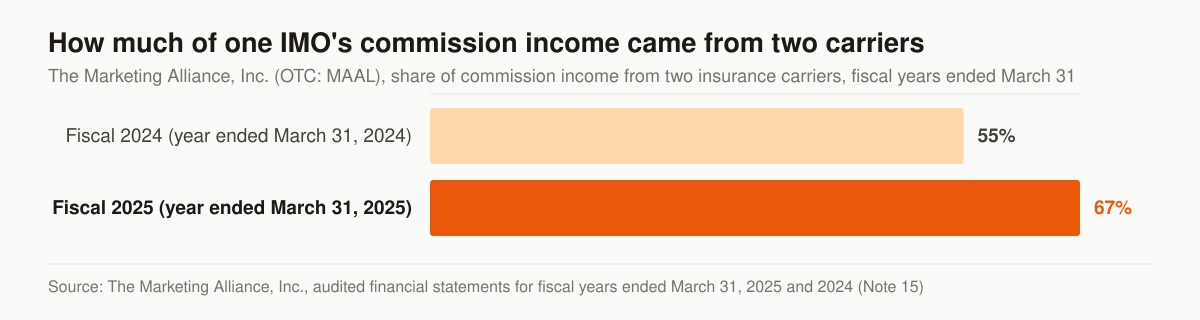
That matters to you because an upline’s carrier dependence shapes what it pushes. If two carriers fund most of its income, those two carriers’ products, contests and marketing money are what you will hear about first.
In Medicare the money flow has been argued over in public. In its April 2024 final rule, CMS summarized commenters’ description of how FMOs fund their “free” services to agents: by “negotiating with the MA organizations to pay the FMO the administrative fees associated with the agent or brokers’ enrollments” (CMS-4205-F, 89 FR 30448). The rule would have folded those “administrative payments (i.e. overrides)” into the capped per-enrollment compensation from contract year 2025, with a one-time $100 increase to the fair market value cap to make room for them.
It never took effect. On July 3, 2024 the U.S. District Court for the Northern District of Texas enjoined those changes nationwide, as CMS itself recorded in a correcting notice, and on August 18, 2025 the court vacated them in Americans for Beneficiary Choice v. HHS (order, No. 4:24-cv-00439-O). The same order left standing the rule’s requirement that a beneficiary consent before one third-party marketing organization shares their personal data with another. If you read 42 CFR 422.2274 on the eCFR today, remember that the vacated compensation text may still be printed there.
The practical reading for an agent: whatever an FMO gives you for free is funded by carrier payments tied to your production. That is the normal business model, not a scandal, but it is why our FMO due-diligence guide treats “free leads” as something you pay for in your contract level.
The largest insurance marketing organizations, grouped by who owns them
There is no independent ranking of IMOs by size. Each company publishes its own figures, and they count different things: “agents and advisors”, “financial professionals”, acquisitions, or premium. So the lists below are grouped by ownership rather than ranked, every figure is the company’s own claim with a link to where it says so, and organizations within each group appear in alphabetical order.
Groups built by acquisition
| Organization | Based | Since | Ownership, as the company states it | Size it publishes |
|---|---|---|---|---|
| AmeriLife | Clearwater, Florida | 1971 | Thomas H. Lee Partners led a majority investment in 2020; Genstar Capital joined as an equal investor in 2022 (about) | “Over 300,000 insurance agents and advisors”, “114 marketing organizations” |
| Integrity | Dallas, Texas | 2006 | Silver Lake led a $1.2 billion minority investment in 2021; founders, management and employees remained majority shareholders (release) | “More than 420,000 agents and advisors” (2021 release) |
| Simplicity Group | Summit, New Jersey | 2016 | Announced a definitive agreement in August 2024 for a majority investment from SkyKnight Capital and Dragoneer, buying out Lee Equity Partners’ funds (release) | “Over 65 acquisitions” in eight years (site) |
Integrity calls itself “the nation’s leading independent distributor of life and health insurance products” (overview). AmeriLife describes itself as a national leader in developing, marketing and distributing life and health insurance and annuities. Simplicity describes its offer as wealth accumulation and financial protection products.
Distributors that kept their own names inside a larger group
| Organization | Based | Focus it describes | Parent, and when |
|---|---|---|---|
| Brokers International | Des Moines area, Iowa | Annuities, life insurance, and investments through its RIA and broker-dealer | Integrity, agreement announced March 2021 (release) |
| Crump Life Insurance Services | Founded in Memphis, Tennessee, in 1920 | Life, annuities, long-term care, linked benefit and disability | AmeriLife, acquisition closed March 3, 2025; Crump continues “as a standalone company and brand” (release) |
| Ritter Insurance Marketing | Harrisburg, Pennsylvania | Health and life insurance; calls itself “a national FMO” (site) | Integrity, agreement announced May 18, 2022 (release) |
| Senior Market Sales | Omaha, Nebraska, founded 1982 | Senior market: Medicare and financial products | Joined Alliant Insurance Services in 2020 (about) |
| Western Marketing | Missouri Valley, Iowa, launched 1983 | Medicare, life insurance, annuities and hospital indemnity | Joined Integrity, announced March 22, 2022 (release) |
Their published sizes, again in each company’s own words: Brokers International lists “19,000” financial professionals and “50+” carrier relationships on its homepage; Crump partners with “more than 31,000 financial professionals” according to AmeriLife’s January 2025 announcement; Ritter’s 2022 announcement put it at “over 15,000 independent insurance agents in all 50 states”; Western Marketing “supports more than 18,000 agents nationwide” per its 2022 release.
Independent IMOs
| Organization | Based | Since | Ownership, as the company states it | Size it publishes |
|---|---|---|---|---|
| Advisors Excel | Topeka, Kansas | 2005 | “Fully independent … no private equity” (about) | “1,000+ teammates” (careers) |
| CreativeOne | Overland Park, Kansas | 1984, as Creative Marketing, Inc. | Declared its independence from a carrier in 2013; renamed CreativeOne in 2014 (our story) | Not published as an agent count |
| Financial Independence Group (FIG) | Cornelius, North Carolina | 1976 | “Privately held and independently owned” (release, January 2026) | “Over 3,000 financial professionals”, “more than 100 carriers” |
| The Marketing Alliance (TMA) | St. Louis, Missouri | 1996 | Publicly traded (OTC: MAAL); says it has run more than 20 years without raising outside capital (site) | “More than 36 carriers across five product lines” |
Lines differ more than the logos suggest. Advisors Excel lists annuities, life insurance, wealth management and Medicare; CreativeOne covers annuities, life insurance, disability, advisory and securities; FIG lists fixed and indexed annuities, life insurance and care planning; TMA is a life-side IMO whose lineup runs across five product lines.
Why ownership is the first thing to check
Look at the dates in those tables: 2020, 2021, 2022, 2024, 2025. Agents who contracted with Ritter, Crump, Brokers International, Western Marketing or Senior Market Sales before those years now work, one step removed, with a different owner than the one they signed with. Nothing about that is improper, and a well-funded parent can bring better technology and carrier leverage. It does change who sets policy on the things that decide your income.
Before you sign, ask four ownership questions and get the answers in writing:
- Who owns you today, and who has the final say on release requests? If decisions sit with a parent, a friendly local manager cannot promise you a release.
- Which carriers do you hold directly, and which run through someone above you? Each extra layer is paid from the same commission.
- If you are sold, what happens to my contract level and release terms? Ask whether your agreement allows them to be changed on a change of control.
- Which carriers produce most of your income? As the chart above shows, even a multi-carrier IMO can depend on two of them.
Why every “top 10 IMO” list disagrees
Three reasons, and they are worth knowing before you trust any list, including this one.
- Many of the lists are about something else. A search for the best insurance marketing organizations returns several rankings of marketing agencies, which are vendors rather than distributors.
- The size figures are not comparable. One company counts agents and advisors, another financial professionals, another acquisitions or premium; none of them is audited against the others.
- Publishers are rarely neutral. Some lists are published by an IMO that appears on its own list. Our tables avoid ranking for the same reason: we sell marketing services to agents and to IMOs, so a ranking from us would not be neutral either.
How to shortlist an IMO or FMO
Start from your line, not from the size of the organization. A Medicare agent needs an FMO with direct contracts and AEP support for the plans in their counties; an annuity producer needs case design and illustration support for the carriers they actually write. Then compare two or three uplines on the same five rows:
| Check | What to ask for |
|---|---|
| Ownership | Parent company, and who approves releases |
| Contract level | The level, carrier by carrier, in writing |
| Release policy | The written policy and how long releases take |
| Lead or marketing program | What it costs you in fees or in level, and who owns the leads |
| Carrier lineup | Which carriers are direct in your line and state |
Our step-by-step guide to choosing an FMO goes deeper on each of these, including vesting, chargebacks and the twelve questions worth asking on the first call.
Where a marketing agency fits
An IMO gets you contracted. It does not make your phone ring unless you rely on its lead program, and a lead program financed from your commission level ties your pipeline to that upline. The alternative is a lead flow you own: your own website, search visibility, ads and follow-up, which keep working if you change uplines. That is what we build, on published monthly tiers, and you can see how it works on our insurance lead generation for agents page. If you run an IMO or FMO yourself, the same system can be delivered under your brand through our white-label marketing program for FMOs and IMOs.
Not sure where your own leads are leaking? Book the free 15-minute teardown and we will look at your current lead sources before you decide anything, whichever upline you are with.
- How to Choose an FMO Without Signing Away Your Book
How to choose an FMO as an insurance agent: contract levels, release policy, the honest economics of free-lead programs, and red flags to avoid.
- Best Insurance Marketing Agencies & Companies: A Buyer's Guide
Best insurance marketing agencies compared by provider type, real cost ranges, and the six vetting criteria that matter. See which model fits your agency.
- How to Recruit Insurance Agents: The Recruitment-Marketing Playbook
How to recruit insurance agents with marketing, not just job boards: employer brand, recruitment ads, funnels, and referral systems for agencies and FMOs.
- Best CRM for Insurance Agents: An Honest, Vendor-Neutral Guide
A vendor-neutral guide to the best CRM for insurance agents — CRM vs AMS, the best tools by line and budget, real 2026 pricing, and where marketing fits.