What insurance marketing agencies charge, vendor by published price
Twelve insurance marketing vendors publish a price. The lowest recurring figure is $89 a month for a website subscription; the highest published entry point is $2,500 a month for a managed programme, which is ours. Setup fees run to $5,600. Two named vendors publish no price at all.
Search insurance marketing agency pricing and you get ranges. WebFX’s insurance agency roundup answers “How much does insurance marketing cost?” with “insurance marketing can range anywhere from $50–$6,000 per month”, and prices the agencies it lists in bands — “$3,000+ monthly retainers”, “$50,000+ minimum project size; $10,000+ monthly retainers”, “Custom retainer and project-based pricing”. HawkSEM puts it at “The average cost of a monthly retainer is around $3,500”. Both were read on 6 September 2026, and both are useful for planning a budget and useless for choosing a vendor: a band two orders of magnitude wide is not a price, and no figure on either page is one a named vendor prints on its own site.
This page does the other thing. Below are the prices twelve insurance marketing vendors publish on their own websites, each one read from that vendor’s own pricing page on 6 September 2026, with the URL beside it so you can open it and confirm. Two more vendors are listed with what their pricing page actually contains, which in each case is not a price.
Prices verified 6 September 2026. Vendors change prices, run promotions and retire plans without notice. Treat every figure below as accurate on that date and check the linked page before you sign anything.
What insurance marketing agencies charge: the published prices
This is the whole answer in one table. Every figure is the vendor’s own published number, in the vendor’s own words where the wording matters.
| Vendor | Published recurring price | One-time fee | What the price is for |
|---|---|---|---|
| InsuranceSplash | $89/mo, one plan | None — “No Setup Fees or Contracts” | Custom agency design, professional content writing, hosting and SSL, AI content writer. “We build it in 3 days.” |
| High Volt Digital | HighVolt $99/mo; MegaVolt $299/mo, marked “MOST POPULAR”; GigaVolt “Call for Pricing” | Not published on this page | Insurance websites and marketing. HighVolt is “Mobile Friendly Website”, “Website Hosting”, “Ongoing Updates”, “Email Hosting”, “ADA Compliant”. MegaVolt adds “Weekly Blog Posts”, “Social Media Posts”, “Review Management”, “Local SEO”. |
| Agency Revolution | Forge Essential from $140/mo; Forge Premium from $310/mo | $500 (Essential), $1,000 (Premium) | Forge website platform. Essential includes design, built-in SEO foundations, lead-gen forms, client centre, 200+ coverage pages. Premium adds business texting, local listings, reputation management. |
| Stratosphere | Agency Website “Starting at $199 $149/month”; Marketing Essential from $649/mo; All-in-One Marketing from $999/mo | $2,000 on the website package; “No Setup Fees*” on both marketing packages | Insurance-only agency. Website tier is a build plus hosting; the marketing tiers add local SEO, AI search optimisation, reputation management, content and reporting. |
| Advisor Evolved | Quick Launch $150/mo; Custom Build $350/mo; PowerPack add-on “Now $50” against a struck-through “$75 / month” | $1,800 (Quick Launch), $5,600 (Custom Build) | Insurance agency websites. Quick Launch is described as a full multi-page build; Custom Build is custom design and functionality. |
| BrightFire | Insurance Agency Website $170/mo; Reviews & Reputation Management $110/mo; Local Listings Management $50/mo; Social Media Marketing $100/mo; Search Engine Marketing $160/mo; Ultimate SEO Bundle $290/mo against a struck-through $330 | None — “No Contracts. No Setup Fees. No User Fees. 30-Day Money Back Guarantee.” | À-la-carte services for independent agencies. The SEM line carries the page’s own qualifier: “Per campaign. Ad spend not included.” |
| Agent Autopilot | Local Presence $297/mo; Local Domination $497/mo; Local Service Ads $697/mo (California and Florida only); website build $500 + $25/mo | $497 on all three plans | Local SEO and AI visibility for insurance agents. Local Presence is “Guided and self-managed”; Local Domination is “Fully managed”; the LSA plan adds paid visibility “plus ad spend to Google”. |
| Dcruz Systems | Starter $499/mo; Growth $999/mo; à-la-carte from “Starts at $599 / mo” (Contextual SEO) and “Starts at $199 / mo” (System Automations) | None on Starter; $1,200 on Growth; à-la-carte web development “Starts at $750 One-Time” | Marketing and automation for agencies. Starter is printed as “Leased License (No Ownership)”; Growth is printed as “100% Ownership”. Both add “+10% on ad spend over $2,999”. |
| Quotely | Starter $597/mo (was $1,000/mo); Growth $750/mo (was $1,250/mo); Scale $1,997 one-time (was $3,000) then $997/mo (was $1,500) | First month set-up $997, marked down from $1,500, on Starter and Growth | Google PPC and Facebook ads for insurance agents. The page states “Ad spend is billed directly by Google/Meta to your card.” Prices are Q3 promotional and the page says they “require a coupon code”. |
| Egochi | Insurance plans from $1,500/mo; managed programmes $1,500–$15,000/mo; Local SEO $1,500–$3,000/mo; National SEO $3,000–$7,500/mo; Enterprise SEO from $7,500/mo | Websites $3,500–$5,000, $8,000–$15,000 or $20,000–$50,000+ per project; strategy audit $2,500; full strategy $7,500 | Generalist agency with an insurance practice. Policy-line SEO, local visibility, quote-intent PPC, content, compliance-aware copy, quote-level reporting. |
| OuterBox | SEO Essentials $2,000/mo; Pro $3,000/mo; Enterprise from $7,000+/mo | Not published on this page | Generalist SEO agency. The FAQ states it plainly: “Essentials is $2,000/month, Pro is $3,000/month, and Enterprise starts at $7,000+/month.” |
| Insurance Marketing Co (us) | Foundation $2,500/mo; Growth $3,500/mo; Full-Funnel $5,500/mo | Website build $2,500–$8,000 one-time | Done-for-you managed programme for insurance agents. Ad spend billed at cost straight to the platforms. Month to month, no lock-in. |
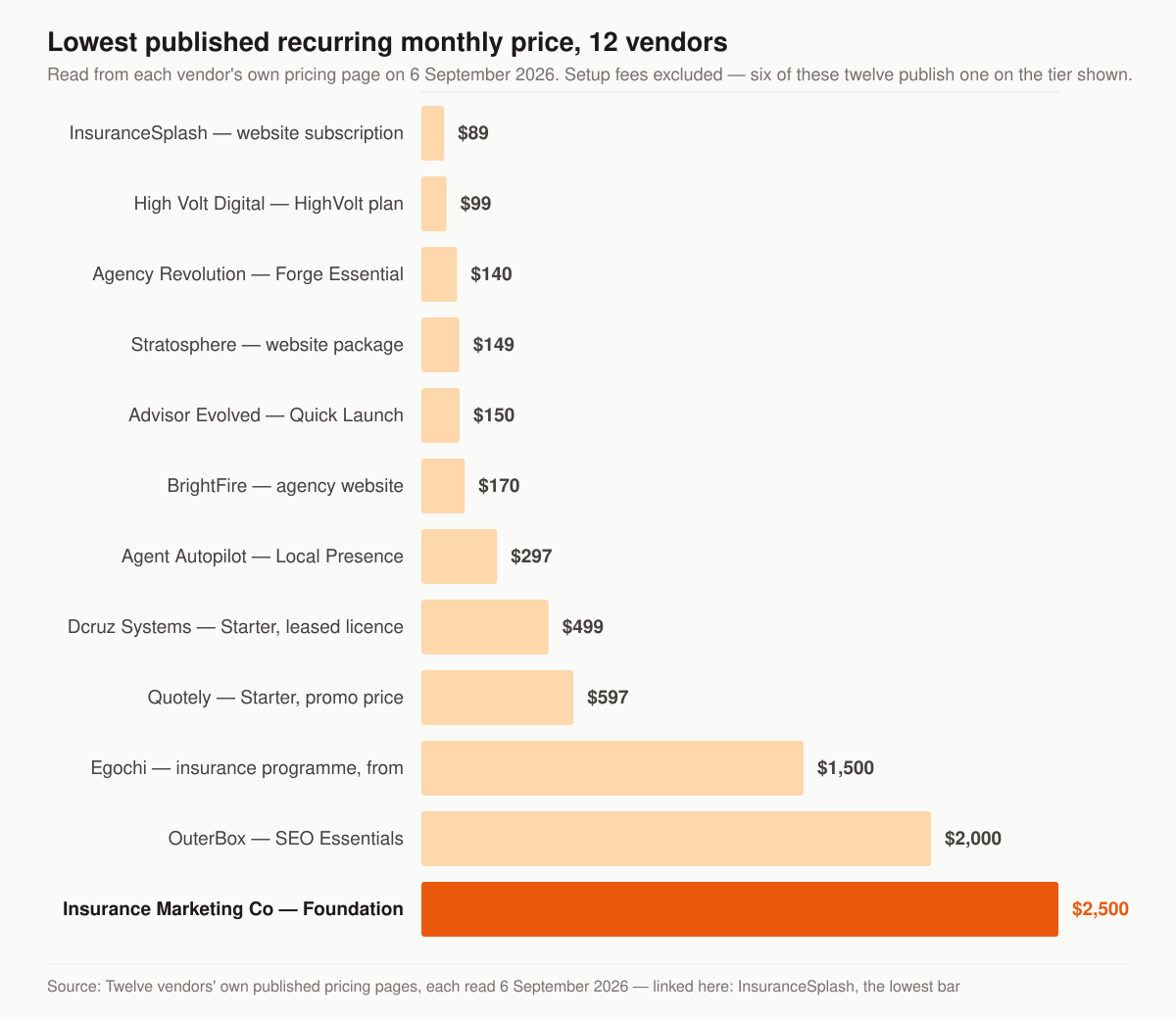
Chart: the lowest recurring monthly figure each vendor publishes, setup fees excluded. Sources, each read 6 September 2026: InsuranceSplash, High Volt Digital, Agency Revolution, Stratosphere, Advisor Evolved, BrightFire, Agent Autopilot, Dcruz Systems, Quotely, Egochi, OuterBox, and our own pricing page.
The $89 subscription and the $3,500 programme are not the same purchase
The table spans a 28-fold range, and a roundup that sorts it by price and calls it a shortlist has told you nothing. The range is wide because two different products are sitting in it.
A website subscription is a licence. You pay a monthly fee, the vendor hosts a template with insurance content in it, and nobody is running anything. InsuranceSplash at $89, High Volt Digital’s HighVolt plan at $99, Agency Revolution’s Forge Essential at $140, Advisor Evolved’s Quick Launch at $150 and BrightFire’s agency website at $170 all sit here. So does Stratosphere’s $149 website tier, once you notice the $2,000 that sits beside it. These are sensible purchases. An agent who needs a credible address on the internet and has no traffic to convert yet is buying exactly the right thing at $89 a month, and no retainer improves on that until there is something to optimise.
A managed programme is labour. Somebody publishes, builds links, manages campaigns, chases reviews and reports on it every month. Stratosphere’s $999 All-in-One tier, Egochi’s $1,500 floor, OuterBox’s $2,000 Essentials and our own $2,500 Foundation sit here. The fee is mostly a team’s time, which is why it does not compress into the low hundreds.
Between them sits a third category that is easy to misread: single-channel management. Quotely at $597 to $997 a month runs Google and Meta campaigns and nothing else. Agent Autopilot at $297 to $697 runs local search and AI visibility and nothing else. Dcruz Systems at $499 to $999 runs a marketing-and-automation stack. These are narrower than a full programme and broader than a template, and their prices land exactly where you would expect.
The practical consequence is that the sorted list is the wrong tool. A vendor is cheaper than another vendor only when both are selling the same scope, and across this table they mostly are not. The buyer’s guide to insurance marketing companies works through the eight provider archetypes and the vetting criteria; this page is the price layer underneath it.
The headline number is not the number you pay
Every figure in the table above is real, published, and quotable. That is exactly what makes a sorted list dangerous: eight of these vendors print a qualifier directly beside or beneath the headline monthly price, and in every case the qualifier changes what you are buying. A roundup that copies the number and drops the line under it produces a comparison that is technically accurate and practically useless.
Here is each headline figure next to the words the same vendor prints against it. Everything in the right-hand column was read on the vendor’s own page on 6 September 2026 and is quoted as printed.
| Vendor | Headline monthly figure | What the vendor’s own page attaches to it |
|---|---|---|
| High Volt Digital | $99/mo | This is the website tier: “Mobile Friendly Website”, “Website Hosting”, “Ongoing Updates”, “Email Hosting”, “ADA Compliant”. Marketing starts a tier up at $299/mo, and the top tier is priced “Call for Pricing”. |
| BrightFire | $50/mo | This is Local Listings Management on its own. The page’s five other lines run $100, $110, $160, $170 and $290 a month; the agency website is the $170 line. |
| Stratosphere | $149/mo | Printed as “Starting at $199 $149/month” with “$2,000 one-time fee*” directly beneath. The marketing programmes are $649/mo and $999/mo. |
| Advisor Evolved | $150/mo | Printed as “$150/mo after $1800 setup”. The other tier is “$350/mo after $5600 setup”. |
| Agent Autopilot | $297/mo | Labelled “Guided and self-managed”, with “+ $497 one-time setup”. The tier labelled “Fully managed” is $497/mo. |
| Dcruz Systems | $499/mo | Printed with “Leased License (No Ownership)” and “+10% on ad spend over $2,999”. “100% Ownership” is the $999/mo plan plus “$1,200 One-Time Setup Fee”. |
| Quotely | $597/mo | Sits under “Q3 Promo — Prices below require a coupon code.” The standing figure is printed alongside as “Was $1,000/mo”, plus “First month $1,500 → $997 Set Up”. |
| Egochi | $1,500/mo | The floor of a published band, not a plan price. Local SEO is listed at “$1,500 - $3,000 per month” and national SEO at “$3,000 - $7,500 per month”. |
Read the right-hand column and the ranking changes. Two of these figures are self-managed or leased products sitting in a list beside managed ones. Two carry a four-figure one-time fee that the monthly number does not mention. One expires with a quarter and requires a code. Two more carry a three-figure setup fee. One is a single à-la-carte line item at a vendor whose website product costs more than three times as much.
None of that is hidden. Every phrase above is printed in public on the vendor’s own page, in most cases within an inch of the price. It is simply not the part that travels when a number gets copied into a comparison table — and a directory listing, a “top 10” post or an AI summary is a copy of a copy. A price is a fact with a date and a URL attached. Without those two things it is a rumour, however confidently it is formatted.
Vendor by vendor: what each published price actually buys
InsuranceSplash — $89 a month, one plan
InsuranceSplash publishes a single plan and nothing else: $89/mo, described on the page as “One Simple Plan. Everything Included.” Included in that figure are a custom agency design, professional content writing, secure hosting and SSL, an AI content writer, mobile optimisation, SEO setup, quote forms and maintenance. The page states “No Setup Fees or Contracts”, “Cancel anytime”, and “We build it in 3 days”. It also offers to build the site before you pay: “See your finished website first. Only start your subscription when it’s ready to launch.”
What this price does not buy is anyone driving traffic to the finished site. It is a website product, and it is priced like one.
High Volt Digital — $99 and $299 a month, and a third tier priced by phone
High Volt Digital publishes a three-tier table at highvoltdigital.com/pricing, reachable from the Pricing link in the site’s own primary nav. HighVolt is $99 “PER MONTH” and lists a mobile-friendly website, website hosting, ongoing updates, email hosting and ADA compliance. MegaVolt is $299 “PER MONTH”, marked “MOST POPULAR”, and adds weekly blog posts, social media posts, review management and local SEO. GigaVolt is priced “Call for Pricing” and lists full-service SEO, custom content, Google Ads management and social media advertising.
The page frames the intent plainly: “At High Volt, we wanted to create a pricing plan that is both affordable and easy to understand.” Two of the three tiers deliver on that; the third is a phone call.
The $99 to $299 step is the clearest published example on this page of where a website stops being a website. At $99 you are renting a site. At $299 somebody is publishing to it and working the local surface, which is the same boundary Stratosphere draws between $149 and $649 and the one we draw between a one-time build and a Foundation programme. Note also that both High Volt pages carry a 2023 modified date and the site footer reads “© 2023 High Volt Digital”, so the prices are published but not recently restated — worth confirming on the call.
Agency Revolution (Forge) — $140 and $310 a month, plus setup
Agency Revolution publishes two tiers of its Forge platform. Forge Essential is “Starting at $140 /month – $500 setup” and lists modern design, built-in SEO foundations, lead-gen forms, a self-service client centre, 200+ coverage pages, quick-start FAQs and standard support. Forge Premium is “Starting at $310 /month – $1,000 setup” and adds business texting, local listings, reputation management, advanced sales and service tools, customisable FAQs and premium support.
The same page publishes its add-on rates separately: business texting $50/month, local listings $50/month per location, reputation management $110/month, social media $90/month. The footer links a cancellation request form, which is worth noting as a fact about friction rather than a criticism.
Stratosphere — $149, $649 and $999 a month
Stratosphere is an insurance-only agency and it publishes three packages. Agency Website reads “Starting at $199 $149/month” with “$2,000 one-time fee*” printed beneath it. Marketing Essential is “Starting at $649/month” with “No Setup Fees*”. All-in-One Marketing is “Starting at $999/month” with “No Setup Fees*”.
The footnotes matter more than usual here. Under the website package the page states that pricing “applies to small websites (10–12 pages)”, that the “Base setup fee assumes content is provided by the client”, and that “Full-site professional SEO content creation is available as a $1,000 add-on”. The asterisk on the two marketing packages resolves to a separate note: “*Additional setup fees may apply for non-Stratosphere-hosted websites.” Add-ons are published too: SEM “Starting at $300 or 15% of spend, whichever is higher”, online reputation management at “Starting at $149 $49/month per Agent/location”, and an AI chatbot “Starting from $29”. The page also states “No Long-Term Contracts - Just results!”
Read together, the $149 headline is a website with a $2,000 fee behind it and a content assumption inside it. The comparable figure to a managed programme is the $999 tier.
Advisor Evolved — $150 and $350 a month, behind large setup fees
Advisor Evolved publishes Quick Launch at “$150/mo after $1800 setup” and Custom Build at “$350/mo after $5600 setup”. The page describes Quick Launch as suitable for “scratch and smaller 1-5 man agencies” and as “a full, multi-page website build”; Custom Build is for agencies wanting “a completely custom design or custom functionality”. A PowerPack Add-On is listed at “Now $50 / month” against a struck-through “$75 / month”.
The $5,600 setup on Custom Build is the largest published one-time fee in this comparison other than project-priced website work, and it lands this vendor in a different bracket than its $350 monthly figure suggests. Our own insurance website build is a one-time $2,500–$8,000 with no monthly licence attached, which is the same trade made in the opposite direction.
BrightFire — priced per service, from $50 to $290 a month
BrightFire does not sell tiers. It publishes a per-service ladder: Insurance Agency Website $170/month, Reviews & Reputation Management $110/month, Local Listings Management $50/month, Social Media Marketing $100/month (with “Custom campaigns are available for an additional $75 each, per month”), Search Engine Marketing $160/month carrying the qualifier “Per campaign. Ad spend not included”, and an Ultimate SEO Bundle at $290/month against a struck-through $330, which the page says “saves you $40/month off standalone prices”.
Its commercial terms are the clearest in the comparison and are printed at the top of the page: “No Contracts. No Setup Fees. No User Fees. 30-Day Money Back Guarantee.” The FAQ confirms each clause individually, including “you are never under contract and are free to cancel at any time”. That is a checkable commitment, and it is a fair standard to hold any vendor to, including us.
Agent Autopilot — $297, $497 and $697 a month, plus $497 setup
Agent Autopilot, trading its product as Visible Agent, publishes three plans on its homepage. Local Presence is “$297 /month + $497 one-time setup” and is labelled “Guided and self-managed”. Local Domination is “$497 /month + $497 one-time setup” and is labelled “Fully managed”. Local Service Ads is “$697 /month + $497 setup, plus ad spend to Google” and is marked “California and Florida only”. Separately it publishes a website build at “$500 + $25/month”, hosted on AWS.
The page also states “EXCLUSIVE — One agent per territory”. Its dedicated /pricing URL does not restate the plan prices; it routes you to a free “Agent Visibility Score” first, which means the figures live on the homepage rather than the page named Pricing.
The self-managed versus fully managed distinction is the one to hold on to. $297 is the entry price and it is also the tier where the agent does the work; the fully managed equivalent is $497, and a comparison that carries the lower figure across is comparing a training programme to a service.
Dcruz Systems — $499 and $999 a month, and an ownership clause with a price on it
Dcruz Systems publishes two plans and an à-la-carte column under the heading “Plans Built for Agency Growth”. Starter is “$499/mo”, printed with “Leased License (No Ownership)” and “+10% on ad spend over $2,999”. Growth is “$999/mo”, printed with “$1,200 One-Time Setup Fee”, “+10% on ad spend over $2,999” and “100% Ownership”. The third column prices services individually: web development “Starts at $750 One-Time” plus “$25/mo ($15 Hosting + $10 Maint)”, contextual SEO “Starts at $599 / mo”, and system automations “Starts at $199 / mo” plus platform fees.
This is the most useful piece of published pricing in the comparison, because it puts a dollar figure on a term that is normally invisible until you try to leave. At this vendor, owning your own marketing assets costs $500 a month more plus $1,200 up front. Asset ownership is one of the six vetting criteria in our buyer’s guide, and here it has a price tag.
Quotely — $597 to $997 a month, on a coupon
Quotely runs Google PPC and Facebook campaigns for insurance agents, and publishes three tiers under “Flat management fees. Zero surprises.” Starter is “$597/mo” against “Was $1,000/mo”. Growth, marked “Most Popular”, is “$750/mo” against “Was $1,250/mo”. Scale is “$1,997 one-time” against “Was $3,000 one-time”, “then $1,500 → $997/mo”. Starter and Growth both show “First month $1,500 → $997 Set Up”, while the page also states “All plans are month-to-month. No setup fees.”
The condition attached to all of it is printed above the tiers: “Q3 Promo — Prices below require a coupon code.” followed by an instruction to book a demo before the discount applies. So the published prices are real and the standing prices are also published, and which one you pay depends on a call. On ad spend the page is unambiguous: “Ad spend is billed directly by Google/Meta to your card. You pay us to manage it — that’s it.”
If a paid-media programme is what you are pricing, our managed insurance PPC sits inside the Full-Funnel tier rather than being sold as a standalone line, which makes Quotely the cleaner comparison for an agent who wants ads and nothing else.
Egochi — from $1,500 a month, with a full published rate card
Egochi is a generalist agency with an insurance practice, and it publishes more numbers than anyone else here. Its insurance page states: “Plans start at $1,500 monthly, pricing published up front.” Its FAQ repeats it: “Egochi’s insurance marketing plans start at $1,500 monthly and scale with the coverage lines and markets you target.”
Its main pricing page breaks that into a rate card. Local SEO is “$1,500 - $3,000 per month”, National SEO “$3,000 - $7,500 per month”, and Enterprise SEO “Custom, from $7,500 per month”. Website work is project-priced: Starter “$3,500 - $5,000 per project”, Professional “$8,000 - $15,000 per project”, Enterprise “$20,000 - $50,000+ per project”. A strategy audit is $2,500 one-time and a full strategy $7,500 one-time. Maintenance is listed at $150/month. The page opens by summarising the whole rate card in one sentence: “Digital marketing pricing at Egochi runs $1,500 to $15,000 per month for managed programs, $3,500 to $50,000 for web design projects, $2,500 to $7,500 for standalone strategy, and $499 to $2,499 and up for logo work.”
The insurance page is also candid about a gap that matters to an agency buyer: “No insurance agency sits in the published portfolio yet, and Egochi will not pretend otherwise.” The case studies it does show are a commercial finance company, a business the page labels a “Community Bank”, a clinical waste company, a family law firm, an art studio and an ecommerce brand — adjacent regulated or local-trust categories rather than insurance.
OuterBox — $2,000, $3,000 and $7,000+ a month
OuterBox is a generalist SEO agency and publishes three packages: Essentials $2,000/month, Pro $3,000/month described as fitting “growing businesses ready to compete regionally or nationally”, and Enterprise from $7,000+/month which “scales with program complexity”. Its FAQ states it in one line: “Essentials is $2,000/month, Pro is $3,000/month, and Enterprise starts at $7,000+/month.”
OuterBox is the closest published comparison to our own monthly figures, and it is a generalist. That is the trade an agent is making at this end of the market: an agency with more scale and a broader portfolio, against one that only works on insurance and knows the CMS marketing rules, TCPA consent and state advertising rules without being briefed on them. Our insurance SEO service and our AI search and GEO work both sit inside a tier rather than being priced per channel.
The two vendors that publish nothing
Not publishing a price is a legitimate way to sell. It is also a fact about the buying process, and it is worth knowing before you spend forty-five minutes on a demo.
| Vendor | Page checked | What is on it |
|---|---|---|
| AgentMethods | agentmethods.com/pricing | A page titled “Pricing for Our Insurance Websites and Email Campaigns” whose body is a “Request Your Live Demo Now” form asking for first name, last name, email, phone and primary product focus, plus a phone number and three averaged customer claims. No figure appears. |
| Forge3 | forge3.com/pricing | Redirects to Agency Revolution’s page titled “Book Your 30-Minute Marketing Consultation”. No price. The whole of forge3.com redirects there, not just the pricing URL, and Agency Revolution’s own published prices are in the table above. |
Two more vendors publish part of the way. High Volt Digital prices its first two tiers at $99 and $299 a month and marks the third “Call for Pricing” — so the entry point is public and the ceiling is not. Agent Autopilot publishes all three plan prices, but on its homepage rather than on the URL named Pricing; that page leads with a free Agent Visibility Score and publishes only the $500 + $25/month website. In both cases the figure exists, and in both cases you would miss it by checking one page.
The reasonable question to ask any of these is the one in our FAQ below: what is the monthly figure, what is the one-time figure, is ad spend inside or outside it, and who owns the assets if you leave.
Where our own pricing sits, and why it is the top of the range
We publish three tiers on our pricing page and they are the highest published entry point in this comparison. Foundation is $2,500/mo, Growth is $3,500/mo, Full-Funnel is $5,500/mo, and a one-time website build is $2,500–$8,000. Ad spend is billed at cost, straight to the platforms. Programmes run month to month.
We are more expensive than every website subscription in the table by a factor of fifteen to thirty, and more expensive than the entry tier of every single-channel manager. That is a real fact about the choice, so here is the honest version of it.
Foundation at $2,500 includes an optimised insurance website or landing pages, local SEO and Google Business Profile, on-page SEO, and monthly reporting. Set that against InsuranceSplash at $89: you get the site in both cases, and at Foundation you also get someone working the local search surface every month. If your agency has no web presence and no traffic, the $89 purchase is the rational one and we will tell you that on the call.
Growth at $3,500 adds an ongoing SEO and content engine, AI-search visibility work, and reputation and review management. Set that against BrightFire’s Ultimate SEO Bundle at $290: BrightFire is giving you the website, listings and review tooling as a managed subscription. Growth is giving you a team publishing and building the entity signals that decide whether an assistant names your agency in an answer. Different scope, different labour, different price.
Full-Funnel at $5,500 adds managed paid ads on Google and Meta, landing-page conversion work, and marketing automation. Set that against Quotely’s $750 Growth tier: Quotely manages the ads and stops there. Full-Funnel manages the ads on top of everything the other two tiers contain.
The choice this table really presents is not cheap-versus-expensive. It is how much of the work you intend to do yourself. Every price below roughly $500 a month leaves the campaign labour with you or leaves it undone. Every price above it is buying somebody’s hours. If you have the hours and enjoy the work, the bottom of this table is genuinely the better buy, and the marketing budget guide will help you size what you spend around it.
What is never inside the headline monthly price
Six things get quoted separately across this set of vendors, and they are where a $999 quote turns into a $2,400 invoice.
Ad spend. Priced outside the fee at every vendor here that runs ads. BrightFire prints “Ad spend not included” beside its $160 SEM line. Quotely bills it “directly by Google/Meta to your card”. Agent Autopilot’s LSA tier says “plus ad spend to Google”. Dcruz Systems takes “+10% on ad spend over $2,999” on both plans. Stratosphere prices paid media at “$300 or 15% of spend, whichever is higher”. Ours is billed at cost to the platforms.
Setup. Six of the eleven other vendors publish one: $497 at Agent Autopilot, $500 and $1,000 at Agency Revolution, $1,200 at Dcruz Systems Growth, $1,800 and $5,600 at Advisor Evolved, $2,000 at Stratosphere’s website package, and $997 for a promotional first month at Quotely. Ours is the seventh: a one-time website build at $2,500 to $8,000. BrightFire, InsuranceSplash and Stratosphere’s two marketing packages state in writing that they charge none. Quotely’s page states both at once — a first-month set-up figure on two tiers, and “All plans are month-to-month. No setup fees.” — which is a question to put to them before signing.
Content. Stratosphere’s footnote is explicit that the setup fee “assumes content is provided by the client” and that full-site SEO content is “a $1,000 add-on”. InsuranceSplash and BrightFire both include content in the subscription.
Extra locations or producers. Agency Revolution prices local listings “per location”. Stratosphere prices reputation management “per Agent/location” and notes its package “includes deliverables tailored for 1 location or 1 agent”, with more available “at an additional cost”. If you run a multi-producer agency, ask for the multiplied number before you compare anything.
Ownership. Dcruz Systems is the vendor that prices this openly. Elsewhere it is a contract question rather than a line item, and it is the one to raise before signing: the website, the content, the ad accounts and the lead data should be yours if the relationship ends.
Add-on modules. BrightFire’s custom social campaigns are “$75 each, per month”. Advisor Evolved’s PowerPack is $50/month. Agency Revolution’s four add-ons run $50 to $110 a month each. A base tier plus three add-ons is a different price than the base tier.
How to price-check any insurance marketing vendor
The verification that produced this page took under two hours and needs no tooling. Run the same four steps on any vendor you are considering.
- Try
/pricingon the domain first, even if nothing else on the site mentions money. High Volt Digital’s services page names its MegaVolt and GigaVolt plans with no rate attached, which reads like a vendor that quotes on request; highvoltdigital.com/pricing publishes $99 and $299 a month. Agent Autopilot is the mirror image — its plan prices are on the homepage, not on the page named Pricing. Check both before concluding a vendor publishes nothing. - Read the small print under the number. The $149 with a $2,000 fee beneath it, the $297 with “self-managed” beside it, the $499 with “Leased License (No Ownership)” printed on it, and the $750 that “require[s] a coupon code” are all cases where the qualifier is doing more work than the price.
- Screenshot it with the date. Prices move. Stratosphere, Quotely and Advisor Evolved all show struck-through figures right now, which means today’s number is a promotion and next quarter’s may not be.
- Ask the four questions in writing. Monthly figure, one-time figure, is ad spend inside or outside, and who owns the assets. Any vendor that will answer all four in an email is a vendor whose quote you can actually compare.
If you want that comparison run for you against your current setup, our free marketing teardown does the vendor-scope arithmetic without a pitch attached, and our published tiers and what each one contains are on the page rather than behind a call.
- Insurance Agency Website Build Cost: What 12 Vendors Publish
Insurance agency website build cost, read off 12 vendors' own pricing pages on 6 September 2026: eight publish a number, four publish none, URL beside every figure.
- Best Insurance Marketing Agencies & Companies: A Buyer's Guide
Best insurance marketing agencies compared by provider type, real cost ranges, and the six vetting criteria that matter. See which model fits your agency.
- Best CRM for Insurance Agents: An Honest, Vendor-Neutral Guide
A vendor-neutral guide to the best CRM for insurance agents — CRM vs AMS, the best tools by line and budget, real 2026 pricing, and where marketing fits.
- 40 Content Ideas for Final Expense Agents You Can Steal This Week
40 content ideas for final expense agents: cost and qualifying answers, video hooks, offline angles, and the capture step that turns views into leads.