Insurance Agency Website Build Cost: What 12 Vendors Publish
An insurance agency website costs $0 to $8,000 as a one-time build fee and $17 to $350 a month as a subscription, read from twelve vendors' own pricing pages on 6 September 2026. The highest third-party setup fee is $5,600; the $8,000 ceiling is our own. Eight of the twelve publish a number, four publish none.
Search “insurance agency website cost” and the first result is a vendor product page that publishes no price. Zywave’s insurance agency website page — the company describes itself there as the largest provider of insurance agency websites in the United States — carries a case-study figure, a feature list and the instruction “Request the Zywave Websites Demo.” No dollar amount appears on it.
That is the shape of this market. Website vendors selling to insurance agents split cleanly into two camps: the ones that post a number on a public page, and the ones that route you to a call. This page is a list of the numbers, read directly off each vendor’s own live pricing page on 6 September 2026, with the URL beside every figure so you can check it yourself.
One thing to fix before the table. This site publishes its own rates, and we are among the more expensive options on the list — our one-time website build is $2,500 to $8,000 depending on scope, against subscription products that charge no build fee at all. That is a real gap and this page does not argue it away. There is a section below on when the $89-a-month product is the right purchase for a solo agent, because for a large share of the people reading this it will be.
What twelve vendors publish, and what they don’t
The table below lists every vendor we checked, what the product actually is, the exact figure printed on the vendor’s own page on 6 September 2026, and the page we read it on. Where a vendor publishes no price, the row says so and links to the page that publishes none.
| Vendor | What you are buying | Published price, 6 Sep 2026 | Page we read |
|---|---|---|---|
| InsuranceSplash | Done-for-you agency website, subscription | $89/mo, “No Setup Fees or Contracts” | websites.insurancesplash.com |
| Squarespace | General website builder, self-served | $25/mo Basic to $139/mo Advanced on monthly billing; the page’s default display is the annual rate, $19/mo to $99/mo | squarespace.com/pricing |
| Quotely | Custom-coded site, insurance-specific | $1,250 one-time setup + $125/mo | quotelyleads.com/websites |
| Stratosphere | Agency Website package | $149/mo (against a struck-through $199) + $2,000 one-time fee | joinstratosphere.com/packages |
| Advisor Evolved | Quick Launch, 20–30 day turnaround | $150/mo after $1800 setup | advisorevolved.com/plans |
| Advisor Evolved | Custom Build, 30–90 day turnaround | $350/mo after $5600 setup | advisorevolved.com/plans |
| BrightFire | Insurance Agency Website, subscription | $170/mo, “No Contracts. No Setup Fees. No User Fees.” | brightfire.com/pricing |
| AgentMethods | Insurance agent websites and email | No price published — page titled “Pricing for Our Insurance Websites and Email Campaigns”, CTA is “Request Your Live Demo Now” | agentmethods.com/pricing |
| Forge3 ActiveAgency | Insurance agency websites | No price published — forge3.com/pricing now redirects to Agency Revolution’s consultation booking page | forge3.com/pricing |
| Zywave (ITC / Insurance Website Builder) | Insurance agency website design | No price published — CTA is “Request the Zywave Websites Demo”; ITC’s own page titled “Website Plans and Pricing” is a feature matrix carrying no dollar figure | zywave.com/products/zywave-websites · insurancewebsitebuilder.com/products/websites/features.aspx |
| Jenesis Software | Insurance agency websites | No price published — a four-tier plan table with no dollar column; its own FAQ answers “Costs vary based on design, functionality, and integrations.” | jenesissoftware.com |
| Wix | General website builder | Free tier, then $17/mo Light to $159/mo Business Elite — footnoted “Displayed prices are for yearly subscriptions, paid in full at the time of purchase” and “USD prices displayed for reference only” | wix.com/plans |
| Insurance Marketing Co (us) | Custom one-time build | $2,500–$8,000 one-time by scope; monthly programs $2,500 / $3,500 / $5,500 are separate | /pricing |
Eight of the twelve entries publish a checkable number — seven vendors plus us. Four publish nothing at all: AgentMethods, Forge3, Zywave/ITC and Jenesis. That is the single most useful split on this page, because the four that publish nothing are not cheaper or dearer than the eight, they are a different buying process.
Prices verified 6 September 2026. Software and agency pricing moves without notice; confirm the current figure on the vendor’s own page before you budget against it.
The number the monthly price hides
Every vendor above talks in monthly terms, because monthly is the number that sounds smallest. The figure that varies far more between them is the one-time fee attached to getting the site built in the first place, and on several pages it sits in smaller type beside the monthly price.
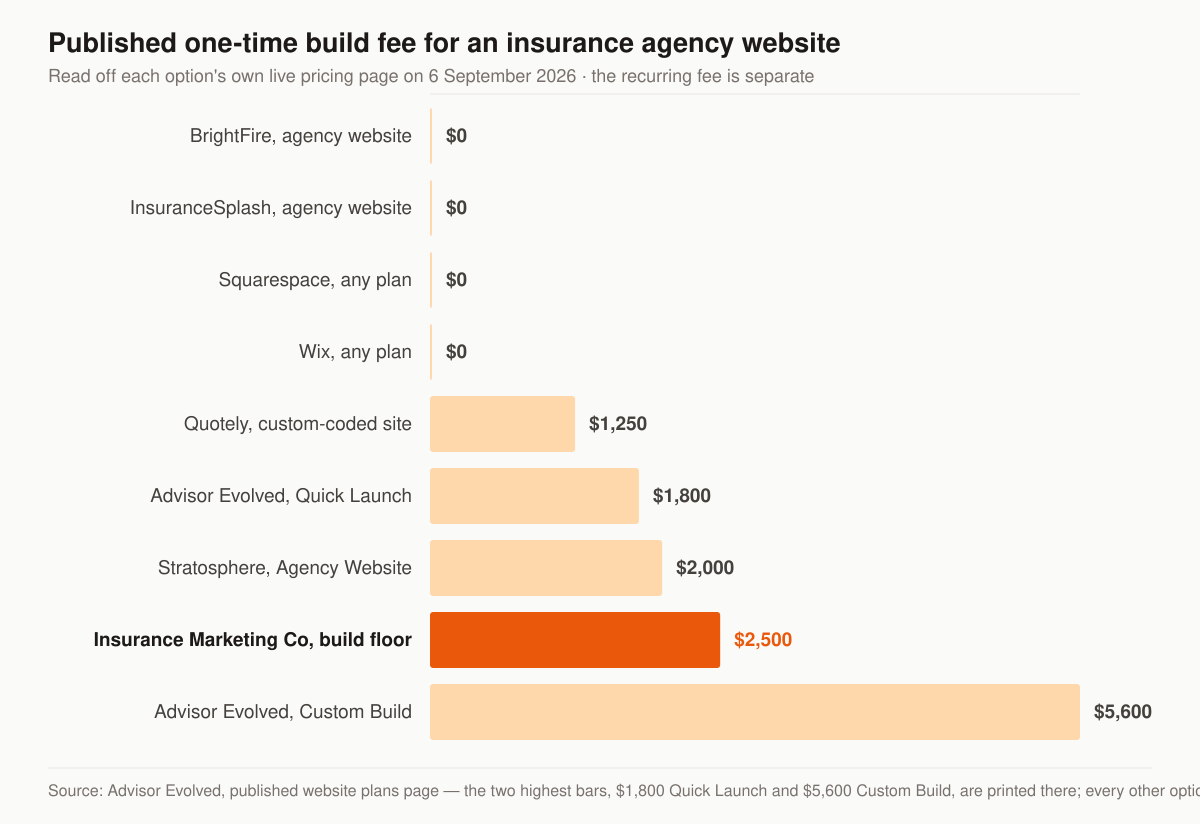
Chart: the one-time build or setup fee each option publishes, read off that option’s own live pricing page on 6 September 2026. Every URL is in the table above. The recurring monthly fee is a separate charge and is not shown here.
Four of the nine publish a build fee of zero, and three of them make a selling point of it. BrightFire’s pricing page runs “Complete solutions for independent insurance agencies at an amazing price.” as its subheading and “No Contracts. No Setup Fees. No User Fees. 30-Day Money Back Guarantee.” on the line beneath it. InsuranceSplash heads its pricing block “One Simple Plan. Everything Included.”, subtitles it “No contracts, no setup fees, no surprises”, and prints “$89/mo” above “Hosting, maintenance, & professional content included.” Squarespace and Wix charge nothing to start a site; their plans are pure subscription, and Wix’s free tier charges nothing at all until you want your own domain on it.
The other five bars belong to three vendors and to us, and all of them put real money at the front. Quotely’s website page prices a “Custom-Coded AI Website” at “One-time setup: $1,250” plus “$125/mo”, annotated “Hosting, edits, and support included” and closing on “No long-term contracts. Cancel anytime.” Advisor Evolved publishes two rungs, each printing the monthly figure above the setup figure: “$150/mo” over “after $1800 setup” for Quick Launch, “$350/mo” over “after $5600 setup” for Custom Build. Its order step spells the first rung out as “Your total:” / “$1,800 one-time + $150/mo”, with “No contracts. No hidden fees.” beneath and “Monthly billing begins 30 days from date of initial purchase.” beneath that. Stratosphere prices its Agency Website at “$149/month”, struck through from “$199”, with “$2,000 one-time fee*” beside it.
The table below puts the two components side by side for the seven vendors that publish both, because a comparison built on one column alone is misleading in either direction.
| Option | Published one-time fee | Published recurring fee | What the page says the fee covers |
|---|---|---|---|
| InsuranceSplash | $0 | $89/mo | “Hosting, maintenance, & professional content included”; “We build it in 3 days”; “Free edits anytime” |
| BrightFire | $0 | $170/mo | Custom design rather than a template. Its FAQ page answers “Are your website designs templates?” with “No. Instead, we will work closely with you to create a custom web design just for your agency.” A separate entry, “What’s included in a custom website design?”, promises “a custom home page layout and a custom internal page layout” |
| Squarespace | $0 | $25/mo Basic to $139/mo Advanced on monthly billing | Templates, drag-and-drop editor, hosting, SSL, SEO tools; annual plans include one year of domain registration |
| Wix | $0 | $17/mo Light to $159/mo Business Elite | Custom domain, hosting, AI creation tools, 24/7 customer care; the card prices are yearly-subscription prices paid in full up front, tax excluded, and Wix labels its USD display “for reference only” |
| Quotely | $1,250 | $125/mo | “Custom-coded, AI-perfected website”, hosting, edits and support; “No long-term contracts. Cancel anytime.” |
| Advisor Evolved | $1,800 (Quick Launch) / $5,600 (Custom Build) | $150/mo / $350/mo | Quick Launch is a “full, multi-page website build” on a 20–30 day turnaround; Custom Build adds custom design and functionality, the PowerPack add-on, monthly blogs and Google Business Profile management on a 30–90 day turnaround |
| Stratosphere | $2,000 | $149/mo | Custom design, mobile-responsive, SEO-optimized structure, lead-generation forms — the fee applies to “small websites (10–12 pages)” and assumes “content is provided by the client” |
Read the last column before the price column. Two of these products include the copywriting; one of them explicitly excludes it and sells it back as a $1,000 add-on. That single line moves Stratosphere’s entry cost by half its setup fee, and it is a footnote.
Why this page does not print a first-year total
The obvious next move is to add the build fee to twelve months of the subscription and rank the results. We are not doing that, for a reason worth stating plainly.
Every figure above can be checked against the page it came from, in one click. The moment two of them are added together, the result cannot — it becomes our arithmetic on our assumption about how long you stay, and a reader who wanted to verify it has to redo the sum. A comparison table stops being worth citing at exactly the point where its cells stop matching a source.
So do the sum yourself, against the term you actually intend to hold the site. Two things change the answer more than the ranking would suggest. First, the break-even between a build fee and a subscription moves out as the term lengthens, and an agency website is an asset people keep for years, not months. Second, the subscription is not only rent on the software — on several of these products it is also the content, the hosting, the security patching and the support queue, which are real costs you would otherwise pay separately or absorb yourself.
What the four “no price” vendors are telling you
Four vendors here publish nothing, and it is worth reading that as information rather than as evasion.
AgentMethods maintains a page at /pricing whose title tag reads “Pricing for Our Insurance Websites and Email Campaigns”. The page itself contains a demo-request form, a product list, testimonials and a phone number. No dollar figure appears. The form asks for your primary product focus — Medicare/Senior Market, Individual Health, Group Benefits, Life Insurance, P&C, Ancillary — which suggests the quote varies by line and book size. The loop closes on itself: AgentMethods’ separate FAQ page asks “How much does AgentMethods cost?” and answers “Our pricing is available on our website here.”, with “here” linking to the page that prints no price. The nearest thing to a number anywhere in that answer is the next line — “We offer a 10% discount for annual payments.” — a discount on a figure you have to book a demo to see.
Forge3, the insurance-specific vendor behind ActiveAgency, no longer runs its own pricing page: forge3.com/pricing resolves to Agency Revolution’s consultation booking page, headed “Book Your 30-Minute Marketing Consultation.” Agency Revolution is an FMG Suite brand and its footer carries the FMG Suite copyright line. If you have an old Forge3 quote or a colleague’s recommendation from a few years ago, that is who you are now buying from.
Zywave absorbed ITC, the company behind Insurance Website Builder, and this is the row most likely to be reported wrongly, so here is the whole trail. insurancewebsitebuilder.com does run a page whose title tag reads “Website Plans and Pricing - Insurance Website Builder”, linked from the product’s own sub-nav as “Plans & Features”, at /products/websites/features.aspx. It returns HTTP 200. What it contains is a feature-availability matrix — roughly a hundred rows marked “Included” or “Optional (Additional Costs Apply)” — with no dollar figure anywhere on it, closing on the line “for much less than you might expect to pay”. The sibling URL /products/automated-agency-marketing/pricing.aspx also returns 200 and resolves to the AgencyBuzz features table, again with no dollar figure. The “Order a Website Now” button now redirects off the domain entirely, to Zywave’s product page, whose CTA is a demo request. So the accurate claim is not that ITC has no pricing page; it is that ITC has pages named for pricing and prints no price on them.
Jenesis Software goes furthest of the four without arriving at a price. Its websites page publishes a four-column plan table — Basic, Premium, Elite, Platinum, at 8 pages, 15 pages, up to 25 and up to 25 — and every cell in it is a tick or a page count, never a dollar. The FAQ below the table asks the question outright, “How much does a website for an insurance agency cost?”, and answers: “Costs vary based on design, functionality, and integrations. A simple website with essential pages and forms may start at a few thousand dollars, while a fully customized site with advanced tools—like quoting engines, CRM integration, and marketing features—will be more.”
What that pattern costs you is time. A published price means a self-serve sign-up and a decision you can make on a Tuesday evening. A quote-only page means a discovery call, a scoped proposal and usually a follow-up. Neither is better; they are different sales motions attached to different products, and the vendors with the larger enterprise footprint are the ones that hide the number. Budget the calendar as well as the cash.
Where the general builders land, and which number they are showing you
An agent choosing between a $170-a-month insurance-specific vendor and a $25-a-month general builder is not comparing two versions of the same thing, and the price gap is not the interesting part. What is interesting is that both general builders show you a number that is not the monthly price.
Squarespace publishes two US price sets for the same four plans, 24 to 29 per cent apart, and a comparison that mixes them is wrong by that much. The cards on the pricing page default to the annual-billing display — Basic $19/mo, Core $29/mo, Plus $49/mo, Advanced $99/mo — beneath a header reading “Free for 14 days. Pay annually to save up to 36%.” and a “Pay annually / Pay monthly” toggle set to annual. The structured data the same page publishes for US buyers carries both: monthly-billed $25.00, $39.00, $65.00 and $139.00 a month, annual-billed $228.00, $348.00, $588.00 and $1,188.00 a year. Both sets are correct and they answer different questions. Every Squarespace figure in the tables above is the monthly-billing one, because an agent who does not want to hand over a year up front will be charged $25, not $19. Our website examples guide quotes the other set, $19 to $99 — same page, same day, different billing basis.
The boundary that matters on Squarespace for an insurance agent is not price but its feature table. “Code injection”, “Code block (advanced)” and “Premium integrations and blocks” are all marked “Not included” on Basic and “Included” from Core upward. A rater embed, a call-tracking snippet and a CRM form script all live on the far side of that line. If lead capture is the reason the site exists, Basic is not the plan.
Wix does the same thing more quietly, and then says so in the footnote. Read on a US request on 6 September 2026, wix.com/plans publishes five rungs: a free tier, Light $17/mo, Core $29/mo, Business $39/mo (labelled “RECOMMENDED”) and Business Elite $159/mo. Every plan above the free tier lists a custom domain and a free domain for one year; the free tier lists neither.
Beneath the comparison table sits a single paragraph that qualifies every one of those five numbers. Quoted in full, because the half that gets quoted is not the half that matters: “Prices and currency vary by location. USD prices displayed for reference only. Displayed prices are for yearly subscriptions, paid in full at the time of purchase. Additional subscription periods are available. Prices do not include applicable taxes, which are determined according to your billing address. The final price can be seen on the purchase page, before payment is completed.”
Three things follow, and we are not going to argue past any of them. The $17 rung is a year bought in one charge, not seventeen dollars a month; Wix does not print the monthly-billing rate anywhere on the page. The figures exclude tax. And Wix’s own words for its USD display are “for reference only” — the vendor declines to promise that $17 is what lands on a given buyer’s invoice, so neither will we. That is why the Wix row in the tables above carries its billing basis and this caveat rather than a bare number. It is still a published price, which is more than four vendors on this page manage; it is just a published price with the vendor’s own asterisk on it.
What $89 to $170 a month actually buys
Subscription products in this market are not stripped-down versions of a custom build. They are a different product with a different economic model, and being clear-eyed about it is what makes the rest of this page credible.
What you get: a site that exists next week rather than next quarter, written by someone else, hosted and patched by someone else, with insurance-specific page structures already in place — quote forms, carrier pages, line-of-business pages, and in several cases compliance-aware content the vendor maintains. InsuranceSplash advertises a three-day build and free edits. BrightFire states it designs a custom home page and internal page layout rather than handing you a template. Both remove a category of work from your week permanently.
What you do not get: control of the structure. On a subscription platform, a layout change is a request in a queue and a schema change is generally not on the menu at all. Instrumentation is limited — you can usually see form submissions, and rarely much else. And the site is built inside the vendor’s system, which is the reason the ownership question below matters.
The ownership answers differ, and the vendors that answer it clearly deserve credit for doing so. Advisor Evolved’s plans page states: “Your content and domain name are yours forever. If you leave, we can export your content (page/post, images, forms, SEO settings)”, alongside a note that its activation fee is non-refundable. Stratosphere’s packages page states “When you build a website with Stratosphere, you own it!” and that on leaving “you can take your entire website with you for a nominal transfer fee” — a fee it does not price. Ask any vendor to put the exit terms in writing before you sign, and register the domain yourself, in the agency’s name, whoever builds the site. The domain is the asset that makes every other asset recoverable.
When the subscription product is the right answer
For a newly licensed agent with no ad spend, no organic traffic and no CRM, an $89-to-$170-a-month site is a defensible purchase and a custom build is not. The reasoning is arithmetic rather than taste.
A build fee is a bet that the traffic arriving at the site is worth optimizing. If nobody is arriving yet, there is nothing to optimize, and the money buys structure that no visitor sees. The subscription buys presence — a professional-looking site, a quote form, a Google Business Profile that has somewhere to point — for less in a year than a single build costs up front. It also buys back the hours you would otherwise spend on hosting and updates, which for a solo agent are the scarcest input in the business.
The signals that the calculus has flipped are concrete: you are paying for clicks and the landing experience is the variable you cannot change; you need a rater, a dialer or a CRM wired into the form and the platform will not allow it; your organic pages are competing on terms where page structure and speed decide the ranking; or you have outgrown the template’s page types and are fighting the editor weekly. Until then, rent it. We would rather say that than sell a build to someone who is not ready for one, and the website examples guide exists partly to show what a good subscription site looks like.
When a one-time build earns its price
The case for paying $2,500 to $8,000 once is not that the result looks better. It is that three specific things stop being someone else’s decision.
Structure. On a build you own, the page hierarchy, the URL structure, the internal linking and the schema are yours to change. That is the machinery behind ranking an agency site on Google, and on a subscription platform most of it is fixed by the vendor’s template system.
Speed and the form path. A build lets you set a performance budget and hold it, and lets you instrument the form end to end — which fields are abandoned, which traffic source produces a booked appointment rather than a submission. That measurement is what turns a website from a brochure into something you can improve. Senior-market visitors in particular arrive on older phones and slower connections, which is why the final expense agent website work is built around load time before it is built around design.
Integration. Rater embeds, call tracking, CRM handoff, TCPA-aware consent capture with a timestamp — the things that make a lead usable rather than merely collected. These are the requirements that most often collide with a platform’s limits.
Priced against that list, our build is $2,500 to $8,000 as a single fee, moved by page count and by how many systems the forms have to reach. What sits inside the fee and what does not is itemised on the pricing page; the scope detail is on our insurance website design service. Nothing here obliges you to buy a retainer alongside it. The monthly programs that can run behind a build — $2,500 Foundation, $3,500 Growth, $5,500 Full-Funnel, ad spend billed at cost straight to the platforms — exist because a finished site with nothing pointed at it is a common and expensive way to spend a build fee, not because the build depends on one. If the question is which of the two to fund first, the marketing budget guide works through it.
At $2,500 we are more expensive up front than every subscription product on this page, and more expensive than three of the four published setup fees. That is the correct comparison to make, and the answer to it is scope, not value language.
What moves a build quote up or down
Three variables account for most of the spread between the published figures above, and all three are visible in the vendors’ own footnotes.
Page count. Stratosphere’s $2,000 setup fee is footnoted “Pricing applies to small websites (10–12 pages).” A twenty-five-page site with a page per line of business, a page per location and a blog architecture is a different build, and every vendor prices it as one.
Who writes the content. The same Stratosphere footnote reads “Base setup fee assumes content is provided by the client. Full-site professional SEO content creation is available as a $1,000 add-on.” That is half the setup fee again, disclosed in small type. InsuranceSplash and BrightFire both include content in the monthly fee instead. When you compare two quotes, check this line first — it is the item that most often makes a cheaper quote the more expensive one, and the content marketing service exists because agencies underestimate it consistently.
Integrations and turnaround. Advisor Evolved’s two rungs are the clearest published illustration: $1,800 buys a 20–30 day turnaround on a standard multi-page build; $5,600 buys 30–90 days with custom design and custom functionality. The gap is not design polish. It is the developer time that custom functionality requires. If you need a rater embedded, a dialer wired in or a quote flow that behaves differently by state, you are buying the second product regardless of which vendor you buy it from.
A fourth variable rarely appears on any pricing page: what happens after launch. Ongoing hosting, security patching, plugin licences and edits are inside the monthly fee on every subscription product here. On a one-time build they are a separate line you should ask about before you sign, because a site nobody updates degrades quietly.
How we verified these prices
Every figure on this page was read on 6 September 2026 directly from the vendor’s own live page, linked in the table above — not from a directory, a roundup or a review site. Where a vendor publishes no price, the row names the pages we opened looking for one, including the pages whose titles promise pricing, rather than substituting a number from somewhere else.
This page covers the build only. The same verification, applied to monthly retainers across the wider vendor field, is in the insurance marketing agency price comparison.
Two failure modes turned up repeatedly while doing it, and both produce wrong numbers in perfect good faith. The first is billing basis. Squarespace shows $19 and $25 a month for the identical plan depending on how you pay; every price on Wix’s card row is a yearly-subscription price by the page’s own footnote, and that same footnote calls the USD display “for reference only”. Copy either without its basis and the figure you print is not the figure on the invoice — and quote only the convenient half of a footnote and you have published the vendor’s caveat as though it were their promise. The second is the negative claim. “This vendor publishes no price” feels like a fact and is actually a search result: ITC’s pricing-titled pages exist, return 200, and print no price — which is a different and more useful thing to tell a buyer than “no pricing page”. A price you cannot find is worth one sentence about where you looked.
Prices in this market change without announcement, promotional rates expire, and several of the pages above show a struck-through original beside a current figure. Treat this page as a snapshot with a date on it, open the vendor’s page before you commit, and ask for the exit terms and the add-on list in writing.
Not sure whether your current site is worth rebuilding or worth keeping and feeding? Get a no-pitch teardown of your current site and we will tell you which one it is, including when the answer is that you should stay where you are.
- What insurance marketing agencies charge, vendor by published price
Twelve insurance marketing vendors' published prices, each read from that vendor's own pricing page on 6 September 2026, from $89 a month to $2,500 a month.
- Best Insurance Marketing Agencies & Companies: A Buyer's Guide
Best insurance marketing agencies compared by provider type, real cost ranges, and the six vetting criteria that matter. See which model fits your agency.
- Best CRM for Insurance Agents: An Honest, Vendor-Neutral Guide
A vendor-neutral guide to the best CRM for insurance agents — CRM vs AMS, the best tools by line and budget, real 2026 pricing, and where marketing fits.
- 40 Content Ideas for Final Expense Agents You Can Steal This Week
40 content ideas for final expense agents: cost and qualifying answers, video hooks, offline angles, and the capture step that turns views into leads.